Kód: 53597014
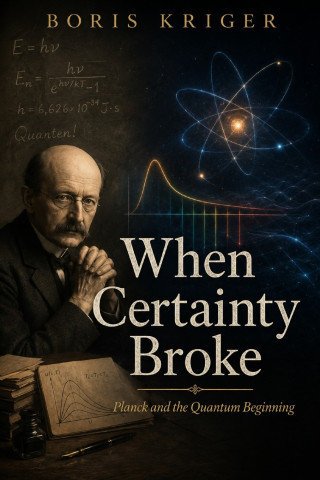
WHEN CERTAINTY BROKE
Autor Boris Kriger
In the space of a single year, a cautious German professor who disapproved of revolutions produced two numbers that would shape the century after him. One of them was measured. The other was manufactured. Nobody, including him, ev ... celý popis


- Jazyk:
 Angličtina
 - Vazba: Brožovaná
- Počet stran: 434
Nakladatelství: Independently published, 2026
- Více informací o knize


Mohlo by se vám také líbit
-

Murdoku
309 Kč -

Threshing Day (Wing and Claw Collection)
400 Kč -

Berserk Deluxe Volume 1
879 Kč -

Threshing Day (Limited Deluxe Edition)
473 Kč -

White Nights
89 Kč -

The Odyssey
335 Kč -

Berserk Deluxe Volume 2
917 Kč -

Kid's Box New Generation Level 2 Activity Book with Digital Pack British English
251 Kč -

Onyx Storm (Deluxe Limited Edition) (The Empyrean, 3)
552 Kč -

What Happened Yesterday
371 Kč -

Berserk Deluxe Volume 3
805 Kč -

Kid's Box New Generation Level 3 Activity Book with Digital Pack British English
251 Kč -

Kid's Box New Generation Level 1 Activity Book with Digital Pack British English
251 Kč -

Kid's Box New Generation Level 2 Pupil's Book with eBook British English
469 Kč -

Fourth Wing
515 Kč -

Dancing The Dream
482 Kč -

The Count of Monte Cristo
232 Kč -

Iron Flame
527 Kč -

Needoh - Nice Cube (random colours)
191 Kč -

Jojo's Bizarre Adventure: Part 7--Steel Ball Run, Vol. 8
427 Kč -

Moonwalk
270 Kč
Darujte tuto knihu ještě dnes
- Objednejte knihu a zvolte Zaslat jako dárek.
- Obratem obdržíte darovací poukaz na knihu, který můžete ihned předat obdarovanému.
- Knihu zašleme na adresu obdarovaného, o nic se nestaráte.
Informovat o naskladnění knihy
Zadejte do formuláře e-mailovou adresu a jakmile knihu naskladníme, zašleme vám o tom zprávu. Pohlídáme vše za vás.
Více informací o knize WHEN CERTAINTY BROKE
Nákupem získáte 54 bodů
 Anotace knihy
In the space of a single year, a cautious German professor who disapproved of revolutions produced two numbers that would shape the century after him. One of them was measured. The other was manufactured. Nobody, including him, ever wrote the difference down.
The first was the quantum of action, squeezed out of infrared readings taken by instrument builders in a Berlin laboratory founded to help the lamp industry sell brighter lamps. It was a real quantity, extracted from real dials, and it has survived every revision physics has thrown at it since. Today it does not merely describe the kilogram. It defines it.
The second was the Planck length. It was not measured, and it could not have been. It was assembled out of three constants by dimensional bookkeeping, in a short paper written a year before its author had any quantum theory at all. It sits roughly twenty orders of magnitude below anything any instrument has ever touched, which is a polite way of saying that the gap between it and our best microscope is larger than the gap between our best microscope and a continent. Over the following century it hardened into something else entirely: a wall, a grain, a floor, a foam, the place where space and time were said to give out. Whole research programs were built on the assumption that something happens there. Nobody has ever explained how that assumption was arrived at, because it was never argued for. It was inherited.
This book follows both numbers from the same desk in Berlin to their opposite fates, and uses them to ask a question that reaches well past physics: how do we tell the part of a result that the instruments recorded from the part we supplied ourselves so that the recording would mean something? Max Planck faced that question more sharply than almost anyone alive. He answered it brilliantly in one case and never thought to ask it in the other.
Around the two numbers stands a life: the boy who watched armies march into his hometown, the student advised that physics was nearly finished and he had better find something else to do, the theorist who called his own greatest step an act of despair, the realist who quarreled with Ernst Mach and then quarreled with Niels Bohr, the pianist with perfect pitch who believed harmony and physical law were two roads to the same absolute, the patriot who signed a war manifesto he could not defend, the old man who sat across a desk from Adolf Hitler and accomplished exactly nothing, and the father who outlived every one of his children, the last of them by way of a hangman in January of 1945.
It is a book about a constant that turned out to be real, a length that never earned the right to be, and the unglamorous discipline that could have told them apart from the beginning.
Keywords: Max Planck; quantum theory; scientific method; history of physics; measurement; certainty; scientific revolutions
Parametry knihy
538 Kč
- Plný název: WHEN CERTAINTY BROKE
- Podnázev: PLANCK AND THE QUANTUM BEGINNING
- Autor: Boris Kriger
- Jazyk: Angličtina
- Vazba: Brožovaná
- Počet stran: 434
- EAN: 9798193973409
- ID: 53597014
- Nakladatelství: Independently published
- Hmotnost: 578 g
- Rozměry: 229 × 152 × 22 mm
- Datum vydání: 21. August 2026
Osobní odběr Praha, Brno a 47546 dalších
Copyright ©2008-26 nejlevnejsi-knihy.cz Všechna práva vyhrazenaSoukromíCookies

 Vrácení do měsíce
 571 999 099 (8-15.30h)