Kód: 48915024
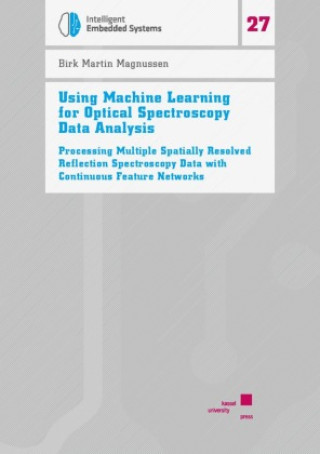
Using Machine Learning for Optical Spectroscopy Data Analysis
Autor Birk Martin Magnussen
Living a healthy lifestyle is an ever-increasing priority. To facilitate such a healthy lifestyle, accurate, quick, and inexpensive feedback on diet quality is essential. Sensors based on multiple spatially resolved reflection spe ... celý popis


- Jazyk:
 Angličtina
 - Vazba: Brožovaná
- Počet stran: 164
Nakladatelství: kassel university press, 2025
- Více informací o knize

957 Kč
Dostupnost:
50 % šance Máme informaci, že by titul mohl být dostupný. Na základě vaší objednávky se ho pokusíme do 6 týdnů zajistit.
Prohledáme celý svět
Mohlo by se vám také líbit
-

Moonwalk
261 Kč -

The Score
332 Kč -

The Deal
283 Kč -

The Mistake
227 Kč -

Jujutsu Kaisen, Vol. 30
233 Kč -

Witch Hat Atelier: Grimoire Edition 1
777 Kč -

Berserk Deluxe Volume 1
804 Kč -

Invincible Compendium Volume 2
1024 Kč -

Invincible Compendium Volume 1
1108 Kč -

The Goal
321 Kč -

Berserk Deluxe Volume 2
862 Kč -

Witch Hat Atelier Manga Box Set 1
1268 Kč -

Heated Rivalry
227 Kč -

Lord of Mysteries, Vol. 3: The Clown, Part III
355 Kč -

Moonwalk: A Memoir
525 Kč -

Murdoku
358 Kč -

Jujutsu Kaisen, Vol. 25
240 Kč -

Jujutsu Kaisen, Vol. 26
240 Kč -

Berserk Deluxe Volume 3
804 Kč -

Jujutsu Kaisen, Vol. 29
240 Kč -

Veil Volume 1
292 Kč
Darujte tuto knihu ještě dnes
- Objednejte knihu a zvolte Zaslat jako dárek.
- Obratem obdržíte darovací poukaz na knihu, který můžete ihned předat obdarovanému.
- Knihu zašleme na adresu obdarovaného, o nic se nestaráte.
Informovat o naskladnění knihy
Zadejte do formuláře e-mailovou adresu a jakmile knihu naskladníme, zašleme vám o tom zprávu. Pohlídáme vše za vás.
Více informací o knize Using Machine Learning for Optical Spectroscopy Data Analysis
Nákupem získáte 96 bodů
 Anotace knihy
Living a healthy lifestyle is an ever-increasing priority. To facilitate such a healthy lifestyle, accurate, quick, and inexpensive feedback on diet quality is essential. Sensors based on multiple spatially resolved reflection spectroscopy aim to provide such feedback. However, current data processing algorithms require highly accurate hardware. This requirement for accuracy causes production costs of the sensors to be too expensive, while the application scope is too small to be viable for end-customers. In order to keep production costs low, new algorithms capable of handling production inaccuracies need to be developed. This thesis proposes such a novel neural network architecture called a continuous feature network. In addition to being wellsuited for the sensor data at hand, continuous feature networks are capable of compensating for sensor inaccuracies. A continuous feature network is also capable of predicting results from an input sample with partially missing data, allowing it to ignore certain production defects. In this thesis, continuous feature networks are proposed, implemented, trained, and investigated using real-world sensor data. To improve training, a novel method for semi-supervised learning based on the available datasets is introduced and evaluated. Based on the ability of the continuous feature network to operate on partially missing data, a novel explainable AI method is introduced, allowing to accurately quantify possible error sources for a measurement. The newly introduced methods are applied to the processing of sensor data, relaxing the requirement for highly accurate sensor hardware while increasing prediction accuracy. This enables a significant reduction in production rejects and thus sensor cost, while also allowing for the detection and prediction of new vitality parameters.
Parametry knihy
Zařazení knihy Knihy v angličtině Technology, engineering, agriculture Energy technology & engineering
957 Kč
- Plný název: Using Machine Learning for Optical Spectroscopy Data Analysis
- Podnázev: Processing Multiple Spatially Resolved Reflection Spectroscopy Data with Continuous Feature Networks
- Autor: Birk Martin Magnussen
- Jazyk: Angličtina
- Vazba: Brožovaná
- Počet stran: 164
- EAN: 9783737612081
- ID: 48915024
- Nakladatelství: kassel university press
- Hmotnost: 220 g
- Rozměry: 210 × 148 mm
- Rok vydání: 2025
Osobní odběr Praha, Brno a 46512 dalších
Copyright ©2008-26 nejlevnejsi-knihy.cz Všechna práva vyhrazenaSoukromíCookies

 Vrácení do měsíce
 571 999 099 (8-15.30h)