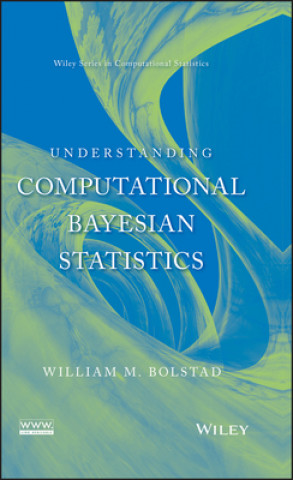
Kód: 01387961
Understanding Computational Bayesian Statistics
Autor William M. Bolstad
A hands-on introduction to computational statistics from a Bayesian point of view§§Providing a solid grounding in statistics while uniquely covering the topics from a Bayesian perspective, Understanding Computational Bayesian Stat ... celý popis


- Jazyk:
 Angličtina
 - Vazba: Pevná
- Počet stran: 336
Nakladatelství: John Wiley & Sons Inc, 2010
- Více informací o knize


Mohlo by se vám také líbit
-

O duších 1-4
620 Kč -

Should I Stay or Should I Go
442 Kč -

NOS VEMOS HOY 1 HIBRIDA INGLESA
828 Kč -

Egri csillagok
413 Kč -

Winnie and Wilbur: The Magic Wand
243 Kč -

Russian in Exercises for Spanish Speakers/El Ruso en Ejercicios
574 Kč -

Gargoyles and Grotesques
272 Kč -

Tika the Iggy
313 Kč -

Školní detektiv
232 Kč -

Lucifer Flirtování se zatracenými
419 Kč -

Beyond Dog Massage
766 Kč -

Apocalypse Now / Collector's Edition
553 Kč -

Spice Girls
567 Kč -

History of Greece Greek language
546 Kč -

Civil Imagination: A Political Ontology of Photography
460 Kč -

Sexy Comedy Highlights
302 Kč -

KVplan Sonderausgabe Warendorf
162 Kč -

Gwreans an Bys
428 Kč -

Barcelona escape room
333 Kč -

Transcription
620 Kč -

Management Accounting
1027 Kč -

Three Films By Yasujirô Ozu
689 Kč -

I Don't Know Who I Am Anymore: Restoring Your Identity Shattered by Grief and Loss
358 Kč -

Emotional Healing
396 Kč -

Untersuchungen zur Gefriertrocknung von Doxorubicin-beladenen HSPC/Cholesterol- Liposomen
583 Kč -

Che caos in via Babilonia
447 Kč -

Marvel Spider-Man: 1001 Stickers
173 Kč -

Le theatre et son double/Le theatre de Seraphin
288 Kč -

Plurality and Ambiguity
1009 Kč -

POSSESSED
341 Kč -

Africa The Art of A Continent (Paperback) /anglais
1418 Kč -

Verše ze závěti
91 Kč -

Já Baryk - DVD box
88 Kč -

Runtime Verification
1534 Kč -

Der Landarzt. Staffel.9, 3 DVD
584 Kč -

Light Reading: Reflections in Poetry and Prose
358 Kč -

Sindrome do Lixo Sitiante nos Sistemas e Genetica
1014 Kč -

Social Enterprise
1811 Kč -

La Peche En Eau Douce, (Ed.1882)
336 Kč -

Les actions du marketing terrain
732 Kč -

Private Governance and Public Authority
2620 Kč -

PRESIDENTIAL CANDIDATES: CONTAINING SKET
837 Kč -

The Changing Worlds and Workplaces of Capitalism
2467 Kč -

Interchange Level 1 Workbook
376 Kč -

Bimbi
837 Kč -

Through the Storm, Through the Night
1018 Kč -

Meat and Meat Products: Technology, Chemistry and Microbiology
1181 Kč -

Russische Exilkultur als Folge der Revolution von 1917
369 Kč -

Zuschendorf - Beschreibung des Betriebes der Landwirtschaft
671 Kč -

Oeuvres Completes de Alfred de Musset. La Confession d'Un Enfant Du Siecle
614 Kč -

Sentimental Tommy: The Story of his Boyhood
320 Kč -

Modern Bioelectrochemistry
2195 Kč -

The Best of Female Wrestling 2
514 Kč -

Nombres
551 Kč -

Private Action and the Public Good
1927 Kč -

Littlest Pet Shop - Mes cartes à pailleter
267 Kč -

Technetium in the Environment
3324 Kč -

History of Greece 4 Volume Paperback Set
4410 Kč -

MUJER VARADA. LA REBELION DE LA ESPERA
590 Kč -

Mr. McGwire and Mr. McCall, the Rickety Spire and the Red Brick Wall
299 Kč -

Engineering Modeling
2864 Kč -

Troy: Fianna Fáil: Soldiers of Destiny
312 Kč -

Children of Clay: A Family of Pueblo Potters
242 Kč -

Development of a Rapid, Immobilized Probe Assay for the Detection of Mitochondrial DNA Variation in the Hvi and Hvii Regions - Scholar's Choice Editio
336 Kč -

Pattern Recognition Problems in Geology and Paleontology
1181 Kč -

Chilling Tales: Evil I Did Dwell - Llewd Did I Live
317 Kč -

Italian Hours
389 Kč -

La sublimidad y lo sublime
459 Kč -

SUDOKU EXTREME VOL.I
156 Kč -

The HerStories Project: Women Explore the Joy, Pain, and Power of Female Friendship
279 Kč -

Inequality and Poverty
3670 Kč -

Anthropology of Cultural Performance
1355 Kč -

Modestly
413 Kč -

Präventive Parameteranpassung zur Sicherstellung des Spanabtransports beim Einlippentiefbohren
912 Kč -

Rosyjski eurazjatyzm - ideologia imperium
291 Kč -

Artificial Intelligence for Knowledge Management
1181 Kč -

Accoppiata al Cacciatore
339 Kč -

Höhepunkte des Siebengebirges (Tischkalender 2026 DIN A5 quer), CALVENDO Monatskalender
426 Kč -

BREAKING NEW GROUND
1294 Kč -

Schock
1214 Kč -

Religion in Revolutionary England
706 Kč -

ADVANCED COURSE IN YOGI PHILOSOPHY AND O
1054 Kč -

Romantic Garden Coloriage
458 Kč -
Combatte La Cellulite in Modo Naturale: La vostra guida per combattere la cellulite in modo naturale!
217 Kč -

Coastal Hazards
3532 Kč -

Der chronische Beckenbodenschmerz
1294 Kč -

The Typology of Scripture
732 Kč -

Antipsychologicum : el papel de la psicología académica : de mito científico a mercenaria del sistema
542 Kč -

Postcolonial Fiction and Sacred Scripture
3335 Kč -

Tribal Sovereignty and the Historical Imagination
756 Kč -

UNA BAÑERA CON HOJAS SECAS
416 Kč
Darujte tuto knihu ještě dnes
- Objednejte knihu a zvolte Zaslat jako dárek.
- Obratem obdržíte darovací poukaz na knihu, který můžete ihned předat obdarovanému.
- Knihu zašleme na adresu obdarovaného, o nic se nestaráte.
Více informací o knize Understanding Computational Bayesian Statistics
Nákupem získáte 343 bodů
 Anotace knihy
A hands-on introduction to computational statistics from a Bayesian point of view§§Providing a solid grounding in statistics while uniquely covering the topics from a Bayesian perspective, Understanding Computational Bayesian Statistics successfully guides readers through this new, cutting-edge approach where inferences are based on random samples drawn from the posterior distribution. With its hands-on approach, step approach, the book shows readers how samples can be drawn from the posterior distribution when the formula giving its shape is all that is known, and how Bayesian inferences can be based on these samples from the posterior. These ideas are illustrated on common statistical models including the multiple linear regression model, the hierarchical mean model, the logistic regression model, and the proportional hazards model.§§The book begins with an outline of the similarities and differences between Bayesian and the likelihood approaches to statistics. Subsequent chapters present key techniques for using computer software to draw Monte Carlo samples from the incompletely known posterior distribution and performing the Bayesian inference calculated from these samples. Topics of coverage include:§ Direct ways to draw a random sample from the posterior by reshaping a random sample drawn from an easily sampled starting distribution§ The distributions from the one-dimensional exponential family§ Markov chains and their long-run behavior§ The Metropolis-Hastings algorithm§ Gibbs sampling algorithm and methods for speeding up convergence§ Markov Chain Monte Carlo Sampling§§Using numerous graphs and diagrams, the author emphasizes a step-by step approach to computational Bayesian statistics. At each step, important aspects of application are detailed, such as how to choose a prior for logistic regression model, the Poisson regression model, and the proportional hazards model. A related web site houses R functions and Minitab(r) macros for Bayesian analysis and Monte Carlo simulations, and detailed appendices in the book guide readers through the use of these software packages.§§Understanding Computational Bayesian Statistics is an excellent book for courses on computational statistics at the upper-level undergraduate and graduate levels. It is also a valuable reference for researchers and practitioners who use computer programs to work with data and solve problems in their everyday work.Bayesian statistics allows the use of assumptions to eliminate improbable paths. The Bayesian view has many important theoretical aspects that students should be familiar with if they are going into fields where statistics will be used. This book uniquely covers the topics usually found in a typical introductory statistics book but from a Bayesian perspective.A hands-on introduction to computational statistics from a Bayesian point of view§§Providing a solid grounding in statistics while uniquely covering the topics from a Bayesian perspective, Understanding Computational Bayesian Statistics successfully guides readers through this new, cutting-edge approach where inferences are based on random samples drawn from the posterior distribution. With its hands-on approach, step approach, the book shows readers how samples can be drawn from the posterior distribution when the formula giving its shape is all that is known, and how Bayesian inferences can be based on these samples from the posterior. These ideas are illustrated on common statistical models including the multiple linear regression model, the hierarchical mean model, the logistic regression model, and the proportional hazards model.§§The book begins with an outline of the similarities and differences between Bayesian and the likelihood approaches to statistics. Subsequent chapters present key techniques for using computer software to draw Monte Carlo samples from the incompletely known posterior distribution and performing the Bayesian inference calculated from these samples. Topics of coverage include: Direct ways to draw a random sample from the posterior by reshaping a random sample drawn from an easily sampled starting distribution§ The distributions from the one-dimensional exponential family§ Markov chains and their long-run behavior§ The Metropolis-Hastings algorithm§ Gibbs sampling algorithm and methods for speeding up convergence§ Markov Chain Monte Carlo Sampling§§Using numerous graphs and diagrams, the author emphasizes a step-by step approach to computational Bayesian statistics. At each step, important aspects of application are detailed, such as how to choose a prior for logistic regression model, the Poisson regression model, and the proportional hazards model. A related web site houses R functions and Minitab(r) macros for Bayesian analysis and Monte Carlo simulations, and detailed appendices in the book guide readers through the use of these software packages.§§Understanding Computational Bayesian Statistics is an excellent book for courses on computational statistics at the upper-level undergraduate and graduate levels. It is also a valuable reference for researchers and practitioners who use computer programs to work with data and solve problems in their everyday work.
Parametry knihy
Zařazení knihy Knihy v angličtině Mathematics & science Mathematics Probability & statistics
3426 Kč
- Plný název: Understanding Computational Bayesian Statistics
- Autor: William M. Bolstad
- Jazyk: Angličtina
- Vazba: Pevná
- Počet stran: 336
- EAN: 9780470046098
- ISBN: 0470046090
- ID: 01387961
- Nakladatelství: John Wiley & Sons Inc
- Hmotnost: 578 g
- Rozměry: 241 × 153 × 25 mm
- Datum vydání: 15. January 2010
Oblíbené z jiného soudku
-
Time-Series Forecasting
3629 Kč -
Robust Statistics 2e
3444 Kč -

Naked Statistics
302 Kč -

How to Lie with Statistics
240 Kč -

How to Lie with Statistics
291 Kč -

Cambridge International AS & A Level Mathematics Probability and Statistics 1 Student's Book
751 Kč -
Fifty Challenging Problems in Probability with Solutions
194 Kč -

Probability Theory
191 Kč -

Pearson Edexcel International A Level Mathematics Statistics 2 Student Book
1056 Kč -

Introduction to Probability, Second Edition
2567 Kč -

Statistical Thermodynamics
178 Kč -

Manga Guide To Statistics
419 Kč -
Elements of Statistical Learning
2074 Kč -
Introduction to Statistical Learning
1384 Kč -

Foundations of the Theory of Probability: Second English
260 Kč -
Elementary Decision Theory
380 Kč -
Statistics: A Very Short Introduction
225 Kč -

Probability Theory
608 Kč -

Outlier Analysis
1269 Kč -
Probability and Statistics with R
3635 Kč -

Analysis of Biological Data
2197 Kč -
Probability and Statistics for Data Science
2196 Kč -

Introduction to Causal Inference
237 Kč -
Understanding Data
1729 Kč -
Explanation in Causal Inference
4431 Kč -

Statistics Done Wrong
419 Kč -

Theory That Would Not Die
319 Kč -
Schaum's Outline of Probability and Statistics
458 Kč -

Collected Works of C.G. Jung
458 Kč -
Statistics Workbook For Dummies, 2nd Edition with Online Practice
412 Kč -
Statistics For Dummies, 2nd Edition
412 Kč -

Manga Guide To Regression Analysis
419 Kč -
An Introduction to Statistical Learning
2780 Kč -

Foundations of the Theory of Probability
210 Kč -

Introductory Econometrics for Finance
1682 Kč -

Probability Theory
3299 Kč -

First Course in Probability, Global Edition
1834 Kč -

Continued Fractions
162 Kč -

Probability: A Very Short Introduction
225 Kč -
Foundations of Modern Probability
2170 Kč -

Understanding Probability
1688 Kč -

Probability and Computing
1907 Kč -

Probability Essentials
1614 Kč -

Unfinished Game
539 Kč -
Basic Probability Theory
380 Kč -
Analytic Combinatorics
2658 Kč -

Philosophy and Probability
1223 Kč -

Multivariate Analysis of Ecological Data with ade4
2073 Kč -
Bayesian Analysis with Python
1229 Kč
Osobní odběr Praha, Brno a 48132 dalších
Copyright ©2008-26 nejlevnejsi-knihy.cz Všechna práva vyhrazenaSoukromíCookies

 Vrácení do měsíce
 571 999 099 (8-15.30h)