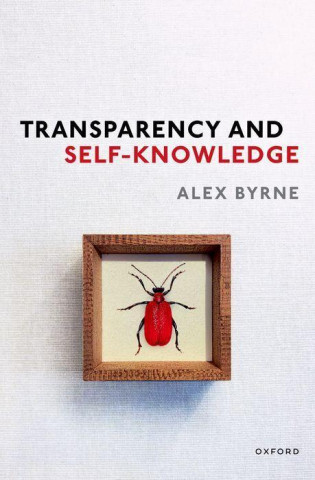
Kód: 38739928
Transparency and Self-Knowledge
Autor Byrne, Alex (Professor of Philosophy, Professor of Philosophy, Massachusetts Institute of Technology)
Alex Byrne sets out and defends a theory of self-knowledge-knowledge of one's mental states. Inspired by Gareth Evans' discussion of self-knowledge in his The Varieties of Reference, the basic idea is that one comes to know that o ... celý popis


- Jazyk:
 Angličtina
 - Vazba: Brožovaná
- Počet stran: 240
Nakladatelství: Oxford University Press, 2022
- Více informací o knize


Mohlo by se vám také líbit
-

Moonwalk
261 Kč -

The Score
337 Kč -

The Deal
283 Kč -

The Mistake
283 Kč -

Jujutsu Kaisen, Vol. 30
233 Kč -

Witch Hat Atelier: Grimoire Edition 1
777 Kč -

Berserk Deluxe Volume 1
805 Kč -
Invincible Compendium Volume 2
1024 Kč -
Invincible Compendium Volume 1
1108 Kč -

The Goal
321 Kč -

Berserk Deluxe Volume 2
863 Kč -

Witch Hat Atelier Manga Box Set 1
1268 Kč -

Heated Rivalry
227 Kč -

Lord of Mysteries, Vol. 3: The Clown, Part III
355 Kč -

Jujutsu Kaisen, Vol. 25
240 Kč -

Moonwalk: A Memoir
525 Kč -

Jujutsu Kaisen, Vol. 26
240 Kč -

Murdoku
358 Kč -

Jujutsu Kaisen, Vol. 29
240 Kč -

Berserk Deluxe Volume 3
914 Kč -

Veil Volume 1
292 Kč
Darujte tuto knihu ještě dnes
- Objednejte knihu a zvolte Zaslat jako dárek.
- Obratem obdržíte darovací poukaz na knihu, který můžete ihned předat obdarovanému.
- Knihu zašleme na adresu obdarovaného, o nic se nestaráte.
Více informací o knize Transparency and Self-Knowledge
Nákupem získáte 79 bodů
 Anotace knihy
Alex Byrne sets out and defends a theory of self-knowledge-knowledge of one's mental states. Inspired by Gareth Evans' discussion of self-knowledge in his The Varieties of Reference, the basic idea is that one comes to know that one is in a mental state M by an inference from a worldly or environmental premise to the conclusion that one is in M. (Typically the worldly premise will not be about anything mental.) The mind, on this account, is 'transparent': self-knowledge is achieved by an 'outward glance' at the corresponding tract of the world, not by an 'inward glance' at one's own mind. Belief is the clearest case, with the inference being from 'p' to 'I believe that p'. One serious problem with this idea is that the inference seems terrible, because 'p' is at best very weak evidence that one believes that p. Another is that the idea seems not to generalize. For example, what is the worldly premise corresponding to 'I intend to do this', or 'I feel a pain'? Byrne argues that both problems can be solved, and explains how the account covers perception, sensation, desire, intention, emotion, memory, imagination, and thought. The result is a unified theory of self-knowledge that explains the epistemic security of beliefs about one's mental states (privileged access), as well as the fact that one has a special first-person way of knowing about one's mental states (peculiar access).
Parametry knihy
791 Kč
- Plný název: Transparency and Self-Knowledge
- Autor: Byrne, Alex (Professor of Philosophy, Professor of Philosophy, Massachusetts Institute of Technology)
- Jazyk: Angličtina
- Vazba: Brožovaná
- Počet stran: 240
- EAN: 9780192868992
- ISBN: 0192868993
- ID: 38739928
- Nakladatelství: Oxford University Press
- Hmotnost: 390 g
- Rozměry: 234 × 156 × 13 mm
- Datum vydání: 23. June 2022
Osobní odběr Praha, Brno a 47529 dalších
Copyright ©2008-26 nejlevnejsi-knihy.cz Všechna práva vyhrazenaSoukromíCookies

 Vrácení do měsíce
 571 999 099 (8-15.30h)