Kód: 01566771
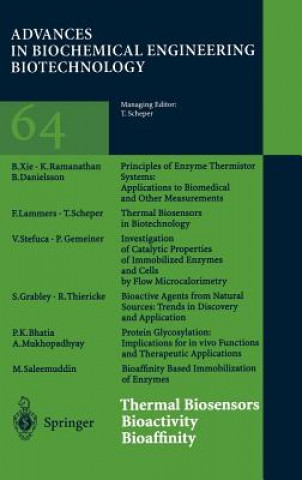
Thermal Biosensors Bioactivity Bioaffinity
Autor Thomas Scheper
The immobilized biocatalyst (IMB) is a key component of biotransformation systems that are used to transform substrates to desired products. The impro- ment of biocatalyst properties has a direct influence on the overall effective ... celý popis


- Jazyk:
 Angličtina
 - Vazba: Pevná
- Počet stran: 239
Nakladatelství: Springer-Verlag Berlin and Heidelberg GmbH & Co. KG, 1998
- Více informací o knize

5236 Kč

Skladem u dodavatele v malém množství
Odesíláme za 11-15 dnů
Potřebujete více kusů?Máte-li zájem o více kusů, prověřte, prosím, nejprve dostupnost titulu na naši zákaznické podpoře.
Přidat mezi přání
Mohlo by se vám také líbit
-

Knights at Tournament
390 Kč -

Oxford Handbook of Music Therapy
1476 Kč -

Rekcja czasownika niemiecki fiszki
195 Kč -

Business English for Beginners A1 - Workbook mit Audios als Augmented Reality
356 Kč -

STREET ART AGAINST OIL and Global Warming
359 Kč -

Ausbildungs- und Prufungsverordnung fur Diatassistentinnen und Diatassistenten (DiatAss-APrV)
168 Kč -

Important Date Keeper: Paris France
176 Kč -

Tom Sawyer
359 Kč -

History of the United States
504 Kč -

Orden der Wilhelmiten
369 Kč -

Orar con San Francisco de Asís
289 Kč -

Drawing on your computer with Paint: Colours, Lines, Circles and Rectangles
279 Kč -

Frauenleben
505 Kč -

Black Man in the CIA
670 Kč -

Barnabas' Gospel Review
1056 Kč -

Grammar Matters
1290 Kč -

What Is Science? A Guide For Those Who Love It, Hate It, Or Fear It
707 Kč -

Indian Affairs in New Mexico Under the Administration of William Carr Lane: From the Journal of John Ward
532 Kč -

Tryal of John Hampden, Esq; ... in the Great Case of Ship-Money, ... Wherein Are Inserted, the Whole Record in Latin and English
471 Kč -

Der Schuchterne Liebhaber
610 Kč -

Memoires
857 Kč
Darujte tuto knihu ještě dnes
- Objednejte knihu a zvolte Zaslat jako dárek.
- Obratem obdržíte darovací poukaz na knihu, který můžete ihned předat obdarovanému.
- Knihu zašleme na adresu obdarovaného, o nic se nestaráte.
Více informací o knize Thermal Biosensors Bioactivity Bioaffinity
Nákupem získáte 524 bodů
 Anotace knihy
The immobilized biocatalyst (IMB) is a key component of biotransformation systems that are used to transform substrates to desired products. The impro- ment of biocatalyst properties has a direct influence on the overall effectiveness of the process based on the biotransformation. The basic catalytic characte- stics of biocatalyst that are followed include kinetic properties, pH optima, stability,and inhibition. The investigation of catalytic properties of immobilized enzymes is still a time consuming procedure and is not always simple. In the 1980s,a major effort was made to standardize the rules by which IMB is char- terized. The Working Party of EFB on immobilized biocatalysts has formul- ed principles of individual methods, among them the requirement of kinetic characterization [1]. It was recommended to use a packed-bed reactor,equipped with temperature control and with infinite flow circulation. The system should be equipped with a post-column unit to measure the time-dependence of the product or substrate concentration [2, 3], the most commonly used analytical methods being spectrophotometry, chemiluminiscence, automatic titration, bioluminiscence, chromatography, polarimetry, and biosensors based on the oxygen electrode. There are two main drawbacks to the application of these methods: 1. The need to vary the analytical principles, depending on the chemical and physical-chemical properties of analytes; 2. In some cases, mainly in the study of hydrolytic enzymes, the natural s- strate must be replaced by an artificial one,that is chromolytic,chromogenic, chemiluminiscent,bioluminiscent,or fluorescent.
Parametry knihy
Zařazení knihy Knihy v angličtině Technology, engineering, agriculture Biochemical engineering
5236 Kč
- Plný název: Thermal Biosensors Bioactivity Bioaffinity
- Autor: Thomas Scheper
- Jazyk: Angličtina
- Vazba: Pevná
- Počet stran: 239
- EAN: 9783540649670
- ISBN: 3540649670
- ID: 01566771
- Nakladatelství: Springer-Verlag Berlin and Heidelberg GmbH & Co. KG
- Hmotnost: 547 g
- Rozměry: 235 × 155 × 18 mm
- Datum vydání: 04. December 1998
Oblíbené z jiného soudku
-

Art and Craft of Natural Dyeing
442 Kč -

Bioprocess Engineering Principles
3140 Kč -
Biomolecular Kinetics
4063 Kč -

A New Systems Thinking Approach to Sustainable Resource Management
4911 Kč -

Au Naturel
1293 Kč -

Microbial Biotechnology for Revolutionizing Biobased Biorefineries
5880 Kč -
Pharming
2357 Kč -
Yeast Biotechnology and Biorefinery
6201 Kč -

Metabolic Pathway Engineering Handbook, Two Volume Set
7768 Kč -

Nanobiotechnology
6069 Kč -

Ionic Liquid in Process Intensification
4575 Kč -

Green Microbial Nanotechnology for Pollution Control
5759 Kč -

Ciclodextrina
671 Kč -

Pulp and Paper Industry
6069 Kč -
Current Developments in Biotechnology and Bioengineering
6069 Kč -

Industrial Centrifugation Technology
3191 Kč -

Biomass, Biofuels, Biochemicals
5807 Kč -

Photoelectrocatalysis
5938 Kč -
Waste Biorefinery Technologies for Sustainable Development
6201 Kč -

Biochar-Based Catalysts for Removal of Environmental Contaminants
6201 Kč -

Current Developments in Biotechnology and Bioengineering
5807 Kč -

Bioprocess Engineering
3501 Kč -

Class 1 Oxidoreductases IV
7121 Kč -

Encyclopedia of Chemical Engineering: Volume I
2961 Kč -
Wastewater Treatment Residues as Resources for Biorefinery Products and Biofuels
5807 Kč -

Tantalum Oxide Thin Films for Embedded Capacitors
1890 Kč -
Bio-derived Carbon Nanostructures: Fundamentals, Synthesis and Applications
5938 Kč -

Phytoremediation Technology for the Removal of Heavy Metals and Other Contaminants from Soil and Water
6069 Kč -

Biochemical Engineering
3049 Kč -

New Trends and Developments in Biochemical Engineering
7827 Kč -

Glycomics on pig derived human glycoproteins
1934 Kč -

Decarbonization of Wastewater Pollutants as a Sustainable Solution
5492 Kč -

Development of Sustainable Bioprocesses - Modeling and Assessment +CD
4531 Kč -
Chemical Engineering Handbook: Volume I
2758 Kč -
Biosynthesis
7057 Kč -

General Engineering Knowledge
1524 Kč -
Pilot Scale Microalgae Cultivation
4496 Kč -
Biochemical and Biological Markers of Neoplastic Transformation
1350 Kč -

Methods for Affinity-Based Separations of Enzymes and Proteins
1182 Kč -

Advances in Synthesis Gas: Methods, Technologies and Applications
6069 Kč -

Class 1 Oxidoreductases VI
7121 Kč -
Current Trends and Future Developments on (Bio-) Membranes
6601 Kč -

Diseno de Reactores Homogeneos
1293 Kč -
Practical Methods for Biocatalysis and Biotransformations 2
3589 Kč -

Advances in Biochemical Engineering
1182 Kč -

Class 1 Oxidoreductases I
7121 Kč -

Development in Wastewater Treatment Research and Processes
6069 Kč -

Principles of Multiple-Liquid Separation Systems
5938 Kč -

Removal of Toxic Pollutants through Microbiological and Tertiary Treatment
5807 Kč
Osobní odběr Praha, Brno a 46010 dalších
Copyright ©2008-26 nejlevnejsi-knihy.cz Všechna práva vyhrazenaSoukromíCookies

 Vrácení do měsíce
 571 999 099 (8-15.30h)