Kód: 52776097
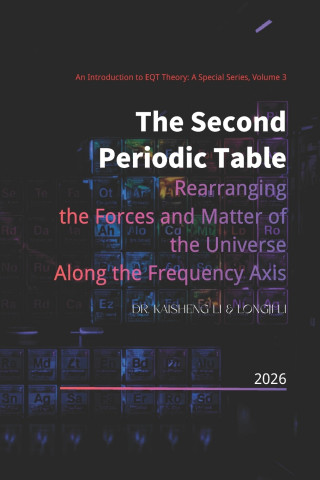
The Second Periodic Table
Autor Longji Li, Kaisheng Li
What if the forces and matter of the universe could be arranged on a single axis?This book begins with a simple but provocative idea: frequency may be the common coordinate of physical reality. Starting from two famous formulas-Pl ... celý popis


- Jazyk:
 Angličtina
 - Vazba: Brožovaná
- Počet stran: 154
Nakladatelství: Independently published, 2026
- Více informací o knize


Mohlo by se vám také líbit
-

Moonwalk
284 Kč -

The Score
323 Kč -

The Deal
275 Kč -

The Mistake
248 Kč -

Jujutsu Kaisen, Vol. 30
271 Kč -

Berserk Deluxe Volume 1
781 Kč -

Invincible Compendium Volume 2
1229 Kč -

The Goal
312 Kč -

Witch Hat Atelier: Grimoire Edition 1
777 Kč -

Berserk Deluxe Volume 2
837 Kč -

Murdoku
380 Kč -

Lord of Mysteries, Vol. 3: The Clown, Part III
409 Kč -

Witch Hat Atelier Manga Box Set 1
1241 Kč -

Jujutsu Kaisen, Vol. 25
221 Kč -

Moonwalk: A Memoir
517 Kč -

Legacy
249 Kč -

Heated Rivalry
227 Kč -

JoJo's Bizarre Adventure: Part 7--Steel Ball Run, Vol. 7
427 Kč -

Berserk Deluxe Volume 3
781 Kč -

Jujutsu Kaisen, Vol. 26
225 Kč -

White Nights
89 Kč
Darujte tuto knihu ještě dnes
- Objednejte knihu a zvolte Zaslat jako dárek.
- Obratem obdržíte darovací poukaz na knihu, který můžete ihned předat obdarovanému.
- Knihu zašleme na adresu obdarovaného, o nic se nestaráte.
Více informací o knize The Second Periodic Table
Nákupem získáte 44 bodů
 Anotace knihy
What if the forces and matter of the universe could be arranged on a single axis?
This book begins with a simple but provocative idea: frequency may be the common coordinate of physical reality. Starting from two famous formulas-Planck's (E=hƒ) and Einstein's (E=mc^2)-it shows how energy, mass, particles, and forces can all be translated into the language of frequency. From there, it builds a new kind of "periodic table": not a table of chemical elements, but a table of Energyons and Massyons, where force carriers and matter particles are placed along the same frequency spectrum.
Written in a clear popular-science style, the book guides readers from blackbody radiation, the photoelectric effect, de Broglie waves, and Compton scattering to a broader frequency-based picture of the universe. It explains why high-frequency forces tend to be intense and short-ranged, while low-frequency forces tend to be weak but long-reaching. The strong force, weak force, electromagnetic force, and gravity are presented not as isolated phenomena, but as different behaviors of one underlying energy-density field across different frequency layers.
The book then extends this table into cosmology. The history of the universe is read as a process of stepwise cooling and freezing: high-frequency structures appear first, atoms and light emerge later, gravity patiently gathers matter into stars and galaxies, while dark matter and dark energy occupy the most mysterious blank regions of the table. These blank spaces are treated with caution: they are not claimed as established facts, but presented as testable directions for future inquiry.
In its final chapters, the book asks an even more daring question: if particles, forces, stars, and galaxies can be understood through frequency structures, could consciousness also have a place in this broader map? The answer is deliberately left open. Rather than offering a final solution, the book uses this question to clarify the boundary between scientific explanation, philosophical speculation, and honest uncertainty.
The Second Periodic Table is both a guided tour of modern physics and an imaginative proposal for seeing it anew. It does not ask readers to accept a completed theory. Instead, it invites them to stand before a new table of the universe-filled with known entries, uncertain estimates, and open blanks-and ask what reality might look like if frequency were its deepest organizing coordinate.
Parametry knihy
444 Kč
- Plný název: The Second Periodic Table
- Podnázev: Rearranging the Forces and Matter of the Universe Along the Frequency Axis
- Autor: Longji Li, Kaisheng Li
- Jazyk: Angličtina
- Vazba: Brožovaná
- Počet stran: 154
- EAN: 9798199913065
- ID: 52776097
- Nakladatelství: Independently published
- Hmotnost: 216 g
- Rozměry: 229 × 152 × 8 mm
- Datum vydání: 03. June 2026
Osobní odběr Praha, Brno a 46611 dalších
Copyright ©2008-26 nejlevnejsi-knihy.cz Všechna práva vyhrazenaSoukromíCookies

 Vrácení do měsíce
 571 999 099 (8-15.30h)