Kód: 53438933
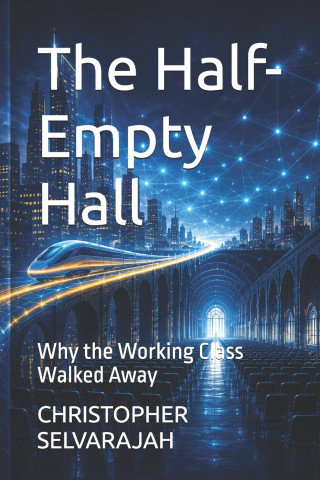
The Half-Empty Hall
Autor CHRISTOPHER SELVARAJAH
Why are so many working people abandoning the political centre? Why has support for populist movements surged across Australia, Britain, the United States and Europe? And why do so many people feel that, despite living in wealthie ... celý popis


- Jazyk:
 Angličtina
 - Vazba: Brožovaná
- Počet stran: 356
Nakladatelství: Independently published, 2026
- Více informací o knize


Mohlo by se vám také líbit
-

Murdoku
319 Kč -

Threshing Day (Wing and Claw Collection)
400 Kč -

Berserk Deluxe Volume 1
860 Kč -

Threshing Day (Limited Deluxe Edition)
473 Kč -

Berserk Deluxe Volume 2
917 Kč -

White Nights
89 Kč -

The Odyssey
320 Kč -

Kid's Box New Generation Level 2 Activity Book with Digital Pack British English
288 Kč -

Berserk Deluxe Volume 3
779 Kč -

Moonwalk
231 Kč -

Onyx Storm (Deluxe Limited Edition) (The Empyrean, 3)
550 Kč -

Dancing The Dream
482 Kč -

Kid's Box New Generation Level 2 Pupil's Book with eBook British English
376 Kč -

The Score
232 Kč -

Murdoku Volume 2: Back in Time
319 Kč -

Jujutsu Kaisen, Vol. 26
225 Kč -

The Mistake
222 Kč -

Kid's Box New Generation Level 1 Activity Book with Digital Pack British English
288 Kč -

Kid's Box New Generation Level 3 Activity Book with Digital Pack British English
288 Kč -

Fourth Wing
525 Kč -

Lord of Mysteries, Vol. 1: The Clown, Part I
349 Kč
Darujte tuto knihu ještě dnes
- Objednejte knihu a zvolte Zaslat jako dárek.
- Obratem obdržíte darovací poukaz na knihu, který můžete ihned předat obdarovanému.
- Knihu zašleme na adresu obdarovaného, o nic se nestaráte.
Informovat o naskladnění knihy
Zadejte do formuláře e-mailovou adresu a jakmile knihu naskladníme, zašleme vám o tom zprávu. Pohlídáme vše za vás.
Více informací o knize The Half-Empty Hall
Nákupem získáte 34 bodů
 Anotace knihy
Why are so many working people abandoning the political centre? Why has support for populist movements surged across Australia, Britain, the United States and Europe? And why do so many people feel that, despite living in wealthier nations than ever before, their own communities have been left behind?
The Half-Empty Hall begins with an image that captured headlines around the world: Pauline Hanson's sparsely attended speech in London in 2026. To many observers, the half-empty hall symbolised the decline of a politician. Christopher Selvarajah argues that it symbolised something far more significant-a profound misunderstanding of why millions of ordinary citizens have turned away from mainstream politics.
This book contends that populism is not the disease. It is the symptom.
For more than forty years, Australia has become richer, more productive and more globally connected. Yet prosperity has not been shared evenly. Wealth, investment and opportunity have become increasingly concentrated within knowledge-intensive metropolitan centres, while many regional towns and outer suburban communities have experienced the gradual loss of industries, local ownership, public services and civic confidence. The result has been not simply inequality between people, but inequality between places.
Blending economics, political science, history and lived experience, Selvarajah explores how technological change, globalisation, automation and the movement of capital have quietly transformed the relationship between work, place and belonging. Stable employment disappeared, local institutions weakened, and communities that once formed the backbone of the nation increasingly felt invisible.
At the heart of the book is Generation X-the overlooked generation that entered adulthood just as Australia's post-war social contract began to unravel. Raised to believe that education, hard work and home ownership would provide a secure future, they instead found themselves navigating recession, economic restructuring, insecure employment and rising financial pressure. Their political realignment did not arise from ideological extremism but from decades of accumulated disappointment.
Through vivid opening vignettes, each chapter begins with the everyday lives of ordinary Australians before examining the deeper structural forces reshaping modern society. Rather than reducing politics to culture wars or partisan conflict, The Half-Empty Hall reveals how changing economic geography has altered democratic behaviour across the Western world.
Yet this is not a book of despair.
Selvarajah argues that democratic societies have repeatedly renewed themselves throughout history, adapting to industrialisation, depression and global conflict. The challenge today is to build a new social contract-one that reconnects prosperity with place, productivity with dignity and economic success with community. Regional Australia is not presented as a problem to be managed, but as an essential partner in the nation's future.
Thought-provoking, deeply researched and accessible to the general reader, The Half-Empty Hall offers a new way of understanding one of the defining political questions of our time. It challenges readers to look beyond elections, personalities and slogans, and instead examine the long-term structural changes that have reshaped democratic societies.
This is the third volume in The Global Reckoning Series, following How We Thought the World Would Work and After the Reckoning. Together, the trilogy traces the journey from the optimism of the post-Cold War world, through the emergence of a multipolar international order, to the social and democratic consequences experienced by ordinary citizens. The Half-Empty Hall completes that journey by asking not simply how the world changed, but what those changes have meant for the people living through them.
Parametry knihy
340 Kč
- Plný název: The Half-Empty Hall
- Podnázev: Why the Working Class Walked Away
- Autor: CHRISTOPHER SELVARAJAH
- Jazyk: Angličtina
- Vazba: Brožovaná
- Počet stran: 356
- EAN: 9798189853531
- ID: 53438933
- Nakladatelství: Independently published
- Hmotnost: 478 g
- Rozměry: 229 × 152 × 20 mm
- Datum vydání: 03. August 2026
Osobní odběr Praha, Brno a 48595 dalších
Copyright ©2008-26 nejlevnejsi-knihy.cz Všechna práva vyhrazenaSoukromíCookies

 Vrácení do měsíce
 571 999 099 (8-15.30h)