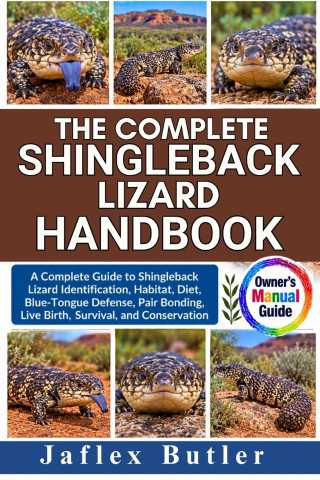
Kód: 54170158
THE COMPLETE SHINGLEBACK LIZARD HANDBOOK
Autor JAFLEX BUTLER
Introducing the Shingleback LizardThe shingleback lizard, Tiliqua rugosa, is one of Australia's most distinctive reptiles. Heavy-bodied, slow-moving, and covered with large rough scales, it has an appearance unlike that of the sle ... celý popis


- Jazyk:
 Angličtina
 - Vazba: Brožovaná
- Počet stran: 192
Nakladatelství: Independently published, 2026
- Více informací o knize


Mohlo by se vám také líbit
-

Threshing Day (Limited Deluxe Edition)
488 Kč -
Threshing Day (Wing and Claw Collection)
423 Kč -

Murdoku
342 Kč -

The Mirror of Infinite Endings
333 Kč -
The Long-Lived King: An Original The Owl House Graphic Novel
445 Kč -
The Art of Gravity Falls
917 Kč -

White Nights
89 Kč -

Berserk Deluxe Volume 1
900 Kč -

Court of Thorns and Roses 6
358 Kč -

21 Days of Fear
406 Kč -

Lord of Mysteries, Vol. 4: The Faceless, Part I
358 Kč -

The Mirror of Infinite Endings
531 Kč -

Jojo's Bizarre Adventure: Part 7--Steel Ball Run, Vol. 9
438 Kč -

Berserk Deluxe Volume 3
823 Kč -

Berserk Deluxe Volume 2
941 Kč -

Fourth Wing
563 Kč -

Witch Hat Atelier: Grimoire Edition 1
712 Kč -

Trust Fall
252 Kč -

Iron Flame
551 Kč -
Protocols
334 Kč -

Penguin Readers Level 4: The Adventures of Sherlock Holmes (ELT Graded Reader)
178 Kč
Darujte tuto knihu ještě dnes
- Objednejte knihu a zvolte Zaslat jako dárek.
- Obratem obdržíte darovací poukaz na knihu, který můžete ihned předat obdarovanému.
- Knihu zašleme na adresu obdarovaného, o nic se nestaráte.
Informovat o naskladnění knihy
Zadejte do formuláře e-mailovou adresu a jakmile knihu naskladníme, zašleme vám o tom zprávu. Pohlídáme vše za vás.
Více informací o knize THE COMPLETE SHINGLEBACK LIZARD HANDBOOK
Nákupem získáte 49 bodů
 Anotace knihy
Introducing the Shingleback Lizard
The shingleback lizard, Tiliqua rugosa, is one of Australia's most distinctive reptiles. Heavy-bodied, slow-moving, and covered with large rough scales, it has an appearance unlike that of the sleek, fast-running lizards many people imagine when thinking about reptiles. Its broad head, powerful body, short legs, and unusually blunt tail create an unmistakable outline. When threatened, the contrast becomes even more dramatic as the lizard opens its mouth and displays a broad blue tongue. These features have made the shingleback one of the most recognizable members of Australia's diverse skink fauna.
Different regions have also given this remarkable reptile several familiar names. It may be called the shingleback, sleepy lizard, bobtail, stumpy-tailed lizard, or pinecone lizard, with local usage varying across Australia. Many of these names refer directly to its unusual appearance or behavior. The term "shingleback," for example, reflects the large overlapping scales that give the body a rugged, tiled appearance, while names such as bobtail and stumpy-tail draw attention to its extraordinary short tail.
Beneath this unusual exterior is an animal with a surprisingly complex natural history. Shinglebacks are omnivorous, using both plant and animal foods; they regulate body temperature by carefully selecting sun and shade; they can store important energy reserves in their thick tails; and females give birth to live, unusually large young rather than laying eggs. Perhaps most famously, adult males and females can form long-lasting social associations, with pairs repeatedly reuniting during breeding seasons. Such behavior has made the species especially valuable for studies of reptile sociality.
The shingleback is therefore much more than an unusual-looking Australian lizard. Its anatomy, feeding ecology, reproductive strategy, social relationships, and ability to survive in demanding environments provide a fascinating example of reptile adaptation. Understanding these foundations makes it easier to appreciate every later aspect of its life, from its slow search for food to the challenges it faces from predators, roads, habitat change, and increasingly modified landscapes.
Understanding Tiliqua rugosa and Its Distinctive Biology
Tiliqua rugosa belongs to the family Scincidae, the enormous and diverse group of reptiles commonly known as skinks. Within that family, it belongs to Tiliqua, a genus containing the familiar blue-tongued skinks. Although these relatives share several recognizable characteristics, the shingleback has developed a particularly specialized combination of features that immediately separates it from the more elongated members of the group.
Its body is robust and comparatively slow-moving, supported by four relatively short limbs. This build does not suggest an animal designed primarily to escape danger through prolonged high-speed running. Instead, the shingleback combines sturdy construction, tough scales, concealment, defensive displays, and a strong bite with its ability to move toward protective vegetation or shelter. Its survival strategy therefore depends on several complementary defenses rather than speed alone.
Parametry knihy
487 Kč
- Plný název: THE COMPLETE SHINGLEBACK LIZARD HANDBOOK
- Podnázev: A Complete Guide to Shingleback Lizard Identification, Habitat, Diet, Blue-Tongue Defense, Pair Bonding, Live Birth, Survival, and Conservation
- Autor: JAFLEX BUTLER
- Jazyk: Angličtina
- Vazba: Brožovaná
- Počet stran: 192
- EAN: 9798161158845
- ID: 54170158
- Nakladatelství: Independently published
- Hmotnost: 266 g
- Rozměry: 229 × 152 × 10 mm
- Datum vydání: 09. October 2026
Osobní odběr Praha, Brno a 48395 dalších
Copyright ©2008-26 nejlevnejsi-knihy.cz Všechna práva vyhrazenaSoukromíCookies

 Vrácení do měsíce
 571 999 099 (8-15.30h)