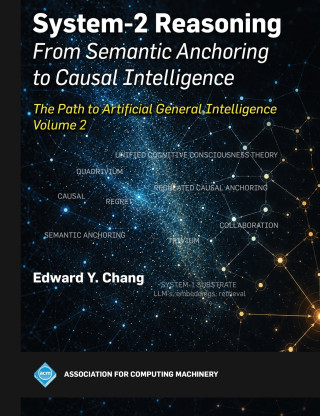
Kód: 53229929
System-2 Reasoning
Autor Edward Chang
Large language models can write poetry, pass bar exams, and generate fluent code. Yet they continue to fail in the domains where intelligence must be accountable: distinguishing causation from correlation, recognizing when evidenc ... celý popis


- Jazyk:
 Angličtina
 - Vazba: Pevná
- Počet stran: 434
Nakladatelství: Association for Computing Machinery 6504698, 2026
- Více informací o knize


Mohlo by se vám také líbit
-

Moonwalk
270 Kč -

The Score
241 Kč -

Berserk Deluxe Volume 1
779 Kč -

The Deal
254 Kč -

The Mistake
254 Kč -

Jujutsu Kaisen, Vol. 30
221 Kč -

Berserk Deluxe Volume 2
942 Kč -

Dancing The Dream
517 Kč -

Murdoku
334 Kč -

Berserk Deluxe Volume 3
804 Kč -

The Goal
253 Kč -

White Nights
89 Kč -

Invincible Compendium Volume 2
1108 Kč -

Chainsaw Man, Vol. 21
270 Kč -

The Legacy
244 Kč -

Jujutsu Kaisen, Vol. 29
199 Kč -

Invincible Compendium Volume 3
1123 Kč -

Threshing Day (Wing and Claw Collection)
400 Kč -

Lord of Mysteries, Vol. 3: The Clown, Part III
373 Kč -

Berserk Deluxe Volume 5
804 Kč -

Witch Hat Atelier: Grimoire Edition 1
786 Kč
Darujte tuto knihu ještě dnes
- Objednejte knihu a zvolte Zaslat jako dárek.
- Obratem obdržíte darovací poukaz na knihu, který můžete ihned předat obdarovanému.
- Knihu zašleme na adresu obdarovaného, o nic se nestaráte.
Informovat o naskladnění knihy
Zadejte do formuláře e-mailovou adresu a jakmile knihu naskladníme, zašleme vám o tom zprávu. Pohlídáme vše za vás.
Více informací o knize System-2 Reasoning
Nákupem získáte 224 bodů
 Anotace knihy
Large language models can write poetry, pass bar exams, and generate fluent code. Yet they continue to fail in the domains where intelligence must be accountable: distinguishing causation from correlation, recognizing when evidence is insufficient, preserving commitments over time,and correcting their own reasoning failures. This book argues that the transition from pattern matching to genuine reasoning requires a System-2 layer grounded in coordinated diagnosis, audit, causal validation, memory, and meta-cognitive control.
The volume develops this architecture from first principles through operational protocols. Semantic Anchoring (UCCT) demonstrates how contextual constraints can bind latent model representations into governed reasoning processes rather than prior-driven completion. Regulated Causal Anchoring (RCA) and RAudit diagnose sycophancy, pathological skepticism, and trace-output inconsistency without relying exclusively on ground-truth supervision. The Causal Abstraction Bridge and the CausalTSK benchmark reveal where models collapse from interventional and counterfactual reasoning back into associative prediction.
Epistemic Regret Minimization (ERM) identifies causal shortcuts and failures of warranted inference, while Reinforcement Learning from Epistemic Regret (RLER) transforms those reasoning failures into a structured learning signal. Trivium introduces temporal accountability through a Causal Transaction Log, and Quadrivium integrates contextual, causal, temporal, and meta-cognitive regulation into a unified System-2 MACI architecture.
The author's central thesis is that Artificial General Intelligence (AGI) will not emerge from scaling monolithic pattern-completion systems alone. AGI will require architectures capable of explaining why an answer is warranted, refusing conclusions when evidence remains indeterminate, and improving through epistemic failure.
Written for researchers, advanced students, and practitioners, this book presents a framework for AI systems that are not merely impressive, but auditable, corrigible, and trustworthy. It is suitable for graduate-level courses in artificial intelligence, multi-agent systems, causal reasoning, and trustworthy AI.
Parametry knihy
2242 Kč
- Plný název: System-2 Reasoning
- Podnázev: The Path to Artificial General Intelligence, Volume 2
- Autor: Edward Chang
- Jazyk: Angličtina
- Vazba: Pevná
- Počet stran: 434
- EAN: 9798400728044
- ID: 53229929
- Nakladatelství: Association for Computing Machinery 6504698
- Hmotnost: 957 g
- Rozměry: 235 × 191 × 24 mm
- Datum vydání: 03. July 2026
Osobní odběr Praha, Brno a 46961 dalších
Copyright ©2008-26 nejlevnejsi-knihy.cz Všechna práva vyhrazenaSoukromíCookies

 Vrácení do měsíce
 571 999 099 (8-15.30h)