Kód: 53370846
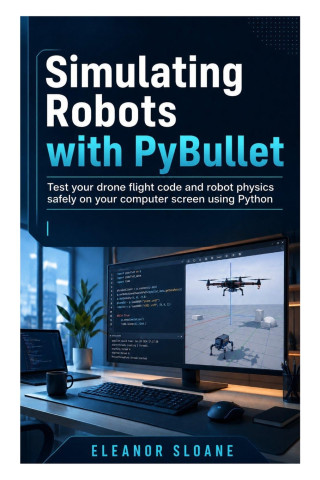
Simulating Robots with PyBullet
Autor Elenaor Sloane
Build, Control, and Test Virtual Robots Before Risking Real HardwareA robot may look stable on a computer screen while quietly exceeding a joint limit, applying unrealistic forces, drifting away from its target, touching an obstac ... celý popis


- Jazyk:
 Angličtina
 - Vazba: Brožovaná
- Počet stran: 220
Nakladatelství: Independently published, 2026
- Více informací o knize


Mohlo by se vám také líbit
-

Berserk Deluxe Volume 1
886 Kč -

Moonwalk
243 Kč -

Murdoku
329 Kč -
Threshing Day (Wing and Claw Collection)
439 Kč -

The Score
262 Kč -

Berserk Deluxe Volume 2
917 Kč -

The Mistake
243 Kč -

Dancing The Dream
554 Kč -

Threshing Day (Limited Deluxe Edition)
488 Kč -

Berserk Deluxe Volume 3
779 Kč -

White Nights
87 Kč -

The Deal
252 Kč -

Kid's Box New Generation Level 2 Activity Book with Digital Pack British English
265 Kč -

Jujutsu Kaisen, Vol. 30
220 Kč -

Murdoku Volume 2: Back in Time
333 Kč -

The Odyssey
319 Kč -
Onyx Storm (Deluxe Limited Edition) (The Empyrean, 3)
525 Kč -

Jujutsu Kaisen, Vol. 26
240 Kč -

Witch Hat Atelier: Grimoire Edition 2
854 Kč -
Kid's Box New Generation Level 2 Pupil's Book with eBook British English
432 Kč -
Kid's Box New Generation Level 3 Activity Book with Digital Pack British English
265 Kč
Darujte tuto knihu ještě dnes
- Objednejte knihu a zvolte Zaslat jako dárek.
- Obratem obdržíte darovací poukaz na knihu, který můžete ihned předat obdarovanému.
- Knihu zašleme na adresu obdarovaného, o nic se nestaráte.
Více informací o knize Simulating Robots with PyBullet
Nákupem získáte 42 bodů
 Anotace knihy
Build, Control, and Test Virtual Robots Before Risking Real Hardware
A robot may look stable on a computer screen while quietly exceeding a joint limit, applying unrealistic forces, drifting away from its target, touching an obstacle, or landing too quickly.
Useful simulation requires more than attractive animation. You must define what the experiment is supposed to prove, use appropriate physical parameters, measure the robot's state, record the results, and compare its behaviour with clear pass-and-failure criteria.
Simulating Robots with PyBullet provides a practical introduction to testing robot movement, drone-control logic, collisions, sensors, cameras, feedback controllers, and complete missions with Python.
Written for beginners with basic Python knowledge and intermediate programmers entering robotics simulation, the book uses PyBullet to create controlled virtual environments for wheeled robots, articulated arms, and a simplified quadrotor. Every core exercise runs on a computer, so no physical robot, electronics construction, advanced calculus, or ROS installation is required.
Inside this project-based guide, you will learn how to:
- Understand what physics simulation can and cannot prove
- Distinguish simulation from animation and data visualisation
- Define a clear experimental question before building a virtual world
- Record assumptions, variables, measurements, and acceptance limits
- Create repeatable experiments with controlled starting conditions
- Install Python, PyBullet, NumPy, Matplotlib, and testing tools
- Use isolated virtual environments and reproducible dependency files
- Work in graphical and headless execution modes
- Connect to and disconnect from the PyBullet physics server safely
- Configure gravity, time steps, asset paths, and simulation state
- Load static and dynamic rigid bodies
- Read position, orientation, linear velocity, and angular velocity
- Detect ground contact and record numerical results
- Use consistent SI units throughout a simulation
- Configure mass, inertia, centre of mass, friction, restitution, and damping
- Select stable physics and controller update rates
The book maintains a clear boundary between virtual evidence and real-world safety. It explains that simulation cannot guarantee exact motor performance, sensor behaviour, battery condition, manufacturing quality, or aerodynamic accuracy. Any transfer to physical hardware must repeat checks for motor direction, sensor axes, controller gains, stopping distance, timeouts, emergency shutdown, hover thrust, and landing behaviour.
Supporting resources include an installation and compatibility checklist, version-verification record, coordinate-frame reference, SI-unit table, quaternion conventions, wheel-speed and differential-drive formulas, hover-thrust calculations, PID equations, time-step relationships, and a robotics glossary.
Whether you are a Python learner, robotics student, educator, drone developer, hobbyist, control-systems beginner, or programmer preparing algorithms for later hardware testing, this guide will help you turn a moving virtual model into a measurable engineering experiment.
Define the question. Build only the model required. Measure every result. Automate the acceptance test. Treat a passing simulation as evidence-not proof of hardware safety.
Parametry knihy
423 Kč
- Plný název: Simulating Robots with PyBullet
- Podnázev: Test your drone flight code and robot physics safely on your computer screen using Python
- Autor: Elenaor Sloane
- Jazyk: Angličtina
- Vazba: Brožovaná
- Počet stran: 220
- EAN: 9798189509674
- ID: 53370846
- Nakladatelství: Independently published
- Hmotnost: 274 g
- Rozměry: 229 × 152 × 14 mm
- Datum vydání: 28. July 2026
Osobní odběr Praha, Brno a 48253 dalších
Copyright ©2008-26 nejlevnejsi-knihy.cz Všechna práva vyhrazenaSoukromíCookies

 Vrácení do měsíce
 571 999 099 (8-15.30h)