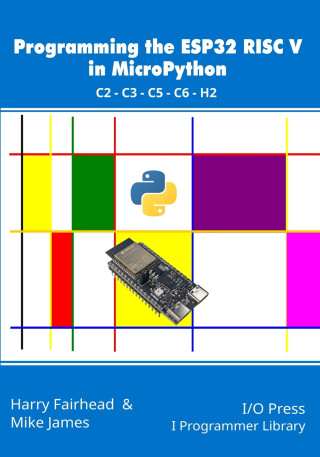
Kód: 52837267
Programming the ESP32 RISC V in MicroPython
Autor Mike James, Harry Fairhead
Espressif's ESP32 RISC V family offers a device for every application. They are all low in cost, but each has many different subsystems that make it more powerful than you might at first think. You can use them for simple applicat ... celý popis


- Jazyk:
 Angličtina
 - Vazba: Brožovaná
- Počet stran: 348
Nakladatelství: I/O Press, 2026
- Více informací o knize


Mohlo by se vám také líbit
-

Complete Advanced Self-Study Pack
1218 Kč -

Punderworld Volume 2
309 Kč -

Crossroads of Ravens
369 Kč -

Outlaw
352 Kč -

Human Centered Design Engineering: Navigating the Intersection of Creativity and Technology
2821 Kč -

Baby Steps To Accounting
754 Kč -

Role Strain, Adaptation and Contemporary Challen – A Festschrift in Honor of Dr. Phillip J. Bowman
2847 Kč
Darujte tuto knihu ještě dnes
- Objednejte knihu a zvolte Zaslat jako dárek.
- Obratem obdržíte darovací poukaz na knihu, který můžete ihned předat obdarovanému.
- Knihu zašleme na adresu obdarovaného, o nic se nestaráte.
Více informací o knize Programming the ESP32 RISC V in MicroPython
Nákupem získáte 75 bodů
 Anotace knihy
Espressif's ESP32 RISC V family offers a device for every application. They are all low in cost, but each has many different subsystems that make it more powerful than you might at first think. You can use them for simple applications because they are cheap, but you can also use them for more sophisticated applications because they are capable. This book covers the C2, C3, C5, C6 and the H2, all of which are based on RISC-V architecture.
One good thing about using MicroPython on the ESP32 is that it is very easy to get started. After a simple installation procedure you have a working MicroPython machine which you can program almost at once using the Thonny IDE.
The purpose of this book is to reveal what you can do with the ESP32's GPIO lines together with widely used sensors, servos and motors and ADCs. After covering the GPIO, outputs and inputs, events and interrupts, it gives you hands-on experience of PWM (Pulse Width Modulation), the SPI bus, the I2C bus and the 1-Wire bus, the UARTs and, of course, WiFi. To round out, it covers direct access to the hardware, adding an SD Card reader, sleep states to save power, the RTC and RMT.
While not strictly a projects book, there isn't much left for you to do to finish and polish the embryonic projects that are used as examples. Instead this book is about understanding concepts and the acquisition of skills. The hope is that having read it, you will know how to tackle your own projects and get them safely to completion without wasting time in trial and error.
Jointly authored by Harry Fairhead and Mike James, this book combines Harry's expertise in electronics and the IoT with Mike's knowledge of Python. Their previous collaborations include Programming the ESP32 in MicroPython, 2nd Edition: ESP32, ESP32 S3, Arduino Nano ESP32, Programming the Raspberry Pi Pico/W in MicroPython, Raspberry Pi IoT In Python Using GPIO Zero and Raspberry Pi IoT In Python Using Linux Drivers.
Harry Fairhead is the author of Programming The ESP32 RISC In C Using The Espressif IDF, Programming the ESP32 in C Using the Espressif IDF , Programming the ESP32 in C Using the Arduino Library and C-language books on the Raspberry Pi and the Pico. He is also the author of Fundamental C: Getting Closer To The Machine and Applying C For The IoT With Linux.
Mike James is the author of the Programmer's Python: Something Completely Different series of books and several other programming and computer science titles in the I Programmer Library.
Parametry knihy
753 Kč
- Plný název: Programming the ESP32 RISC V in MicroPython
- Autor: Mike James, Harry Fairhead
- Jazyk: Angličtina
- Vazba: Brožovaná
- Počet stran: 348
- EAN: 9781918481044
- ISBN: 1918481040
- ID: 52837267
- Nakladatelství: I/O Press
- Hmotnost: 606 g
- Rozměry: 254 × 178 × 18 mm
- Datum vydání: 09. June 2026
Oblíbené z jiného soudku
-

Threshing Day (Wing and Claw Collection)
400 Kč -

Murdoku
319 Kč -

Threshing Day (Limited Deluxe Edition)
473 Kč -

Berserk Deluxe Volume 1
879 Kč -

White Nights
89 Kč -

What Happened Yesterday
380 Kč -

Berserk Deluxe Volume 2
918 Kč -

Berserk Deluxe Volume 3
782 Kč -

Kid's Box New Generation Level 2 Activity Book with Digital Pack British English
251 Kč -
Onyx Storm (Deluxe Limited Edition) (The Empyrean, 3)
527 Kč -

Jojo's Bizarre Adventure: Part 7--Steel Ball Run, Vol. 8
427 Kč -

Dancing The Dream
482 Kč -

Court of Thorns and Roses 6
358 Kč -

Yesteryear
335 Kč -

The Courage To Be Disliked
206 Kč -

Iron Flame
552 Kč -

Kid's Box New Generation Level 1 Activity Book with Digital Pack British English
251 Kč -

Fourth Wing
552 Kč -

Kid's Box New Generation Level 3 Activity Book with Digital Pack British English
251 Kč -

Berserk Deluxe Volume 4
962 Kč -

The Count of Monte Cristo
227 Kč -

Murdoku
373 Kč -

Kid's Box New Generation Level 2 Pupil's Book with eBook British English
409 Kč -

The Odyssey
340 Kč -

Throne of Glass Box Set
1818 Kč -

Lord of Mysteries, Vol. 1: The Clown, Part I
349 Kč -

Jojo's Bizarre Adventure: Part 7--Steel Ball Run, Vol. 2
457 Kč -

East of Eden
262 Kč -

Lord of Mysteries, Vol. 3: The Clown, Part III
331 Kč -

The Mistake
221 Kč -

The Score
227 Kč -

Jujutsu Kaisen, Vol. 26
225 Kč -

I Who Have Never Known Men
206 Kč -

21 Days of Fear
386 Kč -

Murdoku Volume 2: Back in Time
328 Kč -

Berserk Deluxe Volume 5
855 Kč -

Kid's Box New Generation Level 1 Pupil's Book with eBook British English
409 Kč -

Veil Volume 1
260 Kč -

How Lucky Am I?
424 Kč -

Witch Hat Atelier: Grimoire Edition 1
777 Kč -

JoJo's Bizarre Adventure: Part 7--Steel Ball Run, Vol. 7
427 Kč -

Moonwalk
262 Kč -

Atomic Habits
399 Kč -

Kid's Box New Generation Level 3 Pupil's Book with eBook British English
409 Kč -

Kid's Box New Generation Level 4 Activity Book with Digital Pack British English
265 Kč -

The Art of Gravity Falls
854 Kč -

Berserk Deluxe Volume 6
943 Kč -

Berserk Deluxe Volume 7
879 Kč -

Sunrise on the Reaping
215 Kč
Osobní odběr Praha, Brno a 47859 dalších
Copyright ©2008-26 nejlevnejsi-knihy.cz Všechna práva vyhrazenaSoukromíCookies

 Vrácení do měsíce
 571 999 099 (8-15.30h)