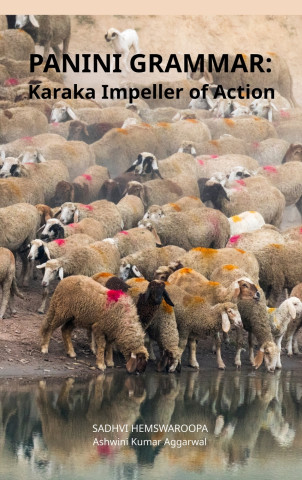
Kód: 52840409
Panini Grammar
Autor Ashwini Kumar Aggarwal, Sadhvi Hemswaroopa
Any word in a sentence that has a direct bearing on the verb is termed as कारकः kāraka. Literally "karaka" means the one that impels action. This is directly associated with the various cases विभक्तिः that govern the sense of noun ... celý popis


- Jazyk:
 Angličtina
 - Vazba: Pevná
- Počet stran: 102
Nakladatelství: Devotees of Sri Sri Ravi Shankar Ashram, 2026
- Více informací o knize


Mohlo by se vám také líbit
-

Moonwalk
270 Kč -

The Score
244 Kč -

The Deal
242 Kč -

Berserk Deluxe Volume 1
779 Kč -

The Mistake
254 Kč -

Jujutsu Kaisen, Vol. 30
221 Kč -

Berserk Deluxe Volume 2
862 Kč -

Dancing The Dream
517 Kč -

Murdoku
319 Kč -

Berserk Deluxe Volume 3
804 Kč -

The Goal
261 Kč -

White Nights
89 Kč -

Chainsaw Man, Vol. 21
240 Kč -

Invincible Compendium Volume 2
1108 Kč -

The Legacy
244 Kč -

Lord of Mysteries, Vol. 3: The Clown, Part III
373 Kč -

Jujutsu Kaisen, Vol. 29
240 Kč -

Invincible Compendium Volume 3
1123 Kč -

Witch Hat Atelier: Grimoire Edition 1
786 Kč -

JoJo's Bizarre Adventure: Part 7--Steel Ball Run, Vol. 7
427 Kč -

Jujutsu Kaisen, Vol. 26
240 Kč
Darujte tuto knihu ještě dnes
- Objednejte knihu a zvolte Zaslat jako dárek.
- Obratem obdržíte darovací poukaz na knihu, který můžete ihned předat obdarovanému.
- Knihu zašleme na adresu obdarovaného, o nic se nestaráte.
Více informací o knize Panini Grammar
Nákupem získáte 42 bodů
 Anotace knihy
Any word in a sentence that has a direct bearing on the verb is termed as कारकः kāraka. Literally "karaka" means the one that impels action. This is directly associated with the various cases विभक्तिः that govern the sense of nouns in a sentence. A noun in a sentence can behave as the Subject, Object, Instrument, etc. This behavior of the Noun is termed as कारकः in Sanskrit.
Since this behavior is closely associated with the case of the Noun, we say that कारकः governs the case of a Noun. Thus there is the concept of कारकः विभक्तिः = कारकविभक्तिः ।
Example
Rama goes to temple from home by car on Sunday for worship.
रामः m1/1 रविवासरे m7/1 गृहात् n5/1 प्रार्थनायै f4/1 वाहनेन n3/1 मन्दिरं n2/1 गच्छति verb iii/1 ।
m = masculine, n= neuter. 1/1 = 1st case singular.
Notice that the 6th case is not a Karaka Vibhakti, since it does not connect to the Verb, rather it connects to a Noun in the sentence.
Kāraka = Noun that connects to a Verb.
---
Includes exhaustive notes on
- Genitive
- Upapada
- Vibhakti
- Sati Saptami (Locative Absolute)
- Anabhihite (Undenoted)
with Ashtadhyayi Sutras.
Parametry knihy
424 Kč
- Plný název: Panini Grammar
- Podnázev: Karaka Impeller of Action
- Autor: Ashwini Kumar Aggarwal, Sadhvi Hemswaroopa
- Jazyk: Angličtina
- Vazba: Pevná
- Počet stran: 102
- EAN: 9789348012685
- ISBN: 9348012681
- ID: 52840409
- Nakladatelství: Devotees of Sri Sri Ravi Shankar Ashram
- Hmotnost: 310 g
- Rozměry: 229 × 152 × 8 mm
- Datum vydání: 05. March 2026
Osobní odběr Praha, Brno a 46804 dalších
Copyright ©2008-26 nejlevnejsi-knihy.cz Všechna práva vyhrazenaSoukromíCookies

 Vrácení do měsíce
 571 999 099 (8-15.30h)