Kód: 53256935
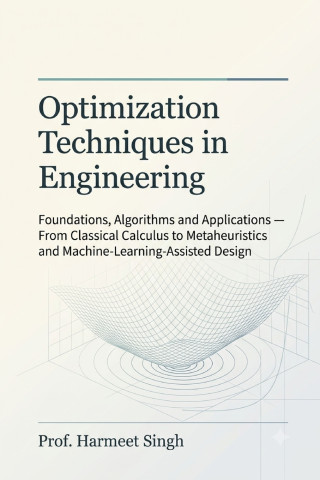
OPTIMIZATION TECHNIQUES IN ENGINEERING
Autor Harmeet Singh
What the book tries to do. It tries to build, from first principles, an understanding of why optimization algorithms work - and, just as importantly, when they fail. Every algorithm in this book is presented in four layers:The ide ... celý popis


- Jazyk:
 Angličtina
 - Vazba: Brožovaná
- Počet stran: 346
Nakladatelství: Independently published, 2026
- Více informací o knize


Mohlo by se vám také líbit
-

Moonwalk
263 Kč -

Berserk Deluxe Volume 1
862 Kč -

The Score
243 Kč -

The Mistake
243 Kč -

The Deal
236 Kč -

Murdoku
339 Kč -

Threshing Day (Wing and Claw Collection)
400 Kč -

Berserk Deluxe Volume 2
942 Kč -

Jujutsu Kaisen, Vol. 30
220 Kč -

Berserk Deluxe Volume 3
781 Kč -

Dancing The Dream
517 Kč -

White Nights
95 Kč -

The Goal
253 Kč -

Jujutsu Kaisen, Vol. 26
240 Kč -

Threshing Day (Limited Deluxe Edition)
488 Kč -

Jujutsu Kaisen, Vol. 29
225 Kč -

Lord of Mysteries, Vol. 3: The Clown, Part III
373 Kč -

Berserk Deluxe Volume 5
862 Kč -

Onyx Storm (Deluxe Limited Edition) (The Empyrean, 3)
526 Kč -

The Legacy
243 Kč -

Chainsaw Man, Vol. 21
240 Kč
Darujte tuto knihu ještě dnes
- Objednejte knihu a zvolte Zaslat jako dárek.
- Obratem obdržíte darovací poukaz na knihu, který můžete ihned předat obdarovanému.
- Knihu zašleme na adresu obdarovaného, o nic se nestaráte.
Více informací o knize OPTIMIZATION TECHNIQUES IN ENGINEERING
Nákupem získáte 40 bodů
 Anotace knihy
What the book tries to do. It tries to build, from first principles, an understanding of why optimization algorithms work - and, just as importantly, when they fail. Every algorithm in this book is presented in four layers:
- The idea. A plain-language statement of the trick that makes the method work, usually accompanied by a picture. If you remember nothing else from a chapter, remember the picture.
- The mathematics. The derivation, the conditions under which it is valid, and the convergence behaviour you should expect.
- The procedure. A step-by-step algorithm you could implement, in pseudocode or in Python, without further help.
- The engineering. A worked example drawn from a real discipline - a truss, a heat exchanger, a distribution network, a controller - carried through to numbers.
How the book is organised. The material is arranged in six parts.
- Part I - Foundations (Chapters 1-3) establishes vocabulary, the mathematical machinery of convexity and optimality, and - most neglected of all topics - the art of formulating an engineering problem so that it is solvable.
- Part II - Classical Deterministic Methods (Chapters 4-8) covers single-variable search, gradient-based multivariable methods, direct search, and the classical treatment of constraints through Lagrange multipliers, the Karush-Kuhn-Tucker conditions, penalty methods, and sequential quadratic programming.
- Part III - Linear, Network and Discrete Optimization (Chapters 9-13) develops linear programming and the simplex method, duality and sensitivity, network models, integer programming, and dynamic programming.
- Part IV - Metaheuristic and Nature-Inspired Methods (Chapters 14-17) treats genetic algorithms, swarm intelligence, simulated annealing, tabu search, differential evolution, and multi-objective optimization.
- Part V - Advanced Topics (Chapters 18-20) covers geometric and quadratic programming, optimization under uncertainty, and surrogate-based design.
- Part VI - Applications and Practice (Chapters 21-24) puts everything to work on structural, mechanical, electrical, chemical and civil case studies, surveys the software landscape, and closes with the fast-moving frontier where machine learning meets optimization.
Parametry knihy
403 Kč
- Plný název: OPTIMIZATION TECHNIQUES IN ENGINEERING
- Podnázev: Foundations, Algorithms and Applications - From Classical Calculus to Metaheuristics and Machine-Learning-Assisted Design
- Autor: Harmeet Singh
- Jazyk: Angličtina
- Vazba: Brožovaná
- Počet stran: 346
- EAN: 9798187698622
- ID: 53256935
- Nakladatelství: Independently published
- Hmotnost: 465 g
- Rozměry: 229 × 152 × 18 mm
- Datum vydání: 17. July 2026
O tomto obchodě
Nákupní rádce
Přehledy
Knihy podle jazyka
Osobní odběr Praha, Brno a 46967 dalších
Copyright ©2008-26 nejlevnejsi-knihy.cz Všechna práva vyhrazenaSoukromíCookies

 Vrácení do měsíce
 571 999 099 (8-15.30h)