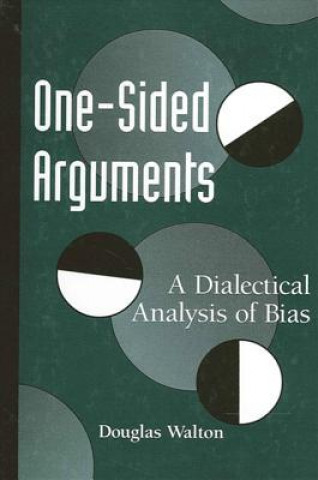
Kód: 04700612
One-Sided Arguments
Autor Douglas N. Walton
We often feel that an argument should be doubted or held as suspicious because it has a bias. But bias isn't always wrong. It is a normal phenomenon in advocacy argumentation, and in many cases it is to be expected. Yet sometimes ... celý popis


- Jazyk:
 Angličtina
 - Vazba: Brožovaná
- Počet stran: 295
Nakladatelství: State University of New York Press, 1999
- Více informací o knize

909 Kč
Dostupnost:
50 % šance Máme informaci, že by titul mohl být dostupný. Na základě vaší objednávky se ho pokusíme do 6 týdnů zajistit.
Prohledáme celý svět
Mohlo by se vám také líbit
-

Mengele
350 Kč -

Al Qaeda, the Islamic State, and the Global Jihadist Movement
308 Kč -

From Religion to Philosophy
1193 Kč -

Talking and Doing Science in the Early Years
4807 Kč -

Landmark Cases in Property Law
3379 Kč -

Conserving Living Natural Resources
3782 Kč -

Management Accounting for Hotels and Restaurants
6155 Kč -
Reluctant Modernist
1134 Kč -

Accident, Suicide, or Murder
359 Kč -

Cours d'histoire moderne
1239 Kč -

Menschen der Ehe
267 Kč -

Being Haiku
332 Kč -

Development and Diffusionism
1223 Kč -

Black Los Angeles
2845 Kč
Darujte tuto knihu ještě dnes
- Objednejte knihu a zvolte Zaslat jako dárek.
- Obratem obdržíte darovací poukaz na knihu, který můžete ihned předat obdarovanému.
- Knihu zašleme na adresu obdarovaného, o nic se nestaráte.
Informovat o naskladnění knihy
Zadejte do formuláře e-mailovou adresu a jakmile knihu naskladníme, zašleme vám o tom zprávu. Pohlídáme vše za vás.
Více informací o knize One-Sided Arguments
Nákupem získáte 91 bodů
 Anotace knihy
We often feel that an argument should be doubted or held as suspicious because it has a bias. But bias isn't always wrong. It is a normal phenomenon in advocacy argumentation, and in many cases it is to be expected. Yet sometimes bias can be quite harmful in argumentation. In this book, bias is defined as one-sided advocacy of a point of view in argumentation. It is shown to be harmful, or properly subject to critical condemnation, only when the dialogue exchange is supposed to be a balanced, two-sided exchange of viewpoints.The book concedes the postmodernist premise that bias is quite normal in everyday conversational arguments, and that a finding of bias should not, by itself, constitute grounds for criticizing an argument as critically deficient or fallacious. But the book strongly disagrees with the postmodernist conclusion that no standard of rationality can be brought to bear to condemn narrowly interest-based or one-sided arguments as biased. It is argued that in some cases narrow, one-sided partisanship in an argument is justifiably a basis for negative criticism of the worth of the argument.
Parametry knihy
Zařazení knihy Knihy v angličtině Humanities Philosophy History of Western philosophy
909 Kč
- Plný název: One-Sided Arguments
- Podnázev: A Dialectical Analysis of Bias
- Autor: Douglas N. Walton
- Jazyk: Angličtina
- Vazba: Brožovaná
- Počet stran: 295
- EAN: 9780791442685
- ID: 04700612
- Nakladatelství: State University of New York Press
- Hmotnost: 426 g
- Rozměry: 228 × 151 × 17 mm
- Datum vydání: 12. August 1999
Oblíbené z jiného soudku
-

Meditations
186 Kč -

Why I Am so Clever
61 Kč -
Nausea
248 Kč -

The Myth of Sisyphus
178 Kč -

Beyond Good and Evil
248 Kč -

Thus Spoke Zarathustra: A Book for Everyone and No One
221 Kč -

On the Shortness of Life
178 Kč -

Aphorisms on Love and Hate
102 Kč -

Either/Or
336 Kč -

Existentialism Is a Humanism
248 Kč -

Discourses and Selected Writings
235 Kč -

Anti-Oedipus
381 Kč -

Fear and Trembling
248 Kč -
On the Genealogy of Morals
235 Kč -

City of God
319 Kč -

The Sickness Unto Death
248 Kč -

Critique of Pure Reason
365 Kč -

Think
281 Kč -

Letters from a Stoic
317 Kč -

Phenomenology of Spirit
456 Kč -
Meditations
358 Kč -

New History of Western Philosophy
467 Kč -

Fragments
272 Kč -

Less Than Nothing
1398 Kč -

Myth of Sisyphus
271 Kč -

Beyond Good and Evil
358 Kč -

On the Heights of Despair
732 Kč -
Plato: Five Dialogues
360 Kč -

History of Western Philosophy
490 Kč -

Enquiry concerning Human Understanding
253 Kč -
Introduction to the Reading of Hegel
676 Kč -

Lily of the Field and the Bird of the Air
225 Kč -

First Philosophers
248 Kč -

Discourse on Political Economy and The Social Contract
178 Kč -
Alienation
568 Kč -

Guide to the Good Life
396 Kč -

Accursed Share, Volumes II & III
599 Kč -

Nietzsche
482 Kč -

Sex, Ecology, Spirituality
1024 Kč -

Art of Rhetoric
288 Kč -

Libidinal Economy
838 Kč -
Hegel's Science of Logic
812 Kč -

Transparency of Evil
482 Kč -
Plotinus
1218 Kč -

Theurgy and the Soul
795 Kč -

Young Hegelians
1166 Kč -

Heidegger on Being and Acting
826 Kč -
Philosophical Explanations
1230 Kč -

Ride the Tiger
430 Kč
Osobní odběr Praha, Brno a 47405 dalších
Copyright ©2008-26 nejlevnejsi-knihy.cz Všechna práva vyhrazenaSoukromíCookies

 Vrácení do měsíce
 571 999 099 (8-15.30h)