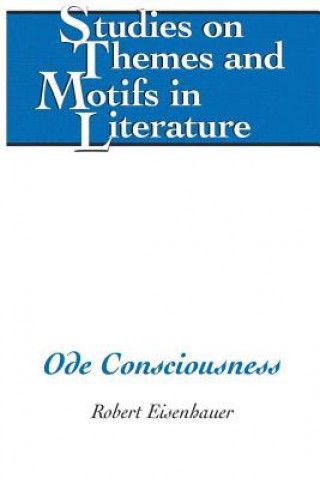
Kód: 10025715
Ode Consciousness
Autor Robert Eisenhauer
Ode Consciousness examines a preeminent literary form in its three-thousand-year history, navigating between philosophy and literature, offering cross-cultural perspectives on a poetic logic informed by polar intensities of sensuo ... celý popis


- Jazyk:
 Angličtina
 - Vazba: Pevná
- Počet stran: 261
Nakladatelství: Peter Lang Publishing Inc, 2009
- Více informací o knize


Mohlo by se vám také líbit
-

Absolute Batman Vol. 1: The Zoo
407 Kč -

Out of the Wilderness
335 Kč -

Phototherapy and Therapeutic Photography in a Digital Age
1188 Kč -

Geschichte des preussischen Staats
893 Kč -

Choix de Poesies Posthumes Et Autres
628 Kč -

L'histoire oubliée du libéralisme
751 Kč -

Silver Aegis
759 Kč
Darujte tuto knihu ještě dnes
- Objednejte knihu a zvolte Zaslat jako dárek.
- Obratem obdržíte darovací poukaz na knihu, který můžete ihned předat obdarovanému.
- Knihu zašleme na adresu obdarovaného, o nic se nestaráte.
Více informací o knize Ode Consciousness
Nákupem získáte 208 bodů
 Anotace knihy
Ode Consciousness examines a preeminent literary form in its three-thousand-year history, navigating between philosophy and literature, offering cross-cultural perspectives on a poetic logic informed by polar intensities of sensuous cognition. Making a double incision on the corpus, Robert Eisenhauer interprets works by Henry Vaughan and the modernist Frank O'Hara, foregrounding the text, but also the text(-ile) message, and the dialogical weave of enunciation. The ancient Chinese ode, translated by Karlgren and estranged by Pound, anchors sentience in the flora and fauna of physical nature, and the I Jing or Book of Changes offers insights on poetry, psychoanalysis, and aleatoriness per se. The rise of the ode in the West is contemporary with that of a philosophical discourse concerning clarity and obscurity of thought. While Milton widens the esoteric scope, Lovelace concretizes ode consciousness through the image of a frozen grasshopper («green ice»), whose non-longevity is contrasted with the human capacity for survival through friendship. Translating the «Polish Horace» (Sarbiewski), Coleridge prepares the ground for the lyricism of Keats and Shelley, raising the neural stakes through passages of lingering, delay, and intoxication. A negative capability inclusive of desire as well as nihilation inhabits Jalal al-Din Rumi and the Arabic qasida. Affliction, a key concept for the Baroque, is discussed in the context of film noir, while Hegel's privileging in the Aesthetics of Schiller's «Song of the Bell» is seen as part of a larger attempt to censure the radical re-Pindarization and revolutionary retexting of the ode, most notably in Klopstock and Hölderlin. The author analyzes the role played by impersonality in Yeats's attempt to recrystallize Keatsian and Confucian sensibility through «annotated seeing» and the opening of windows of clairvoyant perception. Eisenhauer also suggests parallels between O'Hara's autumnal glimpses of New York City at the height of modernism and Keatsian sensibility. Ode Consciousness concludes by examining the return of the repressed in the graphic novels of Osamu Tezuka, thereby enriching our understanding of the ode's perennial relevance.
Parametry knihy
Zařazení knihy Knihy v angličtině Literature & literary studies Literature: history & criticism Literary studies: general
2081 Kč
- Plný název: Ode Consciousness
- Autor: Robert Eisenhauer
- Jazyk: Angličtina
- Vazba: Pevná
- Počet stran: 261
- EAN: 9781433107337
- ISBN: 9781433107337
- ID: 10025715
- Nakladatelství: Peter Lang Publishing Inc
- Hmotnost: 586 g
- Rozměry: 157 × 233 × 22 mm
- Datum vydání: 22. June 2009
Oblíbené z jiného soudku
-

How to Read a Book
248 Kč -

The Picture of Dorian Gray
148 Kč -

Weird and the Eerie
205 Kč -

Count of Monte Cristo
209 Kč -

Odyssey
225 Kč -

Plainwater
319 Kč -

Captain is Out to Lunch
334 Kč -

Idiot
224 Kč -

Consolation of Philosophy
248 Kč -

Selected Journals of L. M. Montgomery: Volume I: 1889-1910
727 Kč -

David Copperfield
241 Kč -

Boyhood
235 Kč -

Rage To Live
531 Kč -

Mysteries of Udolpho
229 Kč -

Gravity's Rainbow Companion
926 Kč -

Means to Freedom
651 Kč -

Means to Freedom
651 Kč -

Long Day's Journey Into Night
235 Kč -

Pride and Prejudice
325 Kč -
Republic
737 Kč -

J. R. R. Tolkien Companion and Guide
2478 Kč -

Vladimir Nabokov
1469 Kč -

Antigone's Claim
773 Kč -

Gormenghast (Adaptation)
402 Kč -

Woodlanders
220 Kč -

Little Dorrit
224 Kč -

Vladimir Nabokov
1293 Kč -
Divine Comedy
288 Kč -

Republic
822 Kč -

Fitzgerald: The Love of the Last Tycoon
825 Kč -

Economy of the Unlost
882 Kč -

Apollodorus' Library and Hyginus' Fabulae
494 Kč -

Stanze of Angelo Poliziano
956 Kč -

Pickwick Papers
209 Kč -

Awakening
504 Kč -

Dubliners
202 Kč -

Zofloya or The Moor
236 Kč -

Karamazov Brothers
209 Kč -
Metamorphoses
162 Kč -

Saga of Tanya the Evil, Vol. 3
278 Kč -

Moveable Feast
194 Kč -

SEOUL University Korean 1B Workbook (QR), m. 1 Audio
753 Kč -

Rumi: The Big Red Book
270 Kč -
Art of Rhetoric
95 Kč -

Edda
178 Kč -
If Not, Winter: Fragments Of Sappho
380 Kč -

Iliad
350 Kč -

Simple Passion
228 Kč -

SEOUL University Korean 1B Student's Book (QR), m. 1 Audio
1107 Kč
Osobní odběr Praha, Brno a 46735 dalších
Copyright ©2008-26 nejlevnejsi-knihy.cz Všechna práva vyhrazenaSoukromíCookies

 Vrácení do měsíce
 571 999 099 (8-15.30h)