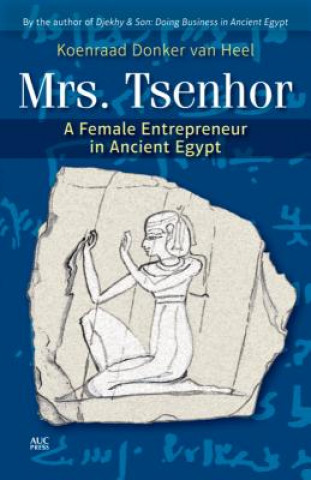
Kód: 05063126
Mrs Tsenhor
Autor Koenraad Donker Van Heel
Tsenhor was born about 550 B C E in the city of Thebes (Karnak). She died some sixty years later, having lived through the reigns of Amasis II, Psamtik III, Cambyses II, Darius I and perhaps even Psamtik IV. By carefully retracing ... celý popis


- Jazyk:
 Angličtina
 - Vazba: Pevná
- Počet stran: 256
Nakladatelství: The American University in Cairo Press, 2014
- Více informací o knize

816 Kč
Dostupnost:
50 % šance Máme informaci, že by titul mohl být dostupný. Na základě vaší objednávky se ho pokusíme do 6 týdnů zajistit.
Prohledáme celý svět
Mohlo by se vám také líbit
-

Avery Singer: Unity Bachelor
1674 Kč -

Le ruban moucheté et autres aventures de Sherlock Holmes
212 Kč -

LA VIDA EN LOS CONFINES DE LA TIERRA
692 Kč -

More Scenes and Monologs from the Best New Plays
650 Kč -

Apprenticeship in Critical Ethnographic Practice
3323 Kč -

Quantification of Operational Risk under Basel II
4059 Kč -

Mixed Lubrication in Hydrodynamic Bearings
3846 Kč
Darujte tuto knihu ještě dnes
- Objednejte knihu a zvolte Zaslat jako dárek.
- Obratem obdržíte darovací poukaz na knihu, který můžete ihned předat obdarovanému.
- Knihu zašleme na adresu obdarovaného, o nic se nestaráte.
Informovat o naskladnění knihy
Zadejte do formuláře e-mailovou adresu a jakmile knihu naskladníme, zašleme vám o tom zprávu. Pohlídáme vše za vás.
Více informací o knize Mrs Tsenhor
Nákupem získáte 82 bodů
 Anotace knihy
Tsenhor was born about 550 B C E in the city of Thebes (Karnak). She died some sixty years later, having lived through the reigns of Amasis II, Psamtik III, Cambyses II, Darius I and perhaps even Psamtik IV. By carefully retracing the events of her life as they are recorded in papyri now kept in museums in London, Paris, Turin, and Vienna, the author creates the image of a proud and independent businesswoman who made her own decisions in life. If Tsenhor were alive today she would be wearing jeans, drive a pick-up, and enjoy a beer with the boys. She clearly was her own boss, and one assumes that this happened with the full support of her second husband Psenese, who fathered two of her children. She married him when she was in her mid-thirties. Tsenhor - - who was probably named after her father's most important client - - was a working wife. Like her father and husband, she could be hired to bring offerings to the dead in the necropolis on the west bank of the Nile. For a fee of course, and that is how her family acquired high-quality farm land on more than one occasion. But Tsenhor also did other business on her own, such as buying a slave and co-financing the reconstruction of a house that she owned together with Psenese. When Tsenhor decided to divide her inheritance, her son and daughter each received an equal share. Even the papyri proving her children's rights to her inheritance were cut to equal size, as if to underline that in her household boys and girls had exactly the same rights. Tsenhor seems in many ways to have been a liberated woman, some 2,500 years before the concept was invented. Embedded in the history of the first Persian occupation of Egypt, and using many sources dealing with ordinary women from the Old Kingdom up to and including the Coptic era, this book aims to forever change the general view on women in ancient Egypt, that is far too often based on the lives of Nefertiti, Hatshepsut, and Cleopatra.
Parametry knihy
Zařazení knihy Knihy v angličtině Humanities History History: earliest times to present day
816 Kč
- Plný název: Mrs Tsenhor
- Podnázev: A Female Entrepreneur in Ancient Egypt
- Autor: Koenraad Donker Van Heel
- Jazyk: Angličtina
- Vazba: Pevná
- Počet stran: 256
- EAN: 9789774166341
- ID: 05063126
- Nakladatelství: The American University in Cairo Press
- Hmotnost: 626 g
- Rozměry: 150 × 230 × 24 mm
- Datum vydání: 30. May 2014
Oblíbené z jiného soudku
-

Tuesdays With Morrie
235 Kč -

The Origins of Totalitarianism
317 Kč -

Medieval Costume and How to Make It
258 Kč -
Gallic War
178 Kč -

Landmark Arrian
608 Kč -

King's Two Bodies
489 Kč -

Caesar
430 Kč -

Augustus
380 Kč -
Histories
194 Kč -

Age Of Capital
336 Kč -

Alexander the Great
240 Kč -

Fall of Yugoslavia
248 Kč -

Thirteen Days: a Memoir of the Cuban Missile Crisis
272 Kč -

Tuesdays With Morrie
248 Kč -

Armies of Celtic Europe 700 BC to AD 106
605 Kč -

Roman Auxiliary Forts 27 BC-AD 378
388 Kč -

Gempei War 1180-85
380 Kč -

Age Of Empire
336 Kč -

Age Of Extremes
358 Kč -

Who Paid The Piper?
336 Kč -

Edexcel AS/A Level History, Paper 1&2: Communist states in the 20th century Student Book + ActiveBook
1264 Kč -

Penguin Historical Atlas of Ancient Civilizations
315 Kč -

Woman Who Would be King
347 Kč -

Elizabethan Stitches
809 Kč -

Ambivalent Conquests
525 Kč -

Indian Summer
227 Kč -

On the Trail of the Assassins
256 Kč -
Ancient Rome on Five Denarii a Day
227 Kč -

Guns, Germs, and Steel
265 Kč -

From Third World to First
285 Kč -

Illustrated Encyclopedia of Uniforms of World War I
445 Kč -

Learn to Read Ancient Sumerian
651 Kč -

Secret Team
442 Kč -

On Tyranny
208 Kč -

Swerve
318 Kč -

Book of Margery Kempe
244 Kč -
24 Hours in Ancient Athens
190 Kč -

History of the Decline and Fall of the Roman Empire
336 Kč -
Egyptian Book of the Dead: The Book of Going Forth by Day : The Complete Papyrus of Ani Featuring Integrated Text and Full-Color Images (History ... M
606 Kč -

Alexander the Great
320 Kč -

Distant Mirror
336 Kč -

Dividing the Spoils
298 Kč -

Streams of Gold, Rivers of Blood
688 Kč -

Fear and Loathing on the Campaign Trail '72
293 Kč -

Fall of Carthage
336 Kč -

Oxford Handbook of Neolithic Europe
1335 Kč -

Life in a Medieval Village
248 Kč -

Safe Area Gorazde
508 Kč -

Swords of the Viking Age
641 Kč
Osobní odběr Praha, Brno a 46795 dalších
Copyright ©2008-26 nejlevnejsi-knihy.cz Všechna práva vyhrazenaSoukromíCookies

 Vrácení do měsíce
 571 999 099 (8-15.30h)