Kód: 04721764
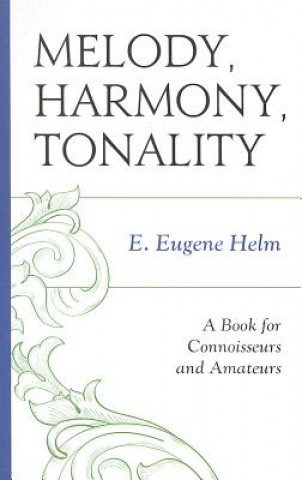
Melody, Harmony, Tonality
Autor E. Eugene Helm
Where did the major scale come from? Why does most traditional non-Western music not share Western principles of harmony? What does the inner structure of a canon have to do with religious belief? Why, in historical terms, is J.S. ... celý popis


- Jazyk:
 Angličtina
 - Vazba: Pevná
- Počet stran: 210
Nakladatelství: Scarecrow Press, 2012
- Více informací o knize


Mohlo by se vám také líbit
-

Big Sleep and Other Novels
291 Kč -

Swamp Thing: The Anatomy Lesson: DC Compact Comics Edition
169 Kč -

Of Love and Other Demons
272 Kč -

Matematyka w punkt. Szkoła podstawowa klasa 6. Zeszyt ćwiczeń
79 Kč -

BDSM - How to Take Your First Steps Into BDSM
279 Kč -

Musikeier Groovy Beats
457 Kč -

Buddha a Kristus
166 Kč -

Stem Starters for Kids Anatomy Activity Book: Packed with Activities and Anatomy Facts!
176 Kč -

Ilustrovaný česko-ukrajinský slovník
134 Kč -

All the Things: How to Draw Books for Kids
248 Kč -

Pioneer B1, Student's Book
836 Kč -

Warrior Cats - Adventskalenderbuch
278 Kč -

How to Suffer Outside: A Beginner's Guide to Hiking and Backpacking
334 Kč -

Representation
1005 Kč -

Behold The Man
297 Kč -

From Modes to Keys in Early Modern Music Theory
2915 Kč -

Life and Teachings of Tsongkhapa
382 Kč -

Building Applications with AI Agents
1268 Kč -

A Field Guide to the Snakes of Australia
763 Kč -

Szent István nemzetsége - Magyarország története 997-1301
179 Kč -

Macko Puf - Zábava s kamarátmi
120 Kč -

Recital Training. Vorspiel-Training, Violine, m. 2 Audio-CDs. Bd.2
510 Kč -

EU Climate Diplomacy
1577 Kč -

Idealny czas na smuteczek
226 Kč -

Socrates: The Best of Socrates: The Founding Philosophies of Ethics, Virtues & Life
340 Kč -

Melody, Harmony, Tonality
1474 Kč -

Gas And Glamour
832 Kč -

Words and Music in the Middle Ages
1976 Kč -

Plant Extract Loaded Biopolymers For Wound Healing
5125 Kč -

Madras
259 Kč -

The Magpie Society tome 1
495 Kč -

Interpretation of Music
5059 Kč -

Knallfroesche
226 Kč -

Right Where I Belong
263 Kč -

Ausbildungsreife
1236 Kč -

Amos and Red Deer
444 Kč -

WWII Diary of a German Soldier
572 Kč -

Praying the Mass: The Prayers of the People
279 Kč -

Human Heredity in the Twentieth Century
5651 Kč -

Perché le persone scelgono di soggiornare con Airbnb?
813 Kč -

Heidegger and the Place of Ethics
1198 Kč -

Crash Politics and Antiracism
1889 Kč -

Metabolic Syndrome
4002 Kč -

My Little UFO Book
237 Kč -

Select Screen
292 Kč -

L'Ere Sans Violence: Revision Du Traite de Francfort
614 Kč -

Prozesse d. Identitätsbildung in frühpremyslidischen Ländern
2614 Kč -

Beyond Xs and Os
472 Kč -

LLUIS PERMANYER/JOAN DE SAGARRA
143 Kč -

No te compliques: Teología pastoral a favor del reino y la persona
196 Kč -

La Maldición del Arquero II. El embrujo de Elba
232 Kč -

ANNUAL REPORT OF THE SUPERINTENDENT OF P
794 Kč -

Night Riders
1115 Kč -

La trama del tiempo : una exposición filosófica
698 Kč -

Expanding the Production and Use of Cool Season Food Legumes
2195 Kč -

Das Grummeleinhorn
245 Kč
Darujte tuto knihu ještě dnes
- Objednejte knihu a zvolte Zaslat jako dárek.
- Obratem obdržíte darovací poukaz na knihu, který můžete ihned předat obdarovanému.
- Knihu zašleme na adresu obdarovaného, o nic se nestaráte.
Více informací o knize Melody, Harmony, Tonality
Nákupem získáte 301 bodů
 Anotace knihy
Where did the major scale come from? Why does most traditional non-Western music not share Western principles of harmony? What does the inner structure of a canon have to do with religious belief? Why, in historical terms, is J.S. Bach's music regarded as a perfect combination of melody and harmony? Why do clocks in church towers strike dominant-tonic-dominant-tonic? What do cathedrals have to do with monochords? How can the harmonic series be demonstrated with a rope tied to a doorknob, and how can it be heard by standing next to an electric fan? Why are the free ocean waves in Debussy's La Mer, the turbulent river waves in Smetana's Moldau, and the fountain ripples in Ravel's Jeux d'Eau pushed at times into four-bar phrases? Why is the metric system inherently unsuitable for organizing music and poetry? In what way does Plato's Timaeus resemble the prelude to Wagner's Das Rheingold? Just how does Beethoven's work perfectly illustrate fully functional tonality, and why were long-range works based on this type of tonality impossible before the introduction of equal temperament? In this new century, what promising materials are available to composers in the wake of harmonic experimentation and, some would argue, exhaustion? The answers to these seemingly complicated questions are not the sole province of music professors or orchestra conductors. In fact, as E. Eugene Helm demonstrates, they can just as easily be explained to amateurs, and their answers are important if we are to understand how Western music works. The full range of Western music is explored through 21 concise chapters on such topics as melody, harmony, counterpoint, texture, melody types, improvisation, music notation, free imitation, canon and fugue, vibration and its relation to harmony, tonality, and the place of music in architecture and astronomy. Intended for amateurs and professionals, concert-goers and conductors, Helm offers in down-to-earth language an explanation of the foundations of our Western music heritage, deepening our understanding and the listening experience of it for all.
Parametry knihy
Zařazení knihy Knihy v angličtině The arts Music Theory of music & musicology
3011 Kč
- Plný název: Melody, Harmony, Tonality
- Podnázev: A Book for Connoisseurs and Amateurs
- Autor: E. Eugene Helm
- Jazyk: Angličtina
- Vazba: Pevná
- Počet stran: 210
- EAN: 9780810886391
- ID: 04721764
- Nakladatelství: Scarecrow Press
- Hmotnost: 449 g
- Rozměry: 236 × 159 × 21 mm
- Datum vydání: 06. December 2012
Oblíbené z jiného soudku
-

The Way I Am
521 Kč -

Study of Counterpoint
334 Kč -

Counterpoint in Composition
1418 Kč -

How Music Works
424 Kč -

Electronic Projects for Musicians
590 Kč -

This is Your Brain on Music
260 Kč -
The Chord Wheel
381 Kč -

Improvisation
328 Kč -

Composing Music
979 Kč -

Music Theory: the essential guide
211 Kč -
Beyond Unwanted Sound
940 Kč -

Fundamentals of Musical Composition
379 Kč -

Guitar Fretboard Workbook
625 Kč -

Melody in Songwriting
570 Kč -

Sonic Warfare
826 Kč -

Harmony of the Spheres
645 Kč -

Carl Czerny
200 Kč -

How Equal Temperament Ruined Harmony (and Why You Should Care)
334 Kč -

Music Theory and Composition
2298 Kč -
Elements of Musical Composition
884 Kč -

Music, Physics and Engineering
302 Kč -

Psychology of Music: A Very Short Introduction
243 Kč -

Uncovering the Voice
413 Kč -

Perfect Wrong Note
628 Kč -

Music and the Ineffable
1770 Kč -

Musicking
635 Kč -

Orchesography
358 Kč -

Sound and Symbol, Volume 1
1494 Kč -

Arranging Songs
829 Kč -

Arabic Musical Scales
358 Kč -

Harmonic Experience
801 Kč -

AB Guide to Music Theory, Part II
326 Kč -

AB Guide to Music Theory, Part I
256 Kč -
Harmony and Theory
459 Kč -

Principles of Orchestration
524 Kč -

Music, Sense and Nonsense
346 Kč -

Bowman Chris Music Theory Workbook for All Musicians Bk
308 Kč -

Harmony Through Melody
2675 Kč -

Musical Idea and the Logic, Technique, and Art of Its Presentation, New Paperback English Edition
739 Kč -

How Music Works
314 Kč -

Oxford Handbook of Music Therapy
1476 Kč -

Great Songwriting Techniques
1195 Kč -

Modulation
147 Kč -

Elementary Training for Musicians
524 Kč -

Complete Musician
3788 Kč -

Everything in its Right Place
1163 Kč -

Sweet Anticipation
1006 Kč -

Into the Maelstrom: Music, Improvisation and the Dream of Freedom
755 Kč -
Sinister Resonance
792 Kč
Osobní odběr Praha, Brno a 48132 dalších
Copyright ©2008-26 nejlevnejsi-knihy.cz Všechna práva vyhrazenaSoukromíCookies

 Vrácení do měsíce
 571 999 099 (8-15.30h)