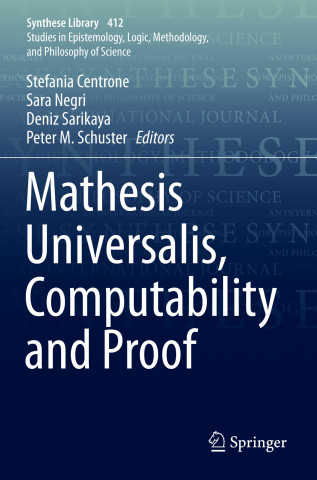
Kód: 33377231
Mathesis Universalis, Computability and Proof
Autor Peter M. Schuster, Deniz Sarikaya, Sara Negri
In a fragment entitled Elementa Nova Matheseos Universalis (1683?) Leibniz writes "the mathesis [...] shall deliver the method through which things that are conceivable can be exactly determined"; in another fragment he takes the ... celý popis


- Jazyk:
 Angličtina
 - Vazba: Brožovaná
- Počet stran: 374
Nakladatelství: Springer Nature Switzerland AG, 2020
- Více informací o knize


Mohlo by se vám také líbit
-

Potraty
259 Kč -

Osudy dobrého vojáka Švejka za světové války
355 Kč -

LEGO EV3 Robotics: A Guide for Educators
810 Kč -

The Ultimate Guide to Sugarcraft: The International School of Sugarcraft
403 Kč -

Bing Ogromne puzzle podłogowe
373 Kč -

L'Arte del Pane e del Lievito Madre
412 Kč -

Everyday Play
441 Kč -

The Three Distinct Knocks along with Jachin and Boaz
308 Kč -

Spickzettel
140 Kč -

Caught in the Middle
274 Kč -

Die Katzen Von Wickham - Silbermord
190 Kč -
Philoponus: On Aristotle Physics 4.1-5
4489 Kč -

Natura
526 Kč -

Die Feier des Stundengebetes - Lektionar. Erste Jahresreihe
660 Kč -

Drocoft
217 Kč -

Sachet de senteur Chakra Collection - Fougère - Chakra du coeur
71 Kč -

Atlanta Braves 101: My First Team-Board-Book
286 Kč -

Descenders (Nintendo Switch)
1031 Kč -

A Brief History of Economics
1787 Kč -

Learn-A-Stitch Crochet Dishcloths
214 Kč -

Western World
156 Kč -

Marjorie's Busy Days (1908)
728 Kč -

Lettre au président de la République sur les citoyens en situation de handicap,
563 Kč -

Journaling for Women
358 Kč -

Estatutos de autonomía y normas complementarias : comentadas y anotadas
2493 Kč -

Traditions of the North American Indians Volume III
449 Kč -

Technology Integration in the Elementary Music Classroom
673 Kč -

Proceedings Seventh International Conference Aussois, France, June 11-15, 1984
5891 Kč -

Linksliberalismus in Der Bundesrepublik Um 1969
1927 Kč -

Irish and British Wars, 1637-1654
1499 Kč -

Guide De La Peinture
641 Kč -

Clytemnestra: And Poems Lyrical And Descriptive (1867)
733 Kč -

Terra X: Der 30jährige Krieg, 1 Blu-ray
584 Kč -

Violated!
636 Kč -
MICHELE REVERDY: 3 X 2 (FLUTE & PIANO)
470 Kč -

Dernier arrêt avant l'automne
248 Kč -

Megan's Phone Call
403 Kč -

The Tariff History Of The United States (1914)
1250 Kč -

Student City
1884 Kč -
Nouveau tour du monde en 80 jours
213 Kč -

Mémoire de l'ombre
903 Kč -

Braddock's Rock
271 Kč
Darujte tuto knihu ještě dnes
- Objednejte knihu a zvolte Zaslat jako dárek.
- Obratem obdržíte darovací poukaz na knihu, který můžete ihned předat obdarovanému.
- Knihu zašleme na adresu obdarovaného, o nic se nestaráte.
Více informací o knize Mathesis Universalis, Computability and Proof
Nákupem získáte 283 bodů
 Anotace knihy
In a fragment entitled Elementa Nova Matheseos Universalis (1683?) Leibniz writes "the mathesis [...] shall deliver the method through which things that are conceivable can be exactly determined"; in another fragment he takes the mathesis to be "the science of all things that are conceivable." Leibniz considers all mathematical disciplines as branches of the mathesis and conceives the mathesis as a general science of forms applicable not only to magnitudes but to every object that exists in our imagination, i.e. that is possible at least in principle. As a general science of forms the mathesis investigates possible relations between "arbitrary objects" ("objets quelconques"). It is an abstract theory of combinations and relations among objects whatsoever. In 1810 the mathematician and philosopher Bernard Bolzano published a booklet entitled Contributions to a Better-Grounded Presentation of Mathematics. There is, according to him, a certain objective connection among the truths that are germane to a certain homogeneous field of objects: some truths are the "reasons" ("Gründe") of others, and the latter are "consequences" ("Folgen") of the former. The reason-consequence relation seems to be the counterpart of causality at the level of a relation between true propositions. Arigorous proof is characterized in this context as a proof that shows the reason of the proposition that is to be proven. Requirements imposed on rigorous proofs seem to anticipate normalization results in current proof theory. The contributors of Mathesis Universalis, Computability and Proof, leading experts in the fields of computer science, mathematics, logic and philosophy, show the evolution of these and related ideas exploring topics in proof theory, computability theory, intuitionistic logic, constructivism and reverse mathematics, delving deeply into a contextual examination of the relationship between mathematical rigor and demands for simplification.
Parametry knihy
Zařazení knihy Knihy v němčině Geisteswissenschaften, Kunst, Musik Philosophie Antike
2827 Kč
- Plný název: Mathesis Universalis, Computability and Proof
- Autor: Peter M. Schuster, Deniz Sarikaya, Sara Negri
- Jazyk: Angličtina
- Vazba: Brožovaná
- Počet stran: 374
- EAN: 9783030204495
- ISBN: 3030204499
- ID: 33377231
- Nakladatelství: Springer Nature Switzerland AG
- Hmotnost: 587 g
- Rozměry: 235 × 155 × 21 mm
- Datum vydání: 06. November 2020
Oblíbené z jiného soudku
-

Four Thousand Weeks: Time Management for Mortals
319 Kč -

Five Dialogues
288 Kč -

Against Interpretation
335 Kč -

Then I Am Myself the World: What Consciousness Is and How to Expand It
490 Kč -
Procrastination
374 Kč -

THE SACRED CODE OF TAROT ~ The Rediscovery Of The Original Nature Of The Marseille Tarot
1407 Kč -

The Theory of Mind As Pure Act
337 Kč -

Critical Thinking: An Introduction to Reasoning Well
810 Kč -

How to Live
210 Kč -

Useful Not True
210 Kč -

The Apocalypse of Peter
339 Kč -

Science and Sanity
857 Kč -

Corpus Hermeticum in Latin and English
552 Kč -

Trost der Philosophie
191 Kč -

History and Class Consciousness
403 Kč -

Vril or Vital Magnetism Secret Doctrine of Ancient Atlantis, Egypt, Chaldea and Greece
241 Kč -

The Enchiridion: A Stoic's Guide to Contentment and Tranquility
267 Kč -

El Discreto: The Complete Man (1646)
520 Kč -
Orthodoxy (Royal Collector's Edition) (Case Laminate Hardcover with Jacket)
794 Kč -

Becoming Yourself
276 Kč -

The Philosophy of Redemption
349 Kč -
The God Delusion
270 Kč -
The Kybalion
165 Kč -

Marcus Aurelius - Meditations
340 Kč -
The Practicing Stoic
318 Kč -

Psychedelic Experience
317 Kč -

Immortal Souls
648 Kč -

Hospicing Modernity
358 Kč -

My Big TOE Awakening Discovery Inner Workings
949 Kč -

Determined: A Science of Life Without Free Will
568 Kč -

Exit the Cave
333 Kč -

Animal Liberation Now
276 Kč -

The Philosophy Book
365 Kč -

That All Shall Be Saved
337 Kč -

Dethronement of Truth
210 Kč -

The Rise of the Fourth Political Theory
485 Kč -

The Antidote: Happiness for People Who Can't Stand Positive Thinking
319 Kč -

Revenge of Reason
489 Kč -
Letters from a Stoic
341 Kč -

Philosophy a Complete Course
525 Kč -

Groundwork for the Metaphysics of Morals
228 Kč -

World Classics Library: Plato
442 Kč -

Introduction to Systems Philosophy: Toward a New Paradigm of Contemporary Thought
1224 Kč -

Meditations by Marcus Aurelius
179 Kč -

On Bullshit
225 Kč -

The Daimon and the Soul of the West
272 Kč -

Master Critical Thinking for Teens
409 Kč -

The Fallacy Detective
624 Kč -

Unqualified Reservations: Volume 1
645 Kč
Osobní odběr Praha, Brno a 48019 dalších
Copyright ©2008-26 nejlevnejsi-knihy.cz Všechna práva vyhrazenaSoukromíCookies

 Vrácení do měsíce
 571 999 099 (8-15.30h)