Kód: 02520625
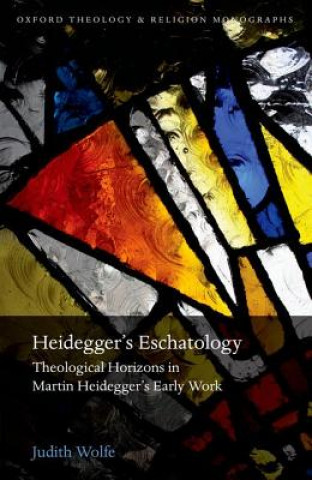
Heidegger's Eschatology
Autor Judith (Tutor in Theology at St John's College in the University of Oxford) Wolfe
Heidegger's Eschatology is a ground-breaking account of Heidegger's early engagement with theology, from his beginnings as an anti-Modernist Catholic to his turn towards an undogmatic Protestantism and finally to a resolutely a-th ... celý popis


- Jazyk:
 Angličtina
 - Vazba: Pevná
- Počet stran: 208
Nakladatelství: Oxford University Press, 2013
- Více informací o knize

3916 Kč
Dostupnost:
50 % šance Máme informaci, že by titul mohl být dostupný. Na základě vaší objednávky se ho pokusíme do 6 týdnů zajistit.
Prohledáme celý svět
Mohlo by se vám také líbit
-

Toppi Gallery
511 Kč -

Very Special Ships
668 Kč -

13 Things Mentally Strong Parents Don't Do
314 Kč -

King Will Come
108 Kč -

Nova express
497 Kč -

La vida infinita : el despertar de la consciencia en una sociedad terminal
546 Kč -

Because You Are Here
742 Kč -

Analyse de l'accès au crédit
1459 Kč -

Social Work, Health, and International Development
7080 Kč -
Handbook of Lexicography
3811 Kč -
Learning from the Impacts of Superstorm Sandy
1576 Kč -

Im Nebel der Zeiten
807 Kč -

Oeuvres Completes: Anatomie, Physiologie, Chirurgie
902 Kč -

Zum positiven Transfer in der Vermittlung der Artikelwoerter in schwedischsprachigen DaF-Lehrwerken
572 Kč
Darujte tuto knihu ještě dnes
- Objednejte knihu a zvolte Zaslat jako dárek.
- Obratem obdržíte darovací poukaz na knihu, který můžete ihned předat obdarovanému.
- Knihu zašleme na adresu obdarovaného, o nic se nestaráte.
Informovat o naskladnění knihy
Zadejte do formuláře e-mailovou adresu a jakmile knihu naskladníme, zašleme vám o tom zprávu. Pohlídáme vše za vás.
Více informací o knize Heidegger's Eschatology
Nákupem získáte 392 bodů
 Anotace knihy
Heidegger's Eschatology is a ground-breaking account of Heidegger's early engagement with theology, from his beginnings as an anti-Modernist Catholic to his turn towards an undogmatic Protestantism and finally to a resolutely a-theistic philosophical method. The book centres on Heidegger's developing commitment to an eschatological vision, derived from theological sources but reshaped into a central resource for the development of an atheistic phenomenological account of human existence. This vision originated in Heidegger's attempt, in the late 1910s, to formulate a phenomenology of religious life that would take seriously the inherent temporality of human existence. In this endeavour, Heidegger turned to two trends in Protestant scholarship: the discovery of eschatology as a central preoccupation of the Early Church by A. Schweitzer and the 'History of Doctrine' School, and the 'existential' eschatology of Karl Barth and Eduard Thurneysen, indebted to Kierkegaard, Dostoevsky, and Franz Overbeck. His synthesis of such trends within a phenomenological framework (elaborated primarily via readings of Paul and Augustine in his lecture courses of 1921-2) led Heidegger to postulate an existential sense of eschatological unrest as the central characteristic of authentic Christian existence. His description of this expectant restlessness, however, was now inescapably at odds with its Christian sources, since Heidegger's commitment to a phenomenological description of the human situation led him to abstract the 'existential' experience of expectation from its traditional object: the 'blessed hope' for the Kingdom of God. Christian hope thus for Heidegger no longer constitutes, but rather negates 'eschatological' unrest, because such hope projects an end to that unrest, and thus to authentic existence itself. Against the Christian vision, Heidegger therefore develops a systematic 'eschatology without eschaton', paradigmatically expressed as 'being-unto-death'. Judith Wolfe tells the story of his re-conception of eschatology, using a wealth of primary and newly available original-language sources, and offering in-depth analysis of Heidegger's relationship to theological tradition and the theology of his time.
Parametry knihy
Zařazení knihy Knihy v angličtině Humanities Philosophy History of Western philosophy
3916 Kč
- Plný název: Heidegger's Eschatology
- Autor: Judith (Tutor in Theology at St John's College in the University of Oxford) Wolfe
- Jazyk: Angličtina
- Vazba: Pevná
- Počet stran: 208
- EAN: 9780199680511
- ISBN: 0199680515
- ID: 02520625
- Nakladatelství: Oxford University Press
- Hmotnost: 382 g
- Rozměry: 219 × 144 × 17 mm
- Datum vydání: 25. July 2013
Oblíbené z jiného soudku
-

Why I Am so Clever
82 Kč -

Meditations
186 Kč -
The Republic
297 Kč -

The Myth of Sisyphus
169 Kč -

Nausea
281 Kč -

Discourses and Selected Writings
235 Kč -

Ride the Tiger
427 Kč -
Letters from a Stoic
226 Kč -

Thus Spoke Zarathustra: A Book for Everyone and No One
235 Kč -
Simulacra and Simulation
470 Kč -
The Nicomachean Ethics
235 Kč -

On the Shortness of Life
178 Kč -

Aphorisms on Love and Hate
98 Kč -

Either/Or
335 Kč -

Phenomenology of Spirit
407 Kč -

Myth of Sisyphus
251 Kč -
City of God
319 Kč -

Existentialism Is a Humanism
224 Kč -

Fear and Trembling
248 Kč -
Intellectual Life
389 Kč -
Symposium
162 Kč -

On the Heights of Despair
732 Kč -
History of Western Philosophy
490 Kč -
Existentialism from Dostoevsky to Sartre
335 Kč -
World as Will and Representation, Vol. 1
458 Kč -
Plato: Five Dialogues
372 Kč -
Joyous Science
282 Kč -

Fear and Trembling and The Sickness Unto Death
379 Kč -

Ecce Homo
244 Kč -
Steps to an Ecology of Mind
690 Kč -

On War
163 Kč -

Jung's Map of the Soul
489 Kč -

Simone Weil: An Anthology
292 Kč -
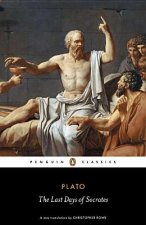
Last Days of Socrates
241 Kč -

World as Will and Representation, Vol. 2
664 Kč -

Thus Spoke Zarathustra
412 Kč -

Art of Travel
276 Kč -
Euthyphro. Apology. Crito. Phaedo
724 Kč -

Thus Spoke Zarathustra
575 Kč -

At The Existentialist Cafe
276 Kč -
Consolations of Philosophy
276 Kč -

Meditations of Marcus Aurelius
196 Kč -
Prolegomena to Any Future Metaphysics
417 Kč -
Aristotle: A Very Short Introduction
260 Kč -
Cynic Philosophers
292 Kč -
New Stoicism
685 Kč -

Kant: A Biography
809 Kč -

Heidegger Explained
491 Kč -
Existentialism and Humanism
261 Kč
Osobní odběr Praha, Brno a 46010 dalších
Copyright ©2008-26 nejlevnejsi-knihy.cz Všechna práva vyhrazenaSoukromíCookies

 Vrácení do měsíce
 571 999 099 (8-15.30h)