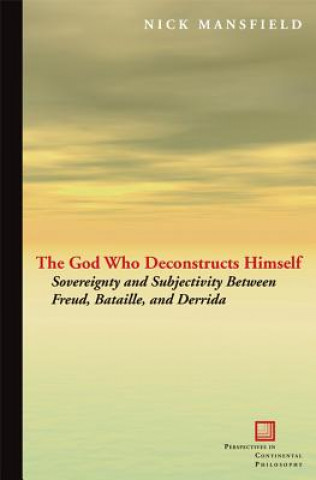
Kód: 04941068
God Who Deconstructs Himself
Autor Nick Mansfield
No topic has caused more discussion in recent philosophy and political theory than sovereignty. From late Foucault to Agamben, and from Guantanamo Bay to the 'war on terror,' the issue of the extent and the nature of the sovereign ... celý popis


- Jazyk:
 Angličtina
 - Vazba: Pevná
- Počet stran: 144
Nakladatelství: Fordham University Press, 2010
- Více informací o knize


Mohlo by se vám také líbit
-
Algebraic Geometry II: Cohomology of Schemes
2074 Kč -
Handbook of Energy Harvesting Power Supplies and Applications
3875 Kč -

Plant galls
723 Kč -

French Phrasebook
421 Kč -
In the House of the Law
877 Kč -

Advances in Critical Flow Dynamics Involving Moving/Deformable Structures with Design Applications
6588 Kč -
Chair Et Langage: Essais Sur Merleau Ponty
1030 Kč
Darujte tuto knihu ještě dnes
- Objednejte knihu a zvolte Zaslat jako dárek.
- Obratem obdržíte darovací poukaz na knihu, který můžete ihned předat obdarovanému.
- Knihu zašleme na adresu obdarovaného, o nic se nestaráte.
Více informací o knize God Who Deconstructs Himself
Nákupem získáte 225 bodů
 Anotace knihy
No topic has caused more discussion in recent philosophy and political theory than sovereignty. From late Foucault to Agamben, and from Guantanamo Bay to the 'war on terror,' the issue of the extent and the nature of the sovereign has given theoretical debates their currency and urgency. New thinking on sovereignty has always imagined the styles of human selfhood that each regime involves. Each denomination of sovereignty requires a specific mode of subjectivity to explain its meaning and facilitate its operation. The aim of this book is to help outline Jacques Derrida's thinking on sovereignty - a theme which increasingly attracted Derrida towards the end of his career - in its relationship to subjectivity. It investigates the late work Rogues: Two Essays on Reason, as not only Derrida's fullest statement of his thinking on sovereignty, but also as the destination of his career-long interest in questions of politics and self-identity. The book argues that in Derrida's thinking of the relationship between sovereignty and subjectivity - and the related themes of unconditionality and ipseity - we can detect the outline of Bataille's adaptation of Freud. Freud completed his 'metapsychology,' by defining the 'economic' nature of subjectivity. In Bataille's hands, this economic theory became a key to the nature of inter-relationship in general, specifically the complex and shifting relationship between subjectivity and power. In playing with Bataille's legacy, Derrida connects not only with the irrepressibly outrageous thinking of philosophy's most self-consciously transgressive thinker, but with the early twentieth century scientific revolution through which 'energy' became ontology. As with so many of the forebears who influenced him, Derrida echoes and adapts Bataille's thinking while radically de-literalising it. The results are crucial for understanding Derrida's views on power, subjectivity and representation, as well as all of the other key themes in late Derrida: hospitality, justice, otherness and the gift.
Parametry knihy
Zařazení knihy Knihy v angličtině Humanities Philosophy History of Western philosophy
2246 Kč
- Plný název: God Who Deconstructs Himself
- Podnázev: Sovereignty and Subjectivity Between Freud, Bataille, and Derrida
- Autor: Nick Mansfield
- Jazyk: Angličtina
- Vazba: Pevná
- Počet stran: 144
- EAN: 9780823232413
- ISBN: 0823232417
- ID: 04941068
- Nakladatelství: Fordham University Press
- Hmotnost: 340 g
- Rozměry: 229 × 152 × 15 mm
- Datum vydání: 15. July 2010
Oblíbené z jiného soudku
-

Why I Am so Clever
66 Kč -

Meditations
177 Kč -
The Myth of Sisyphus
183 Kč -

Nausea
254 Kč -

Ride the Tiger
427 Kč -
The Republic
295 Kč -

Beyond Good and Evil
250 Kč -
Thus Spoke Zarathustra: A Book for Everyone and No One
235 Kč -
Letters from a Stoic
226 Kč -

Existentialism Is a Humanism
224 Kč -
Simulacra and Simulation
482 Kč -
City of God
319 Kč -

Fear and Trembling
248 Kč -
On the Genealogy of Morals
235 Kč -
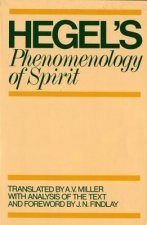
Phenomenology of Spirit
431 Kč -
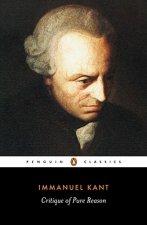
Critique of Pure Reason
365 Kč -
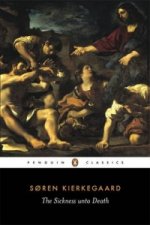
The Sickness Unto Death
248 Kč -
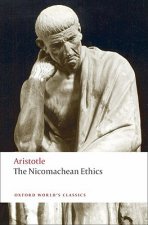
Nicomachean Ethics
205 Kč -
Nicomachean Ethics
144 Kč -
Beyond Good and Evil
358 Kč -
Symposium
162 Kč -
Great Dialogues Of Plato
71 Kč -
How To Be A Stoic
358 Kč -
Early Greek Philosophy
295 Kč -
Symposium
327 Kč -

World as Will and Representation, Vol. 1
458 Kč -

Camera Lucida
235 Kč -

Leviathan
150 Kč -

Schopenhauer
858 Kč -

Complete Works of Aristotle, Volume 2
1455 Kč -
Complete Works of Aristotle, Volume 1
1468 Kč -
How To Read Foucault
392 Kč -

World as Will and Representation, Vol. 2
568 Kč -
Groundwork for the Metaphysics of Morals
225 Kč -

Philosophical Investigations 4e
810 Kč -
Timaeus and Critias
225 Kč -
On Liberty and the Subjection of Women
241 Kč -

Dark Ecology
534 Kč -

Anecdotes of the Cynics
96 Kč -

Selected Writings
303 Kč -

View from Nowhere
1054 Kč -
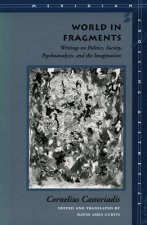
World in Fragments
765 Kč -
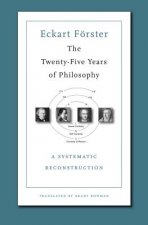
Twenty-Five Years of Philosophy
786 Kč -
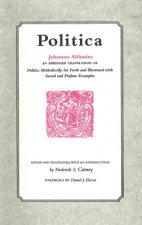
Politica
295 Kč -

Dreamtime
508 Kč -

Humor and the Good Life in Modern Philosophy
945 Kč -

Hegel's Critique of Kant
940 Kč -

Introducing Kierkegaard
221 Kč -
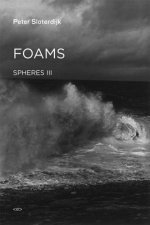
Foams
649 Kč
Osobní odběr Praha, Brno a 46863 dalších
Copyright ©2008-26 nejlevnejsi-knihy.cz Všechna práva vyhrazenaSoukromíCookies

 Vrácení do měsíce
 571 999 099 (8-15.30h)