Kód: 01651424
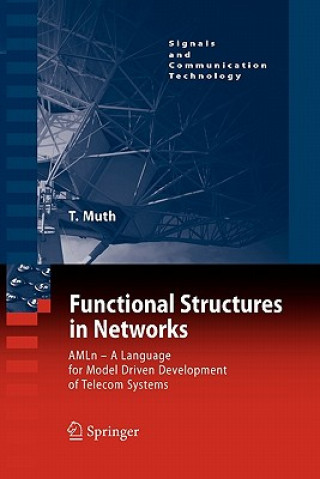
Functional Structures in Networks
Autor Thomas G. Muth
Designed to make life easier for most network designers, whether they are a manager with technical background, work with standardization, the architecture of implementers solutions to standards, product design (constructing the so ... celý popis


- Jazyk:
 Angličtina
 - Vazba: Brožovaná
- Počet stran: 280
Nakladatelství: Springer-Verlag Berlin and Heidelberg GmbH & Co. KG, 2010
- Více informací o knize

2646 Kč

Skladem u dodavatele v malém množství
Odesíláme za 13-18 dnů
Potřebujete více kusů?Máte-li zájem o více kusů, prověřte, prosím, nejprve dostupnost titulu na naši zákaznické podpoře.
Přidat mezi přání
Mohlo by se vám také líbit
-

Vom kleinen Maulwurf, der wissen wollte, wer ihm auf den Kopf gemacht hat
610 Kč -

Hell
303 Kč -

Matika pro spolužáky Planimetrie Pracovní sešit
215 Kč -

Lire et s'entrainer
213 Kč -

Dark Harmony - A Lélektolvaj
294 Kč -

Český jazyk v pohodě 7 - pracovní sešit
145 Kč -

Magirus Kranwagen
951 Kč -

Das Zauberwasser und andere Erzählungen
570 Kč -

Dog Tails
359 Kč -

Hüpf- und Murmelspiele
395 Kč -

Creating Worldviews
1041 Kč -

Dnevnik druge zime
443 Kč -

Seduction of Culture in German History
689 Kč -

Fabulous 50's - Florenza Art Hollycraft
541 Kč -

Genetics of Health
325 Kč -

Winter-Wunder-Weihnachtszeit, 1 Audio-CD
307 Kč -

Historia y santificación del domingo
338 Kč -

Blister - Tarot des lettres hébraïques
621 Kč -

Our Darkness
574 Kč -

Grenzenlos
385 Kč -

Frames of Anime - Culture and Image-Building
637 Kč -

Grown Up Coloring Book 12: Coloring Books for Grownups: Stress Relieving Patterns
154 Kč -

Pimsleur Korean Level 1 CD: Learn to Speak and Understand Korean with Pimsleur Language Programs
5620 Kč -

Manual Hebrew And English Lexicon Including The Biblical Chaldee Designed For Beginners
990 Kč -

Welcome to California
269 Kč -

Ausreiseantrag
207 Kč -

Flughunde
249 Kč -

Big Cash Robbery
197 Kč
Darujte tuto knihu ještě dnes
- Objednejte knihu a zvolte Zaslat jako dárek.
- Obratem obdržíte darovací poukaz na knihu, který můžete ihned předat obdarovanému.
- Knihu zašleme na adresu obdarovaného, o nic se nestaráte.
Více informací o knize Functional Structures in Networks
Nákupem získáte 265 bodů
 Anotace knihy
Designed to make life easier for most network designers, whether they are a manager with technical background, work with standardization, the architecture of implementers solutions to standards, product design (constructing the software and hardware parts of operator networks), system testing, and for operators responsible for the configuration and maintenance of a network. §Develops modeling as a basic principle for producing specifications turns design from being document driven to model-driven. In the context of this book, however, the only model type that is discussed is the information model that describes the purpose, structure, and behavior of a network. §Presents an added-value modeling language that called AMLn (Abstract Modeling Language, network view), which is the first and, so far, the only attempt to create a modeling language for network systems.The book describes a method for creating models of telecom systems. The method is intended for practicing network architects and designers. This method emphasizes modeling the (very complex) functional structure of networks in a way that is independent of any hardware and software design methodology. The method also allows designers to express their model in two main views: a generic view and a system view that takes protocols and network configuration issues into account. The idea is to retain a stable view (the generic) in the context of constant changes and large variations within the system view. The expected benefits are large savings in telecom systems development and maintenance. The terminology is domain unique, i.e., based on de-facto telecom terminology. All concepts that are used in modeling are well defined. The purpose of using a telecom-oriented terminology instead of industry-standard methods for software and protocol design (e.g., UML and SDL) is to be able to create models that are expressive and intelligible for network architects and designers. Models are created as graphical models that show the functional and physical structure of networks at different levels of details. Information on properties, including behavior is attached to the models. A fairly small set of symbols is used in modeling.
Parametry knihy
Zařazení knihy Knihy v angličtině Reference, information & interdisciplinary subjects Research & information: general Information theory
2646 Kč
- Plný název: Functional Structures in Networks
- Podnázev: AMLn - A Language for Model Driven Development of Telecom Systems
- Autor: Thomas G. Muth
- Jazyk: Angličtina
- Vazba: Brožovaná
- Počet stran: 280
- EAN: 9783642061417
- ISBN: 3642061419
- ID: 01651424
- Nakladatelství: Springer-Verlag Berlin and Heidelberg GmbH & Co. KG
- Hmotnost: 456 g
- Rozměry: 235 × 155 × 17 mm
- Datum vydání: 22. October 2010
Oblíbené z jiného soudku
-

The Black Swan
317 Kč -

Linked
540 Kč -

Introduction to Cybernetics
350 Kč -

Cybernetics, Second Edition
548 Kč -

Cybernetic Revolutionaries
764 Kč -

Introduction to Systems Theory
614 Kč -

Deep Simplicity
297 Kč -

Computer and the Brain
404 Kč -

Information Theory
501 Kč -

Brownian Motion, Martingales, and Stochastic Calculus
1315 Kč -

Beautiful Data
720 Kč -

Dynamical System and Chaos
1384 Kč -

Information Theory and Statistics
407 Kč -

Manifolds, Tensor Analysis, and Applications
3297 Kč -

Scheduling
1500 Kč -

Sync
267 Kč -

Human Use Of Human Beings
328 Kč -

Elements of Information Theory
2778 Kč -

Introducing Chaos
205 Kč -

God & Golem, Inc.
937 Kč -

System Identification
4310 Kč -

Recursive Universe
287 Kč -

Cybernetics, Second Edition
686 Kč -

Ethics of Information
1108 Kč -

Problems of Life
376 Kč -

Repair
658 Kč -

Quantum Information Theory
2126 Kč -

Optimal Control Theory
703 Kč -

Systems and Models. Complexity, Dynamics, Evolution, Sustainability
532 Kč -

Turtles, Termites, and Traffic Jams
1088 Kč -

Programmed Visions
727 Kč -

Chaos theory in Psychology and the Life Sciences
1956 Kč -

Riccati Equation
2533 Kč -

Fault Tolerant Control Design for Hybrid Systems
2646 Kč -

System Identification 2e - A Frequency Domain Approach
3907 Kč -

Bioinformatics: An Introduction
2357 Kč -

System Identification, Environmental Modelling, and Control System Design
3532 Kč -

General Systems Theory: Problems, Perspectives, Practice
3408 Kč -

Social Life of Information
597 Kč -

Mathematical Foundations of Information Theory
208 Kč -

Numerical Optimization
1155 Kč -

Linear Robust Control
524 Kč -

Information, Entropy, Life And The Universe: What We Know And What We Do Not Know
732 Kč -

Cybernetics and Systems Theory in Management
4312 Kč -

Cybernetics or Control and Communication in the Animal and the Machine
1035 Kč -

First Course in Network Theory
1169 Kč -

Computational Beauty of Nature
1499 Kč -

Principles of Systems Science
1729 Kč -

Brownian Motion, Martingales, and Stochastic Calculus
1315 Kč
Osobní odběr Praha, Brno a 46026 dalších
Copyright ©2008-26 nejlevnejsi-knihy.cz Všechna práva vyhrazenaSoukromíCookies

 Vrácení do měsíce
 571 999 099 (8-15.30h)