Kód: 54580484
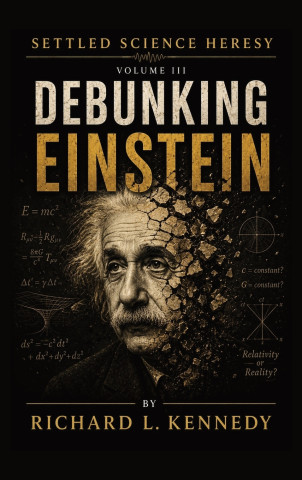
Debunking Einstein
Autor Richard L. Kennedy
In 1919, photographs of stars near the eclipsed Sun helped make Albert Einstein the most celebrated scientist of his age. What did those photographs show? And how did a disputed measurement become a public verdict?In Debunking Ein ... celý popis


- Jazyk:
 Angličtina
- Vazba: Pevná
- Počet stran: 156
Nakladatelství: Richard L. Kennedy, 2026
- Více informací o knize


Mohlo by se vám také líbit
-

Cozy Countdown: An Advent Coloring Book Bundle
503 Kč -

Threshing Day (Limited Deluxe Edition)
455 Kč -

Court of Thorns and Roses 6
348 Kč -

Murdoku
327 Kč -

White Nights
81 Kč -

A Conspiracy of Charming Monsters
454 Kč -

A Conspiracy of Charming Monsters
276 Kč -

The End of Everything
276 Kč -

Once Upon a Broken Heart Collector's Edition
630 Kč -

Trust Fall
227 Kč -

I'll Believe in Anything. The Making of Heated Rivalry Season 1
455 Kč -

Berserk Deluxe Volume 1
902 Kč -

Protocols
293 Kč -

Jojo's Bizarre Adventure: Part 7--Steel Ball Run, Vol. 9
438 Kč -

Chainsaw Man, Vol. 22
216 Kč -
The Mirror of Infinite Endings
438 Kč -

Murdoku Volume 2: Back in Time
327 Kč -

The Long-Lived King: An Original The Owl House Graphic Novel
385 Kč -

Witch Hat Atelier: Grimoire Edition 3
1582 Kč -

Threshing Day (Wing and Claw Collection)
453 Kč -

21 Days of Fear
395 Kč
Darujte tuto knihu ještě dnes
- Objednejte knihu a zvolte Zaslat jako dárek.
- Obratem obdržíte darovací poukaz na knihu, který můžete ihned předat obdarovanému.
- Knihu zašleme na adresu obdarovaného, o nic se nestaráte.
Více informací o knize Debunking Einstein
Nákupem získáte 50 bodů
 Anotace knihy

In 1919, photographs of stars near the eclipsed Sun helped make Albert Einstein the most celebrated scientist of his age. What did those photographs show? And how did a disputed measurement become a public verdict?
In Debunking Einstein, Volume 3 of Settled Science Heresy, Richard L. Kennedy reopens the case. He takes readers to the eclipse expeditions on Príncipe and in Brazil, where astronomers set out to see whether starlight passing near the Sun appeared to shift by the amount Einstein predicted. Follow the evidence from the photographic plates to the newspaper headlines and see how the uncertainties in the measurements gave way to a story of scientific revolution.
The eclipse is the first exhibit. Kennedy traces the gravitational constant back to Henry Cavendish's experiment with lead balls, which set out to determine the density of Earth. He follows Einstein's reasoning to the squared speed of light in E = mc² and asks what the equation tells us about the relationship between matter and energy. Then he takes up one of the strangest pictures to emerge from relativity, a block universe in which the day you were born, the moment you are reading this, and the last day of your life all belong to the same spacetime structure.
The inquiry turns from the history of relativity to things you can picture and, in some cases, watch for yourself. Sand gathers into patterns on a vibrating plate. A collapsing bubble gives off a flash of light. Electrons arrive one at a time, leaving dots that build into bands on a screen. Add detectors to tell which slit the electrons pass through, and the bands disappear. Each example gives the reader a concrete way to consider how motion produces patterns and how the way we observe an experiment affects what we see.
These examples lead to Kennedy's own account of time. A clock gives us two readings. Between them, your heart beats, a car passes, and a cloud crosses the sky. The readings give us points of reference. Kennedy argues that the changes themselves are what make up time.
The Royal Society's motto, Nullius in verba, gives the book its guiding instruction. Take nobody's word for it. Here is the evidence. What would your verdict be?
Parametry knihy
499 Kč
- Plný název: Debunking Einstein
- Autor: Richard L. Kennedy
- Jazyk: Angličtina
- Vazba: Pevná
- Počet stran: 156
- EAN: 9798183162066
- ID: 54580484
- Nakladatelství: Richard L. Kennedy
- Hmotnost: 382 g
- Rozměry: 229 × 152 × 11 mm
- Datum vydání: 18. November 2026
Osobní odběr Praha, Brno a 48091 dalších
Copyright ©2008-26 nejlevnejsi-knihy.cz Všechna práva vyhrazenaSoukromíCookies

 Vrácení do měsíce
 571 999 099 (8-15.30h)
