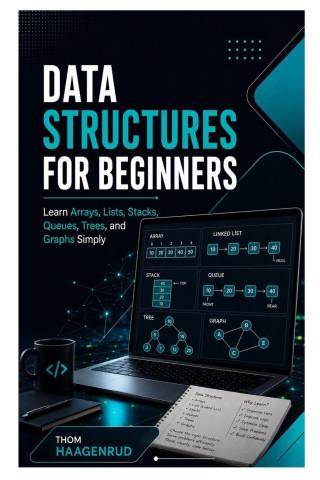
Kód: 53370831
Data Structures for Beginners
Autor Thom Haagenrud
Do you want to understand data structures without getting lost in abstract theory, confusing diagrams, or code examples you cannot explain?Data Structures for Beginners is a practical, beginner-friendly guide to learning how progr ... celý popis


- Jazyk:
 Angličtina
 - Vazba: Brožovaná
- Počet stran: 246
Nakladatelství: Independently published, 2026
- Více informací o knize


Mohlo by se vám také líbit
-

Moonwalk
263 Kč -

Berserk Deluxe Volume 1
803 Kč -

Murdoku
329 Kč -

Threshing Day (Wing and Claw Collection)
439 Kč -

The Score
262 Kč -

Berserk Deluxe Volume 2
917 Kč -

The Mistake
243 Kč -

Berserk Deluxe Volume 3
781 Kč -

Dancing The Dream
597 Kč -

White Nights
95 Kč -

Threshing Day (Limited Deluxe Edition)
488 Kč -

The Deal
252 Kč -

Jujutsu Kaisen, Vol. 30
220 Kč -
Kid's Box New Generation Level 2 Activity Book with Digital Pack British English
265 Kč -

Murdoku Volume 2: Back in Time
325 Kč -

Onyx Storm (Deluxe Limited Edition) (The Empyrean, 3)
525 Kč -

The Odyssey
318 Kč -

Jujutsu Kaisen, Vol. 26
240 Kč -
Kid's Box New Generation Level 2 Pupil's Book with eBook British English
432 Kč -

Berserk Deluxe Volume 5
781 Kč -

Witch Hat Atelier: Grimoire Edition 2
854 Kč
Darujte tuto knihu ještě dnes
- Objednejte knihu a zvolte Zaslat jako dárek.
- Obratem obdržíte darovací poukaz na knihu, který můžete ihned předat obdarovanému.
- Knihu zašleme na adresu obdarovaného, o nic se nestaráte.
Informovat o naskladnění knihy
Zadejte do formuláře e-mailovou adresu a jakmile knihu naskladníme, zašleme vám o tom zprávu. Pohlídáme vše za vás.
Více informací o knize Data Structures for Beginners
Nákupem získáte 42 bodů
 Anotace knihy
Do you want to understand data structures without getting lost in abstract theory, confusing diagrams, or code examples you cannot explain?
Data Structures for Beginners is a practical, beginner-friendly guide to learning how programs organize information, choose efficient operations, and use the right structure for the right problem. Written for beginners, students, career switchers, self-taught programmers, working developers reviewing fundamentals, and interview candidates, this book teaches data structures through clear explanations, Python examples, operation costs, trade-offs, testing, and a complete capstone project.
Instead of presenting data structures as definitions to memorize, this book teaches them as engineering decisions. You will learn how each structure stores information, which operations it supports well, where it can fail, how performance changes as input grows, and when a standard library collection is usually the better practical choice.
The book follows a practical learning sequence. You begin with problem definition, operations, invariants, references, and Big O. Then you study linear structures such as arrays, linked lists, stacks, queues, and deques. From there, you move into recursion, binary trees, binary search trees, heaps, hash tables, dictionaries, sets, graphs, traversal, shortest paths, and structure-selection decisions.
Python is used for the examples because it keeps the focus on structure and behavior rather than heavy syntax. You will implement educational versions of linked lists, stacks, queues, trees, search trees, heaps, and graphs while also learning when Python's built-in types and standard-library collections are the stronger practical choice.
The examples are built around realistic problems: organizing student records, finding duplicate usernames, tracking daily sales, building a music playlist, checking balanced symbols, implementing undo and redo, processing customer requests, representing an organization, maintaining a scoreboard, scheduling support tickets, counting word frequencies, removing duplicates, modeling transport networks, modeling course prerequisites, and finding routes.
The capstone project brings the book together in a complete Help-Desk Ticket System. You will combine direct lookup, FIFO processing, priority scheduling, undo history, dependency tracking, searching, reporting, validation, error handling, testing, and complexity review into one integrated beginner-friendly application.
This book also teaches practical engineering judgment. You will learn to ask which operations dominate, what must remain true after every update, how the design behaves as input grows, whether memory trade-offs are justified, which invariants need testing, and which standard structure already solves the problem safely.
No formal computer-science background or advanced mathematics is required. You should understand variables, basic data types, conditionals, loops, functions, and simple Python lists. Classes, recursion, complexity notation, trees, heaps, hash tables, and graph terminology are introduced before they are used heavily.
Whether you are preparing for coursework, strengthening weak fundamentals, learning Python-based computer science, preparing for technical interviews, or trying to understand how real software chooses structures, this book gives you a structured path into data structures without unnecessary confusion.
Stop memorizing names and diagrams without knowing when to use them. Learn arrays, lists, stacks, queues, trees, heaps, hash tables, graphs, traversal, shortest paths, testing, and structure selection through examples that show how each decision affects correctness, speed, memory, and maintainability.
Parametry knihy
416 Kč
- Plný název: Data Structures for Beginners
- Podnázev: Learn Arrays, Lists, Stacks, Queues, Trees, and Graphs Simply
- Autor: Thom Haagenrud
- Jazyk: Angličtina
- Vazba: Brožovaná
- Počet stran: 246
- EAN: 9798189505140
- ID: 53370831
- Nakladatelství: Independently published
- Hmotnost: 304 g
- Rozměry: 229 × 152 × 16 mm
- Datum vydání: 28. July 2026
Osobní odběr Praha, Brno a 48102 dalších
Copyright ©2008-26 nejlevnejsi-knihy.cz Všechna práva vyhrazenaSoukromíCookies

 Vrácení do měsíce
 571 999 099 (8-15.30h)