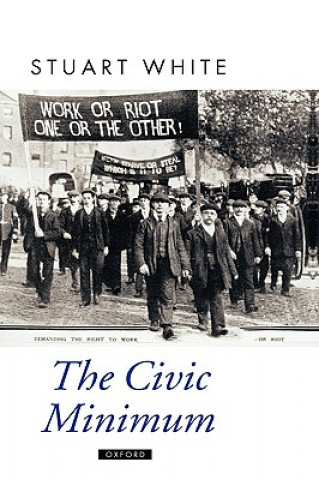
Kód: 04525259
Civic Minimum
Autor Stuart White
Many governments today are engaged in far-reaching programs of 'welfare reform'. But what would a just program of welfare reform consist in? Is the current emphasis on linking welfare 'rights' to 'responsibilities' justifiable? In ... celý popis


- Jazyk:
 Angličtina
 - Vazba: Pevná
- Počet stran: 300
Nakladatelství: Oxford University Press, 2003
- Více informací o knize


Mohlo by se vám také líbit
-

One-Punch Man, Vol. 4
221 Kč -

Goblin Emperor
248 Kč -

Vermeer. The Complete Works
1688 Kč -

Management 3.0
1100 Kč -

Rising Of The Shield Hero Volume 16: The Manga Companion
473 Kč -

Zdraví náš životní úděl
134 Kč -

Pete the Cat Gets Groovy Doll: 14
445 Kč -

Life, Letters, and Epicurean Philosophy of Ninon de L'Enclos
437 Kč -

Financial Risk Manager Handbook+ Test Bank, 6e - FRM (R) Part I/Part II
3656 Kč -

Air Ministry Pilot's Notes
172 Kč -

Fantastic Four By Waid & Wieringo Ultimate Collection Book 2
543 Kč -

God, Are You There?: Understanding God's Character and How He Interacts With Us
217 Kč -

Endocrine Self-Assessment Program Questions, Answers, and Discussions (ESAP 2023)
2813 Kč -

Patrick Modiano
3971 Kč -

I'm a Duck
302 Kč -

The History and Chronicles of Scotland; Volume 1
903 Kč -

Clinical Manual for Treatment of Schizophrenia
2074 Kč -

North Fork, Glacier National Park
218 Kč -

They Who Understand (1919)
619 Kč -

Reinsurance Reference Guide 2012 Edition
952 Kč -

Les recettes culte - Tokyo
374 Kč -

Jake & The Giant (The Gryphon Chronicles, Book 2)
686 Kč -

Planet Obesity
415 Kč -

Dictionary of Literary Biography
13428 Kč -

Comparaison et modernisation du droit à l'aube du XXIe siècle
863 Kč -

Theory of Nuclear Magnetic Relaxation in Liquids
1476 Kč -

Iris Murdoch
2646 Kč -

Advances in Materials Science Research
6361 Kč
Darujte tuto knihu ještě dnes
- Objednejte knihu a zvolte Zaslat jako dárek.
- Obratem obdržíte darovací poukaz na knihu, který můžete ihned předat obdarovanému.
- Knihu zašleme na adresu obdarovaného, o nic se nestaráte.
Více informací o knize Civic Minimum
Nákupem získáte 318 bodů
 Anotace knihy
Many governments today are engaged in far-reaching programs of 'welfare reform'. But what would a just program of welfare reform consist in? Is the current emphasis on linking welfare 'rights' to 'responsibilities' justifiable? In this book, Stuart White reconsiders the principles of economic citizenship appropriate to a democratic society, and explores the radical implications of these principles for public policy. According to White, justice demands that economic cooperation satisfy a standard of 'fair reciprocity'. Against a background of institutions that are sufficiently just in other respects, those citizens who share in the social product have an obligation to make a productive contribution back to the community in return: every citizen should 'do her bit'. While prominent in the work of many past egalitarian thinkers, this duty to contribute has not received much attention in recent political theory. White seeks to redress this neglect, and to show why and how the claims of reciprocity should be integrated with other important concerns that have featured more prominently in recent literature. These include the concerns to prevent brute luck disadvantage and economic vulnerability. From the standpoint of fair reciprocity, it is not necessarily unjust to link welfare rights with the performance of work-related responsibilities. But the justice of such a linkage depends on how far economic institutions meet other requirements of justice. In policy terms, fair reciprocity thus calls for a generous 'civic minimum' in which work-related welfare benefits are complemented by other policies designed to prevent poverty and vulnerability, secure opportunity for meaningful work, and eliminate class-based inequalities in educational opportunity and inherited wealth. In concluding, White contests the fashionable view that egalitarian reform is unfeasible in contemporary circumstances. The philosophy of fair reciprocity provides the basis for a new public conversation about economic citizenship, in which all citizens - not just those currently amongst the welfare poor - are encouraged to confront their responsibility to others.
Parametry knihy
Zařazení knihy Knihy v angličtině Society & social sciences Politics & government Political control & freedoms
3179 Kč
- Plný název: Civic Minimum
- Podnázev: On the Rights and Obligations of Economic Citizenship
- Autor: Stuart White
- Jazyk: Angličtina
- Vazba: Pevná
- Počet stran: 300
- EAN: 9780198295051
- ISBN: 0198295057
- ID: 04525259
- Nakladatelství: Oxford University Press
- Hmotnost: 572 g
- Rozměry: 243 × 166 × 23 mm
- Datum vydání: 20. February 2003
Oblíbené z jiného soudku
-

How Propaganda Works
334 Kč -

Doing Democracy
358 Kč -

Freedom
721 Kč -

International Human Rights Lexicon
1496 Kč -

Propaganda
341 Kč -

On Liberty And Utilitarianism
336 Kč -

Re-enchanting The World
379 Kč -

Natural Right and History
454 Kč -

Anatomy of the State
256 Kč -

From a Native Daughter
679 Kč -

The Gulag Archipelago
317 Kč -

Red Horizons
442 Kč -

Constructing Cassandra
876 Kč -

On Liberty
248 Kč -

Cultural Cold War
555 Kč -

Anarchy
193 Kč -

Public Diplomacy - Foundations for Global Engagement in the Digital Age
536 Kč -

Nothing To Envy
235 Kč -
Political Philosophy: A Very Short Introduction
236 Kč -

Security and Human Rights in Eastern Europe: New Empirical and Conceptual Perspectives on Conflict Resolution and Accountability
648 Kč -

Straight State
641 Kč -

In Order To Live
260 Kč -

The Gulag Archipelago, 1918-1956
381 Kč -
The Gulag Archipelago, 1918-1956
381 Kč -

International Law: A Very Short Introduction
225 Kč -

Victory Lab
342 Kč -
Anatomy of the State
367 Kč -

Gift of Love
227 Kč -

Fire Next Time
202 Kč -

Understanding Ukraine
370 Kč -

Liberal Virus
514 Kč -
Understanding Power
380 Kč -

Suffragettes
82 Kč -

Media Control - Post-9/11 Edition
363 Kč -

Autobiography Of Martin Luther King, Jr
317 Kč -

Creating Capabilities
475 Kč -

Handbook of Tyranny
713 Kč -

Summary of Propaganda by Edward Bernays
128 Kč -

Migrations And Cultures
690 Kč -

The Net Delusion
275 Kč -

Domination and the Arts of Resistance
511 Kč -

Parkland: Birth of a Movement
426 Kč -

Dear Leader
424 Kč -

Manufacture of Madness
334 Kč -

Malcolm X Speaks
275 Kč -

Free Speech
380 Kč -

Power of the Powerless
1428 Kč -

Engineers Of The Soul
604 Kč -

Argentina and the Jews
875 Kč
Osobní odběr Praha, Brno a 47529 dalších
Copyright ©2008-26 nejlevnejsi-knihy.cz Všechna práva vyhrazenaSoukromíCookies

 Vrácení do měsíce
 571 999 099 (8-15.30h)