Kód: 20403397
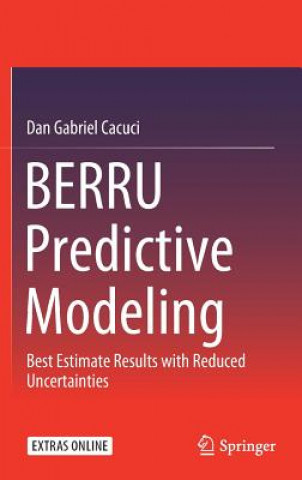
BERRU Predictive Modeling
Autor Dan Gabriel Cacuci
This book addresses the experimental calibration of best-estimate numerical simulation models. The results of measurements and computations are never exact. Therefore, knowing only the nominal values of experimentally measured or ... celý popis


- Jazyk:
 Angličtina
 - Vazba: Pevná
- Počet stran: 451
Nakladatelství: Springer-Verlag Berlin and Heidelberg GmbH & Co. KG, 2019
- Více informací o knize


Mohlo by se vám také líbit
-

Python for Data Analysis 3e
1268 Kč -

Minimalistický fotograf
224 Kč -

Puzzle 2D 3000 Panowanie smoków 16462
880 Kč -

Antibiotic Pharmacokinetic/Pharmacodynamic Considerations in the Critically Ill
1958 Kč -

Familles Des Plantes, Part 1: Contenant Une Preface Istorike Sur L'Etat Ancien Et Actuel De La Botanike, Et Une Teorie De Cette Science (1763)
830 Kč
Darujte tuto knihu ještě dnes
- Objednejte knihu a zvolte Zaslat jako dárek.
- Obratem obdržíte darovací poukaz na knihu, který můžete ihned předat obdarovanému.
- Knihu zašleme na adresu obdarovaného, o nic se nestaráte.
Více informací o knize BERRU Predictive Modeling
Nákupem získáte 400 bodů
 Anotace knihy
This book addresses the experimental calibration of best-estimate numerical simulation models. The results of measurements and computations are never exact. Therefore, knowing only the nominal values of experimentally measured or computed quantities is insufficient for applications, particularly since the respective experimental and computed nominal values seldom coincide. In the author's view, the objective of predictive modeling is to extract "best estimate" values for model parameters and predicted results, together with "best estimate" uncertainties for these parameters and results. To achieve this goal, predictive modeling combines imprecisely known experimental and computational data, which calls for reasoning on the basis of incomplete, error-rich, and occasionally discrepant information. The customary methods used for data assimilation combine experimental and computational information by minimizing an a priori, user-chosen, "cost functional" (usually a quadratic functional that represents the weighted errors between measured and computed responses). In contrast to these user-influenced methods, the BERRU (Best Estimate Results with Reduced Uncertainties) Predictive Modeling methodology developed by the author relies on the thermodynamics-based maximum entropy principle to eliminate the need for relying on minimizing user-chosen functionals, thus generalizing the "data adjustment" and/or the "4D-VAR" data assimilation procedures used in the geophysical sciences. The BERRU predictive modeling methodology also provides a "model validation metric" which quantifies the consistency (agreement/disagreement) between measurements and computations. This "model validation metric" (or "consistency indicator") is constructed from parameter covariance matrices, response covariance matrices (measured and computed), and response sensitivities to model parameters. Traditional methods for computing response sensitivities are hampered by the "curse of dimensionality," which makes them impractical for applications to large-scale systems that involve many imprecisely known parameters. Reducing the computational effort required for precisely calculating the response sensitivities is paramount, and the comprehensive adjoint sensitivity analysis methodology developed by the author shows great promise in this regard, as shown in this book. After discarding inconsistent data (if any) using the consistency indicator, the BERRU predictive modeling methodology provides best-estimate values for predicted parameters and responses along with best-estimate reduced uncertainties (i.e., smaller predicted standard deviations) for the predicted quantities. Applying the BERRU methodology yields optimal, experimentally validated, "best estimate" predictive modeling tools for designing new technologies and facilities, while also improving on existing ones.
Parametry knihy
4002 Kč
- Plný název: BERRU Predictive Modeling
- Podnázev: Best Estimate Results with Reduced Uncertainties
- Autor: Dan Gabriel Cacuci
- Jazyk: Angličtina
- Vazba: Pevná
- Počet stran: 451
- EAN: 9783662583937
- ID: 20403397
- Nakladatelství: Springer-Verlag Berlin and Heidelberg GmbH & Co. KG
- Hmotnost: 863 g
- Rozměry: 235 × 155 × 31 mm
- Datum vydání: 12. January 2019
Oblíbené z jiného soudku
-

Moonwalk
261 Kč -

The Score
337 Kč -

The Deal
285 Kč -

The Mistake
285 Kč -

Jujutsu Kaisen, Vol. 30
240 Kč -

Witch Hat Atelier: Grimoire Edition 1
777 Kč -

Invincible Compendium Volume 2
1168 Kč -

Berserk Deluxe Volume 1
805 Kč -

Invincible Compendium Volume 1
1108 Kč -

The Goal
321 Kč -

Berserk Deluxe Volume 2
863 Kč -

Witch Hat Atelier Manga Box Set 1
1268 Kč -

Heated Rivalry
227 Kč -

Jujutsu Kaisen, Vol. 25
240 Kč -

Lord of Mysteries, Vol. 3: The Clown, Part III
355 Kč -

Jujutsu Kaisen, Vol. 26
240 Kč -

Moonwalk: A Memoir
525 Kč -

Jujutsu Kaisen, Vol. 29
240 Kč -

Invincible Compendium Volume 3
1108 Kč -

Murdoku
358 Kč -

Berserk Deluxe Volume 3
805 Kč -

White Nights
89 Kč -

King of Gluttony
229 Kč -

Veil Volume 1
292 Kč -

The Deal
319 Kč -

The Long Game
227 Kč -

Invincible Volume 1
242 Kč -

JoJo's Bizarre Adventure: Part 7--Steel Ball Run, Vol. 7
432 Kč -

Legacy
248 Kč -

Starside (Deluxe Limited Edition)
582 Kč -

Project Hail Mary
208 Kč -

Berserk Deluxe Volume 5
782 Kč -

Jojo's Bizarre Adventure: Part 7--Steel Ball Run, Vol. 1
442 Kč -

Berserk Deluxe Volume 4
854 Kč -

Jojo's Bizarre Adventure: Part 7--Steel Ball Run, Vol. 2
442 Kč -

Dancing The Dream
522 Kč -

Jujutsu Kaisen, Vol. 28
226 Kč -

Boys Omnibus Vol. 1 TPB
614 Kč -

Murdoku
309 Kč -

The Summer Hikaru Died, Vol. 7
272 Kč -

Veil Volume 2
362 Kč -

The Ballad of Falling Dragons
275 Kč -

Chainsaw Man, Vol. 20
240 Kč -

Project Hail Mary
380 Kč -

Yesteryear
370 Kč -

The Score
319 Kč -

Jujutsu Kaisen, Vol. 1
244 Kč -

Lord of Mysteries, Vol. 1: The Clown, Part I
340 Kč -

Invincible Volume 2 (New Edition)
275 Kč
Osobní odběr Praha, Brno a 47484 dalších
Copyright ©2008-26 nejlevnejsi-knihy.cz Všechna práva vyhrazenaSoukromíCookies

 Vrácení do měsíce
 571 999 099 (8-15.30h)