Kód: 53611290
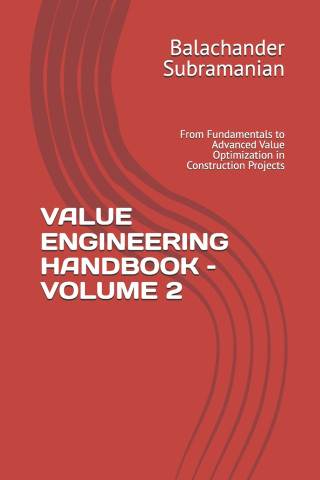
VALUE ENGINEERING HANDBOOK - VOLUME 2
Autor Balachander Subramanian
Value Engineering has evolved significantly from its traditional perception as a cost-reduction exercise. In modern construction and infrastructure projects, Value Engineering is increasingly a structured discipline for improving ... celý popis


- Jazyk:
 Angličtina
 - Vazba: Brožovaná
- Počet stran: 786
Nakladatelství: Independently published, 2026
- Více informací o knize


Mohlo by se vám také líbit
-

Murdoku
309 Kč -

Threshing Day (Wing and Claw Collection)
400 Kč -

Berserk Deluxe Volume 1
879 Kč -

Threshing Day (Limited Deluxe Edition)
473 Kč -

White Nights
89 Kč -

The Odyssey
321 Kč -

Berserk Deluxe Volume 2
943 Kč -

Kid's Box New Generation Level 2 Activity Book with Digital Pack British English
251 Kč -

Onyx Storm (Deluxe Limited Edition) (The Empyrean, 3)
552 Kč -

Berserk Deluxe Volume 3
805 Kč -

Fourth Wing
527 Kč -

Iron Flame
527 Kč -

What Happened Yesterday
371 Kč -

Dancing The Dream
482 Kč -

The Score
237 Kč -

Needoh - Nice Cube (random colours)
191 Kč -

Kid's Box New Generation Level 3 Activity Book with Digital Pack British English
251 Kč -

The Count of Monte Cristo
232 Kč -

Moonwalk
270 Kč -

Murdoku Volume 2: Back in Time
309 Kč -

Jujutsu Kaisen, Vol. 26
220 Kč
Dárkový poukaz: Radost zaručena
- Darujte poukaz v libovolné hodnotě a my se postaráme o zbytek.
- Poukaz se vztahuje na celou naši nabídku.
- Elektronický poukaz vytisknete z e-mailu a můžete ihned darovat.
- Platnost poukazu je 12 měsíců od data vystavení.
Více informací o knize VALUE ENGINEERING HANDBOOK - VOLUME 2
Nákupem získáte 86 bodů
 Anotace knihy
Value Engineering has evolved significantly from its traditional perception as a cost-reduction exercise. In modern construction and infrastructure projects, Value Engineering is increasingly a structured discipline for improving function, performance, cost, quality, constructability, schedule, risk, sustainability, reliability, maintainability, and whole-life value.
This second volume of the Value Engineering Handbook is designed around that broader understanding of value.
The fundamental question addressed throughout this volume is not simply:
How can the project be made cheaper?
It is:
How can the required project functions and outcomes be delivered with the optimum combination of cost, performance, quality, risk, schedule, constructability, sustainability, maintainability, and lifecycle value?
This distinction is fundamental.
A project can achieve a lower construction cost and still destroy value if the reduction results in lower reliability, higher maintenance, reduced durability, increased operational expenditure, longer delivery time, greater safety exposure, or unacceptable operational risk. Conversely, an alternative that requires slightly higher initial investment may create substantially greater value if it reduces lifecycle cost, improves reliability, shortens construction, reduces operational disruption, or strengthens resilience.
The book therefore treats Value Engineering as a decision-making and optimization discipline, rather than merely a mechanism for reducing the project budget.
The volume begins with Risk-Based Value Engineering, recognizing that every VE alternative is developed under uncertainty. A proposed alternative may generate capital savings or productivity improvements while simultaneously introducing technical, procurement, construction, operational, safety, or lifecycle risks. The book consequently extends the traditional relationship of cost, function, and performance to include schedule, risk, quality, constructability, lifecycle considerations, sustainability, and stakeholder value.
This risk-based perspective is particularly important for major projects. The volume demonstrates how alternatives can be evaluated using probability and consequence, risk-adjusted value, lifecycle cost, weighted evaluation, risk mitigation, residual risk, and quantitative techniques such as scenario analysis, sensitivity analysis, expected monetary value, decision trees, and Monte Carlo simulation.
The next major focus is Value Engineering during Project Planning.
This is one of the most strategically important stages because decision flexibility is still high and the cost of changing fundamental decisions is comparatively low. The book emphasizes that early VE can influence project scope, capacity, site selection, configuration, structural systems, MEP systems, procurement strategy, construction methodology, phasing, logistics, sustainability, and operational requirements.
The principle is simple:
Early Value Engineering influences systems; late Value Engineering usually influences components.
This is why the book treats VE as a continuous process rather than a single workshop conducted after design development.
The volume then follows Value Engineering through the major stages of project development:
- Project planning
- Concept design
- Detailed design
- Procurement
- Construction
- Commissioning and handover
- Structural Engineering Value Engineering
- Architectural Value Engineering
- Mechanical Systems Value Engineering
- Electrical Systems Value Engineering
- Civil and Infrastructure Value Engineering
- MEP Coordination and Systems Integration
- Materials and Product Substitution
Parametry knihy
857 Kč
- Plný název: VALUE ENGINEERING HANDBOOK - VOLUME 2
- Podnázev: From Fundamentals to Advanced Value Optimization in Construction Projects
- Autor: Balachander Subramanian
- Jazyk: Angličtina
- Vazba: Brožovaná
- Počet stran: 786
- EAN: 9798194165247
- ID: 53611290
- Nakladatelství: Independently published
- Hmotnost: 1033 g
- Rozměry: 229 × 152 × 40 mm
- Datum vydání: 22. August 2026
Osobní odběr Praha, Brno a 47518 dalších
Copyright ©2008-26 nejlevnejsi-knihy.cz Všechna práva vyhrazenaSoukromíCookies

 Vrácení do měsíce
 571 999 099 (8-15.30h)