Kód: 53328334
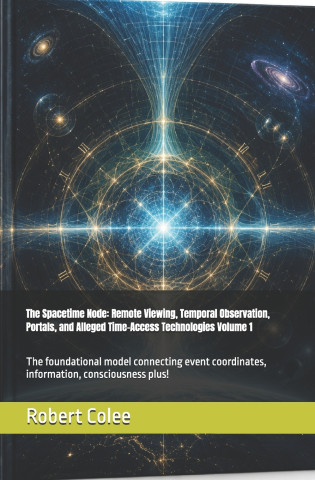
The Spacetime Node
Autor Robert Colee
A better term than "time node""Time node" is a useful starting expression, but I recommend a more precise term:Spacetime Information AddressA spacetime information address would identify an event through a multidimensional set of ... celý popis


- Jazyk:
 Angličtina
 - Vazba: Brožovaná
- Počet stran: 288
Nakladatelství: Independently published, 2026
- Více informací o knize


Mohlo by se vám také líbit
-

Moonwalk
263 Kč -

Berserk Deluxe Volume 1
862 Kč -

The Score
243 Kč -

Murdoku
334 Kč -

Threshing Day (Wing and Claw Collection)
439 Kč -

The Mistake
243 Kč -

Berserk Deluxe Volume 2
941 Kč -

The Deal
276 Kč -

Jujutsu Kaisen, Vol. 30
220 Kč -

White Nights
95 Kč -

Dancing The Dream
517 Kč -

Berserk Deluxe Volume 3
781 Kč -

Threshing Day (Limited Deluxe Edition)
488 Kč -

The Goal
253 Kč -

Jujutsu Kaisen, Vol. 26
240 Kč -

Onyx Storm (Deluxe Limited Edition) (The Empyrean, 3)
525 Kč -

Kid's Box New Generation Level 2 Activity Book with Digital Pack British English
265 Kč -

Berserk Deluxe Volume 5
781 Kč -

Chainsaw Man, Vol. 21
240 Kč -

Jujutsu Kaisen, Vol. 29
225 Kč -

Murdoku Volume 2: Back in Time
329 Kč
Dárkový poukaz: Radost zaručena
- Darujte poukaz v libovolné hodnotě a my se postaráme o zbytek.
- Poukaz se vztahuje na celou naši nabídku.
- Elektronický poukaz vytisknete z e-mailu a můžete ihned darovat.
- Platnost poukazu je 12 měsíců od data vystavení.
Informovat o naskladnění knihy
Zadejte do formuláře e-mailovou adresu a jakmile knihu naskladníme, zašleme vám o tom zprávu. Pohlídáme vše za vás.
Více informací o knize The Spacetime Node
Nákupem získáte 48 bodů
 Anotace knihy
A better term than "time node"
"Time node" is a useful starting expression, but I recommend a more precise term:
Spacetime Information Address
A spacetime information address would identify an event through a multidimensional set of coordinates:
A=A = {x,y,z,t,R,O,S,C\}A=
where:
- x,y,zx,y,zx,y,z identify spatial position;
- ttt identifies temporal position;
- RRR identifies the relevant reference frame;
- OOO describes the observer or observation conditions;
- SSS identifies the desired physical or informational state;
- CCC represents contextual information needed to distinguish the event from similar events.
An event may not merely disappear after it occurs. It may remain encoded in the causal and informational structure of the universe, while access to it depends on correctly addressing, resolving, and reconstructing that information.
That statement is a research hypothesis, not an established scientific conclusion.
Other names we could use include:
- event coordinate;
- temporal reference node;
- worldline address;
- spacetime resonance coordinate;
- causal-state address;
- consciousness-access coordinate;
- holographic event index.
2. The first essential distinction: seeing is not traveling
Much confusion disappears when the subject is divided into four different technological objectives.
Mode I: Temporal observation
The operator receives information about a past, future, or distant event but does not physically enter it.
Examples associated with this category include:
- remote viewing;
- precognition;
- the alleged Chronovisor;
- Project Looking Glass accounts;
- reconstructed historical imagery;
- quantum or computational prediction.
Mode II: Consciousness projection
The observer reports that awareness, perception, or a nonphysical aspect of identity moves to another location or time while the body remains behind.
This category includes accounts of:
- extended remote viewing;
- out-of-body perception;
- alleged psychic time travel;
- consciousness relocation;
- some "super-soldier" memory narratives.
Mode III: Information transfer
A signal, message, measurement, or quantum state moves across an unusual causal path.
This could involve:
- delayed-choice experiments;
- retrocausal interpretations;
- closed timelike curves in mathematical models;
- wormhole-mediated information;
- quantum teleportation, which transfers a quantum state rather than transporting matter instantaneously.
Mode IV: Physical translation
A person or physical object allegedly enters a portal and emerges elsewhere-or elsewhen.
This includes the "sliding glass door" concept you described and claims associated with:
- Montauk's alleged time tunnel;
- Project Pegasus;
- teleportation chambers;
- Einstein-Rosen bridges;
- traversable wormholes;
- alleged jump rooms.
Parametry knihy
475 Kč
- Plný název: The Spacetime Node
- Podnázev: Remote Viewing, Temporal Observation, Portals, and Alleged Time-Access Technologies Volume 1: The foundational model connecting event coordinates, information, consciousness plus!
- Autor: Robert Colee
- Jazyk: Angličtina
- Vazba: Brožovaná
- Počet stran: 288
- EAN: 9798188874568
- ID: 53328334
- Nakladatelství: Independently published
- Hmotnost: 303 g
- Rozměry: 203 × 133 × 15 mm
- Datum vydání: 24. July 2026
Osobní odběr Praha, Brno a 48078 dalších
Copyright ©2008-26 nejlevnejsi-knihy.cz Všechna práva vyhrazenaSoukromíCookies

 Vrácení do měsíce
 571 999 099 (8-15.30h)