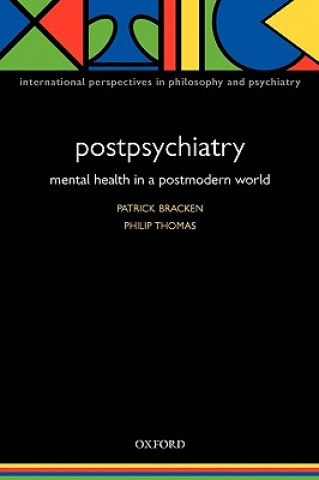
Kód: 04477165
Postpsychiatry
Autor Bracken
How are we to make sense of madness and psychosis? For most of us the words conjure up images from television and newspapers of seemingly random, meaningless violence. It is something to be feared, something to be left to the expe ... celý popis


- Jazyk:
 Angličtina
 - Vazba: Brožovaná
- Počet stran: 312
Nakladatelství: Oxford University Press, 2005
- Více informací o knize


Mohlo by se vám také líbit
-

Moonwalk
270 Kč -

The Score
248 Kč -

The Deal
248 Kč -

The Mistake
227 Kč -

Jujutsu Kaisen, Vol. 30
233 Kč -

Witch Hat Atelier: Grimoire Edition 1
777 Kč -

Berserk Deluxe Volume 1
804 Kč -

Invincible Compendium Volume 2
1123 Kč -

Invincible Compendium Volume 1
1108 Kč -

The Goal
321 Kč -

Berserk Deluxe Volume 2
862 Kč -

Witch Hat Atelier Manga Box Set 1
1268 Kč -

Heated Rivalry
227 Kč -

Lord of Mysteries, Vol. 3: The Clown, Part III
355 Kč -

Moonwalk: A Memoir
525 Kč -

Murdoku
358 Kč -

Jujutsu Kaisen, Vol. 25
240 Kč -

Jujutsu Kaisen, Vol. 26
240 Kč -

Jujutsu Kaisen, Vol. 29
240 Kč -

Berserk Deluxe Volume 3
804 Kč -

White Nights
89 Kč
Dárkový poukaz: Radost zaručena
- Darujte poukaz v libovolné hodnotě a my se postaráme o zbytek.
- Poukaz se vztahuje na celou naši nabídku.
- Elektronický poukaz vytisknete z e-mailu a můžete ihned darovat.
- Platnost poukazu je 12 měsíců od data vystavení.
Více informací o knize Postpsychiatry
Nákupem získáte 210 bodů
 Anotace knihy
How are we to make sense of madness and psychosis? For most of us the words conjure up images from television and newspapers of seemingly random, meaningless violence. It is something to be feared, something to be left to the experts. But is madness best thought of as a medical condition? Psychiatrists and the drug industry maintain that psychoses are brain disorders amenable to treatment with drugs, but is this actually so? There is no convincing evidence that the brain is disordered in psychosis, yet governments across the world are investing huge sums of money on mental health services that take for granted the idea that psychosis is an illness to be treated with medication. Although some people who use mental health services find medication helpful, many do not, and resist the idea that their experiences are symptoms of illnesses like schizophrenia. Consequently they are forced into having treatment against their wishes. So, how do we make sense of this situation? Postpsychiatry addresses these questions.It involves an attempt to rethink some of the fundamental assumptions of mental health work, showing how recent developments in philosophy and ethics can help us to clarify some of the dilemmas and conflicts around different understandings of madness. Throughout, the authors examine the conflicting ways in which politicians, academics, and mental health professionals appear to understand madness, and contrast this with voices and experiences that are usually excluded - those of the people who use mental health services. They then examine the power of psychiatry to shape how we understand ourselves and our emotions, before considering some of the basic limitations of psychiatry as science to make madness meaningful. In the final section of the book they draw on evidence from service users and survivors, the humanities and anthropology, to point out a new direction for mental health practice. This new direction emphasises the importance of cultural contexts in understanding madness, placing ethics before technology in responding to madness, and minimising 'therapeutic' coercion.
Parametry knihy
Zařazení knihy Knihy v angličtině Society & social sciences Psychology Psychological theory & schools of thought
2101 Kč
- Plný název: Postpsychiatry
- Autor: Bracken
- Jazyk: Angličtina
- Vazba: Brožovaná
- Počet stran: 312
- EAN: 9780198526094
- ISBN: 0198526091
- ID: 04477165
- Nakladatelství: Oxford University Press
- Hmotnost: 450 g
- Rozměry: 231 × 156 × 18 mm
- Datum vydání: 22. December 2005
Osobní odběr Praha, Brno a 46811 dalších
Copyright ©2008-26 nejlevnejsi-knihy.cz Všechna práva vyhrazenaSoukromíCookies

 Vrácení do měsíce
 571 999 099 (8-15.30h)