Kód: 53782463
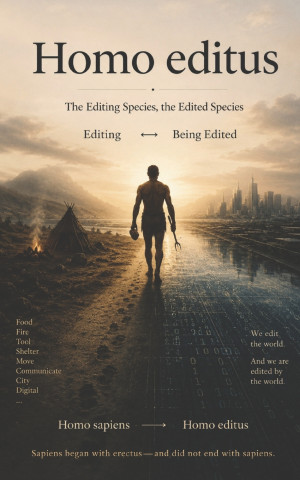
Homo editus
Autor Itekki K.E., Hajime Takahashi
English Edition - Book Description- Sapiens did not end with sapiens.We have called ourselves Homo sapiens-the thinking human, the knowing human, the wise human.It is a remarkably brain-centered name.But Homo never lived by the br ... celý popis


- Jazyk:
 Angličtina
- Vazba: Brožovaná
- Počet stran: 214
Nakladatelství: Independently published, 2026
- Více informací o knize


Mohlo by se vám také líbit
-

Threshing Day (Limited Deluxe Edition)
473 Kč -

Murdoku
342 Kč -
The Mirror of Infinite Endings
331 Kč -

The Long-Lived King: An Original The Owl House Graphic Novel
445 Kč -

White Nights
89 Kč -

Court of Thorns and Roses 6
358 Kč -

I'll Believe in Anything. The Making of Heated Rivalry Season 1
509 Kč -

Trust Fall
206 Kč -

The Art of Gravity Falls
863 Kč -

Cozy Countdown: An Advent Coloring Book Bundle
539 Kč -

Jojo's Bizarre Adventure: Part 7--Steel Ball Run, Vol. 9
438 Kč -

21 Days of Fear
406 Kč -

Lord of Mysteries, Vol. 4: The Faceless, Part I
358 Kč -

Berserk Deluxe Volume 1
899 Kč -
The Mirror of Infinite Endings
475 Kč -

Fourth Wing
562 Kč -

Berserk Deluxe Volume 3
822 Kč -

Iron Flame
562 Kč -

Witch Hat Atelier: Grimoire Edition 1
822 Kč -

Berserk Deluxe Volume 2
964 Kč -

Witch Hat Atelier: Grimoire Edition 2
761 Kč
Dárkový poukaz: Radost zaručena
- Darujte poukaz v libovolné hodnotě a my se postaráme o zbytek.
- Poukaz se vztahuje na celou naši nabídku.
- Elektronický poukaz vytisknete z e-mailu a můžete ihned darovat.
- Platnost poukazu je 12 měsíců od data vystavení.
Více informací o knize Homo editus
Nákupem získáte 31 bodů
 Anotace knihy

English Edition - Book Description
- Sapiens did not end with sapiens.
We have called ourselves Homo sapiens-the thinking human, the knowing human, the wise human.
It is a remarkably brain-centered name.
But Homo never lived by the brain alone.
We stood. We walked. We ate. We carried. We used fire. We made tools. We settled. We built cities. We traveled across distance. We communicated across it. And now, we encounter digital environments and AI.
We changed the world.
And every time we changed the world, the world changed us.
The hand that made the tool became a hand remade by tools.
The body that domesticated fire became a body domesticated by fire.
The humans who built cities became humans increasingly shaped by urban life.
This book rereads the human species not simply as the "wise" species, but as a species that edits-and is edited in return:
Homo editus.
Editing ↔ Being Edited
Homo editus is not the name of a new biological species. Nor is it a name meant to replace Homo sapiens.
It is a shift in perspective:
from brain-centered sapiens to upright, walking editus.
A way of returning sapiens to the body of erectus.
The book begins in the present, with IP-Digitalized Informatization-and excavates backward through layers of communication, transportation, the city, and settlement. From there it descends through cooking, fire, tools, and finally Matter Encounter, asking how Homo has edited the world-and how the world, in turn, has edited Homo.
Eating was never a one-way operation.
Neither was using a tool.
Neither was cooking, domesticating fire, or making things.
Homo edits World.
World edits Homo.
Deep underground, the excavation encounters life itself.
Life takes in what is outside, edits it, and returns something to the world. Differences left behind may persist as Traces that affect the next Encounter. The story of Homo editus thus opens onto life as Trace Updating Practice.
Then the book returns to the present.
AI.
Is AI the next evolutionary stage of Homo sapiens?
Just another tool?
Or are we encountering another kind of editus-one that is not Homo?
This book does not rush to close that question.
Homo editus meets AI editus ?
What our Encounter with AI exposes is not only the question of what AI is.
It forces us to ask again what Homo has been, what it means to edit, and what it means to be edited.
The book concludes with a supplementary essay:
"Scaffold before Prompt: A Support Theory of Human-AI Co-Generation."
Rather than explaining Co-Generation through the visible Prompt alone, the essay turns toward the often invisible Support that makes generation possible: accumulated Traces, relations, questions, concepts, prior outputs, and the evolving scaffold of an ongoing Encounter.
Prompt ≠ Scaffold.
Support ≠ Route.
What is generated is not only an Output.
The Scaffold that makes further generation possible is itself updated through each Encounter.
Homo sapiens.
Homo faber.
Homo ludens.
We have read Homo under many names.
This book asks what happens if we read them again-
sub specie editionis
- under the aspect of editing.
Sapiens was always both an editing species and an edited species.
The story of Editus is not over.
- What comes next has not yet been Edited.
Parametry knihy
307 Kč
- Plný název: Homo editus
- Podnázev: Editing the Species, Edited by the Species
- Autor: Itekki K.E., Hajime Takahashi
- Jazyk: Angličtina
- Vazba: Brožovaná
- Počet stran: 214
- EAN: 9798171369439
- ID: 53782463
- Nakladatelství: Independently published
- Hmotnost: 197 g
- Rozměry: 203 × 127 × 14 mm
- Datum vydání: 05. September 2026
Osobní odběr Praha, Brno a 48511 dalších
Copyright ©2008-26 nejlevnejsi-knihy.cz Všechna práva vyhrazenaSoukromíCookies

 Vrácení do měsíce
 571 999 099 (8-15.30h)
