Kód: 54473074
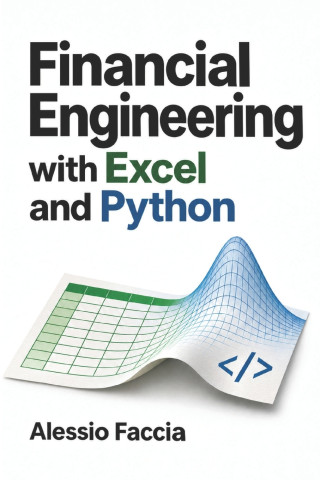
Financial Engineering with Excel and Python
Autor Alessio Faccia
BOOK DESCRIPTION, 4,000 CHARACTERS INCLUDING SPACES AND LINE BREAKSFinancial Engineering with Excel and Python connects quantitative finance with practical implementation. Alessio Faccia guides readers through instrument pricing, ... celý popis


- Jazyk:
 Angličtina
- Vazba: Brožovaná
- Počet stran: 372
Nakladatelství: Independently published, 2026
- Více informací o knize


Mohlo by se vám také líbit
-

Threshing Day (Limited Deluxe Edition)
455 Kč -

Cozy Countdown: An Advent Coloring Book Bundle
514 Kč -

Court of Thorns and Roses 6
385 Kč -

Murdoku
327 Kč -

White Nights
84 Kč -

Trust Fall
227 Kč -

A Conspiracy of Charming Monsters
391 Kč -

I'll Believe in Anything. The Making of Heated Rivalry Season 1
473 Kč -

The Mirror of Infinite Endings
434 Kč -

A Conspiracy of Charming Monsters
276 Kč -

Once Upon a Broken Heart Collector's Edition
571 Kč -

Jojo's Bizarre Adventure: Part 7--Steel Ball Run, Vol. 9
438 Kč -

The Long-Lived King: An Original The Owl House Graphic Novel
385 Kč -

Chainsaw Man, Vol. 22
230 Kč -

Berserk Deluxe Volume 1
917 Kč -

Protocols
310 Kč -

21 Days of Fear
406 Kč -

Murdoku Volume 2: Back in Time
301 Kč -

Lord of Mysteries, Vol. 4: The Faceless, Part I
345 Kč -

Threshing Day (Wing and Claw Collection)
453 Kč -

East of Eden
259 Kč
Dárkový poukaz: Radost zaručena
- Darujte poukaz v libovolné hodnotě a my se postaráme o zbytek.
- Poukaz se vztahuje na celou naši nabídku.
- Elektronický poukaz vytisknete z e-mailu a můžete ihned darovat.
- Platnost poukazu je 12 měsíců od data vystavení.
Více informací o knize Financial Engineering with Excel and Python
Nákupem získáte 77 bodů
 Anotace knihy

- BOOK DESCRIPTION, 4,000 CHARACTERS INCLUDING SPACES AND LINE BREAKS
Financial Engineering with Excel and Python connects quantitative finance with practical implementation. Alessio Faccia guides readers through instrument pricing, risk measurement and portfolio construction using spreadsheet formulas, Python calculations and numerical examples. Each topic links financial reasoning to explicit assumptions, reproducible results and checks for common modelling errors.
Written for finance professionals, analysts, traders, investors and students, the book follows a clear progression from cash flows and discount factors to derivatives, simulation and trading strategies. Readers work with algebra, probability and elementary statistics while developing the judgement needed to interpret model outputs.
PRICE FINANCIAL INSTRUMENTS
Start with no-arbitrage pricing, the time value of money and return measurement. Prepare financial data, align dates and units, and establish a reliable basis for valuation. Calculate bond prices, construct yield curves and bootstrap discount factors. Examine duration and convexity, then work through forwards, futures and interest rate swaps. Price options with binomial trees and Black-Scholes, calculate option Greeks and assess hedging decisions.
MEASURE RISK WITH SIMULATION
Generate random variables and simulate asset prices. Apply Monte Carlo valuation and variance reduction, then examine the sources of uncertainty behind a numerical estimate. Calculate Value at Risk and Expected Shortfall with explicit assumptions about positions, horizons and loss distributions. Study default probabilities, correlated credit losses, stress testing and liquidity constraints. Connect each risk measure to the financial question it addresses.
BUILD AND TEST INVESTMENT STRATEGIES
Construct portfolios with investment constraints and assess how individual positions contribute to total risk. Examine rebalancing through cash movements, holdings and execution rules. Design rule-based trading strategies and test their behaviour using a consistent sequence of information, signals and trades. Account for transaction costs, slippage and backtesting biases. Bring pricing, risk and portfolio outputs together in an integrated Excel and Python investment dashboard.
CHECK THE CALCULATIONS
A financial model needs a clear audit trail. Throughout the book, Excel formulas and Python implementations express the same financial logic. Independent benchmarks, boundary cases and accounting identities help readers investigate discrepancies. Bond valuations reconcile to discounted payments. Portfolio risk contributions reconcile to aggregate risk. Trading records track cash and quantities through each transaction.
The worked examples use synthetic inputs to keep calculations transparent and repeatable. Readers see how assumptions shape prices, risk estimates and allocations. Topics include date conventions, data alignment and numerical precision. These details help readers locate errors before a result enters a report or investment decision.
The book also separates risk-neutral valuation from investment forecasting and distinguishes simulation precision from uncertainty about parameters and model assumptions. Readers learn to interpret a narrow numerical interval within the wider financial question. Hedging examples connect sensitivities with financing, and portfolio examples connect target weights with feasible trades.
Use the chapters as a structured course in financial engineering or return to individual sections when reviewing a bond model, option calculation, risk report or trading backtest. The progression supports readers who want to connect quantitative methods with calculations they are able to inspect and explain.
Parametry knihy
774 Kč
- Plný název: Financial Engineering with Excel and Python
- Podnázev: Pricing Instruments, Modelling Risk and Building Investment Strategies
- Autor: Alessio Faccia
- Jazyk: Angličtina
- Vazba: Brožovaná
- Počet stran: 372
- EAN: 9798141020902
- ID: 54473074
- Nakladatelství: Independently published
- Hmotnost: 499 g
- Rozměry: 229 × 152 × 20 mm
- Datum vydání: 08. November 2026
Osobní odběr Praha, Brno a 48717 dalších
Copyright ©2008-26 nejlevnejsi-knihy.cz Všechna práva vyhrazenaSoukromíCookies

 Vrácení do měsíce
 571 999 099 (8-15.30h)
