Kód: 02005970
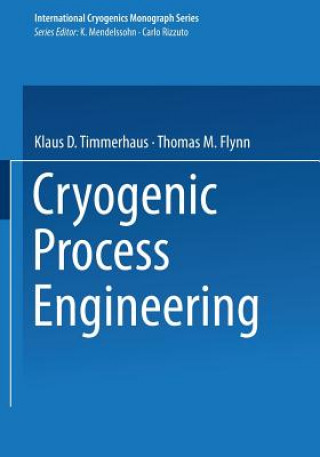
Cryogenic Process Engineering
Autor Klaus D. Timmerhaus, Thomas M. Flynn
Cryogenics, a term commonly used to refer to very low temperatures, had its beginning in the latter half of the last century when man learned, for the first time, how to cool objects to a temperature lower than had ever existed na ... celý popis


- Jazyk:
 Angličtina
 - Vazba: Brožovaná
- Počet stran: 612
Nakladatelství: Springer-Verlag New York Inc., 2013
- Více informací o knize


Mohlo by se vám také líbit
-

Rendezvous With Rama
239 Kč -

Kočka telepatický zářič z Vesmíru
265 Kč -

Zlatý tarot
528 Kč -

Inside Seal Team Six
402 Kč -

With Her Own Hands – Women Weaving Their Stories
358 Kč -

Sny, mýty a pohádky z Japonska
314 Kč -

Mr Porter Paperback
866 Kč -

Passion and Affect
248 Kč -

Starr Conspiracy
513 Kč -

Dot Journal (Gold)
453 Kč -

Thinking Big
335 Kč -

Art Deco Limoges: Camille Tharaud and Other Ceramics
861 Kč -

The London Files: Defanging the London System
618 Kč -

Journeys Through Time
618 Kč -

Schloss und Garten Schoenhausen
197 Kč -

Improve your Skills: Use of English for First Student's Book without key
405 Kč -

Chefs-d'oeuvre de la peinture italienne
472 Kč -

Thinking and Deciding
1352 Kč -

Aristoteles: Aristotelis Opera. Volumen I
7051 Kč -

GLOUTONS & DRAGONS/DUNGEON MESHI 1 (MANGA JAPONAIS)
444 Kč -

Sex on the Moon. Der Mann, der den Mond gestohlen hat, englische Ausgabe
392 Kč -

CAL 26 MOMS FAMILY
421 Kč -

Monte-Carlo Simulation-Based Statistical Modeling
3062 Kč -

SPEECH COMPRESSION USING CODE BOOK EXCITED LINEAR PREDICTION
1209 Kč -
Financial Times Briefing on Sustainable Business
2233 Kč -

Process Modeling and Simulation for Chemical Engineers
2863 Kč -

meraviglie della scienza. Attività e giochi didattici
284 Kč -

Cryogenic Engineering
6588 Kč -

Cryogenic Engineering
3971 Kč -

I Love to Tell the Truth (English Albanian Bilingual Children's Book)
381 Kč -

Identity with Windows Server 2016: Microsoft 70-742 MCSA Exam Guide
1034 Kč -

The Refugees: A Jazz Nemesis novel vol. 2
403 Kč -

Le chalet de la tortue jalouse
388 Kč -

When Enough Is Enough
446 Kč -

How Policy Shapes Politics
1577 Kč -

Surviving Life as a Dumbass
474 Kč -

What Do You Think, Katie?: Writing an Opinion Piece with Katie Woo
204 Kč -

Soukromé modlitby Jana z Jenštejna / The Private Prayers of John of Jenstein
319 Kč -

Cloud Connectivity and Embedded Sensory Systems
4060 Kč -

Sketches of Hayti; From the Expulsion of the French to the Death of Christophe.
695 Kč -

Target Store Data Breaches
4701 Kč -

Schichtarbeit und Gesundheit
1209 Kč -

The Telescope Travelers Ride a Comet
236 Kč -

Critical Republicanism
1708 Kč -

Integrating Spiritual Interventions in Islamic Psychology
684 Kč -

Social Policies, Labour Markets and Motherhood
1201 Kč -

Presse zwischen Lenkung und Freiheit
2505 Kč -

Land and Calendar
1161 Kč -

Memoirs of Madame de Pompadour
641 Kč -

Catherine Morland
500 Kč -

Courte vie de Charlotte de Rutant (La)
388 Kč -

La balle aux mots - maitrise de la langues - guide pédagogique - CE2
891 Kč -

L'argent croyance, mesure, spéculation
891 Kč -
Southern Marches of Imperial Ethiopia
1371 Kč -

"Palac Krowiarki" - verlassener Palast in Polen (Puzzle)
831 Kč -

Cervix Cancer
4060 Kč -

American Graffiti
314 Kč -

Entrepreneurship and Dynamics in the Knowledge Economy
1619 Kč -

Patient Care Technician Exam Secrets Study Guide: Patient Care Test Review for the Patient Care Technician Exam
1455 Kč -

Essential Health Skills for Middle School
3731 Kč -
Leading with Values
1865 Kč -

Methoden Der Journalismusforschung
1080 Kč -

Dislessia per tutti
1217 Kč -

Bible, Gender, and Reception History: The Case of Job's Wife
3676 Kč -

Union des Groupes d'Initiative Commune des Agriculteurs de Bokito
1620 Kč -

Philo Vance Murder Cases
502 Kč -

Consumption and Literature
1457 Kč -

Stark in Religion 7/8
296 Kč -

Elements de Geographie
315 Kč -

Lela's Reading Log
191 Kč -
![Flight of the Eagle. [A Novel.]](https://media.libris.to/jacket/08005064t.jpg "Flight of the Eagle. [A Novel.]")
Flight of the Eagle. [A Novel.]
571 Kč -

Safety in the Handling of Cryogenic Fluids
3532 Kč -

Sight and Embodiment in the Middle Ages
3353 Kč -

Die ganze Welt ist ein Rammelh
411 Kč -

Kater Schnurz
250 Kč -

Oil Producing Community Identity in Nigeria
369 Kč -

23rd Psalm
132 Kč -

Administering Apache
925 Kč -

New Geometries for New Materials
1819 Kč -

Infections in the Adult Intensive Care Unit
2303 Kč -

Advances in Cryogenic Engineering
1182 Kč -

Adventures Of A Brownie
445 Kč -

Handbook of Food Engineering
8804 Kč -

Everyday Mathematics, Grade 6, Spanish Student Journal Re-Order Set
1029 Kč
Dárkový poukaz: Radost zaručena
- Darujte poukaz v libovolné hodnotě a my se postaráme o zbytek.
- Poukaz se vztahuje na celou naši nabídku.
- Elektronický poukaz vytisknete z e-mailu a můžete ihned darovat.
- Platnost poukazu je 12 měsíců od data vystavení.
Více informací o knize Cryogenic Process Engineering
Nákupem získáte 427 bodů
 Anotace knihy
Cryogenics, a term commonly used to refer to very low temperatures, had its beginning in the latter half of the last century when man learned, for the first time, how to cool objects to a temperature lower than had ever existed na tu rally on the face of the earth. The air we breathe was first liquefied in 1883 by a Polish scientist named Olszewski. Ten years later he and a British scientist, Sir James Dewar, liquefied hydrogen. Helium, the last of the so-caBed permanent gases, was finally liquefied by the Dutch physicist Kamerlingh Onnes in 1908. Thus, by the beginning of the twentieth century the door had been opened to astrange new world of experimentation in which aB substances, except liquid helium, are solids and where the absolute temperature is only a few microdegrees away. However, the point on the temperature scale at which refrigeration in the ordinary sense of the term ends and cryogenics begins has ne ver been weB defined. Most workers in the field have chosen to restrict cryogenics to a tem perature range below -150°C (123 K). This is a reasonable dividing line since the normal boiling points of the more permanent gases, such as helium, hydrogen, neon, nitrogen, oxygen, and air, lie below this temperature, while the more common refrigerants have boiling points that are above this temperature. Cryogenic engineering is concerned with the design and development of low-temperature systems and components.
Parametry knihy
Zařazení knihy Knihy v angličtině Mathematics & science Physics Materials / States of matter
4266 Kč
- Plný název: Cryogenic Process Engineering
- Autor: Klaus D. Timmerhaus, Thomas M. Flynn
- Jazyk: Angličtina
- Vazba: Brožovaná
- Počet stran: 612
- EAN: 9781468487589
- ISBN: 1468487582
- ID: 02005970
- Nakladatelství: Springer-Verlag New York Inc.
- Hmotnost: 1171 g
- Rozměry: 254 × 178 × 34 mm
- Datum vydání: 12. January 2013
Oblíbené z jiného soudku
-

Quantum Field Theory for the Gifted Amateur
1246 Kč -
Kittel's Introduction to Solid State Physics
1555 Kč -

Introduction to Random Vibrations, Spectral & Wavelet Analysis
524 Kč -

Basic Notions of Condensed Matter Physics
2483 Kč -

Solid State Physics
2940 Kč -

A First Course in Magnetohydrodynamics
1775 Kč -

Many-Body Quantum Theory in Condensed Matter Physics
2338 Kč -

Space Physics
2097 Kč -
Elements of Gas Dynamics
489 Kč -

Electronics for Guitarists
1303 Kč -

Green's Functions For Solid State Physicists
1521 Kč -

Fundamentals of Crystallography
2505 Kč -

Introduction to Semiconductor Physics and Devices
1288 Kč -

Analog and Digital Electronic Circuits
1500 Kč -

Atomic Physics
1296 Kč -

Global Approach to Quantum Field Theory
2849 Kč -

Basic Space Plasma Physics (Revised Edition)
1668 Kč -

Earth's Ionosphere
3726 Kč -

Theoretical Astrophysics: Volume 1, Astrophysical Processes
2422 Kč -

How to Solve Physics Problems
676 Kč -

Solid State Physics
2459 Kč -

Basics of Crystallography and Diffraction
1716 Kč -

Optical Properties of Solids
1282 Kč -

Quantum Field Theory for the Gifted Amateur
2915 Kč -

Theory of Optical Processes in Semiconductors
2983 Kč -

Nature of Computation
2624 Kč -

Fluid Dynamics
2555 Kč -

Condensed Matter Physics 2e
3928 Kč -

Problems In Solid State Physics With Solutions
1819 Kč -

Tokamaks
11850 Kč -

Methods of Statistical Physics
801 Kč -

Solar Energy
648 Kč -
Physics of Condensed Matter
2226 Kč -

Bose-Einstein Condensation in Dilute Gases
2629 Kč -

Solid-State Physics
1384 Kč -

Quantum Information
1104 Kč -

Plasma Physics
1401 Kč -

Plasma Physics and Fusion Energy
2658 Kč -

Advanced Solid State Physics
2097 Kč -

Solid State Physics
2991 Kč -

Solid State Physics 2e
2031 Kč -

Solid Propellant Rockets
1826 Kč -

Statistical Physics of Spin Glasses and Information Processing
3014 Kč -

Polymer Physics
2265 Kč -

Ultracold Atoms in Optical Lattices
3427 Kč -
Physical Kinetics
1646 Kč -

Principles of Plasma Physics for Engineers and Scientists
2422 Kč -

Introduction to Quantum Spin Systems
1115 Kč -

Introduction to the Atomic and Radiation Physics of Plasmas
2002 Kč
Osobní odběr Praha, Brno a 47410 dalších
Copyright ©2008-26 nejlevnejsi-knihy.cz Všechna práva vyhrazenaSoukromíCookies

 Vrácení do měsíce
 571 999 099 (8-15.30h)