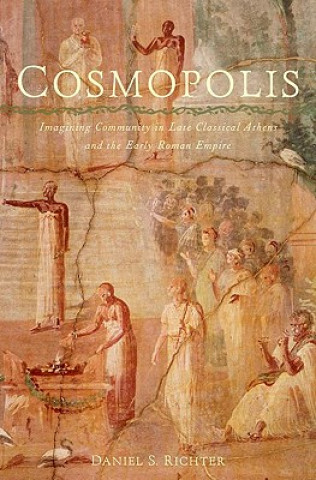
Kód: 04535858
Cosmopolis
Autor Daniel S. Richter
This is a book about the ways in which various intellectuals in the post-classical Mediterranean imagined the human community as a unified, homogenous whole composed of a diversity of parts. More specifically, it explores how aut ... celý popis


- Jazyk:
 Angličtina
 - Vazba: Pevná
- Počet stran: 304
Nakladatelství: Oxford University Press Inc, 2011
- Více informací o knize


Mohlo by se vám také líbit
-

Gilded Tarot Royale Mini
215 Kč -

Geografia bez tajemnic. Szkoła podstawowa klasa 7. Zeszyt ćwiczeń
78 Kč -

Cosmopolis
202 Kč -

Favorinos D'Arles, Oeuvres - Tome I: Introduction Generale - Temoignages - Discours Aux Corinthiens - Sur La Fortune
2165 Kč -

Favorinos D'Arles, Oeuvres Tome III: Fragments
2088 Kč -
Plutarque Et Les Barbares La Rhetorique D'Une Image
1283 Kč -

Cambridge English Skills Real Listening and Speaking 1 with Answers and Audio CD
1251 Kč -

Field, Flower, Vase
516 Kč -

Reaper Dark Verse Tom 2
238 Kč -

La casa de la fuerza ; Te haré invencible con mi derrota ; Anfaegtelse
354 Kč -

Main Street Tote Bag 'Green Valley Bookstore'
381 Kč -
Making Men
1368 Kč -
The Cambridge Companion to Classics and Race
1064 Kč -

Race: Antiquity and Its Legacy
694 Kč -

Manual del anestesiólogo URPA y REA
179 Kč -

Ctesias de Cnide, La Perse - l'Inde - Autres Fragments
2264 Kč -

Catalogue Illustre De La Bibliotheque De Feu Le Marquis De Morante (1872)
903 Kč -

255 caractères. Parcours express en chinois
666 Kč -

Molise-Abruzzo-Lazio-Marche-Umbria. Da Isernia a Bocca Trabaria
869 Kč -

How Do I Get There from Here?: Planning for Retirement When the Old Rules No Longer Apply
342 Kč -

Major Jones's Courtship: Detailed, with Humorous Scenes, Incidents and Adventures
489 Kč
Dárkový poukaz: Radost zaručena
- Darujte poukaz v libovolné hodnotě a my se postaráme o zbytek.
- Poukaz se vztahuje na celou naši nabídku.
- Elektronický poukaz vytisknete z e-mailu a můžete ihned darovat.
- Platnost poukazu je 12 měsíců od data vystavení.
Více informací o knize Cosmopolis
Nákupem získáte 388 bodů
 Anotace knihy
This is a book about the ways in which various intellectuals in the post-classical Mediterranean imagined the human community as a unified, homogenous whole composed of a diversity of parts. More specifically, it explores how authors of the second century CE adopted and adapted a particular ethnic and cultural discourse that had been elaborated by late fifth- and fourth-century BCE Athenian intellectuals. At the center of this book is a series of contests over the meaning of lineage and descent and the extent to which the political community is or ought to be coterminous with what we might call a biologically homogenous collectivity. The study suggests that early imperial intellectuals found in late classical and early Hellenistic thought a way of accommodating the claims of both ethnicity and culture in a single discourse of communal identity. The idea of the unity of humankind evolved in the fifth and fourth centuries as a response to and an engine for the creation of a rapidly shrinking and increasingly integrated oikoumene . The increased presence of outsiders in the classical city-state as well as the creation of sources of authority that lay outside of the polis destabilized the idea of the polis as a kin group (natio). Beginning in the early fourth century and gaining great momentum in the wake of Alexander's conquest of the East, traditional dichotomies such as Greek and barbarian lost much of their explanatory power. In the second-century CE, by contrast, the empire of the Romans imposed a political space that was imagined by many to be coterminous with the oikoumene itself. One of the central claims of this study is that the forms of cosmopolitan and ecumenical thought that emerged in both moments did so as responses to the idea that the natio - the kin group - is (or ought to be) the basis for any human collectivity.
Parametry knihy
Zařazení knihy Knihy v angličtině Humanities History History: earliest times to present day
3879 Kč
- Plný název: Cosmopolis
- Podnázev: Imagining Community in Late Classical Athens and the Early Roman Empire
- Autor: Daniel S. Richter
- Jazyk: Angličtina
- Vazba: Pevná
- Počet stran: 304
- EAN: 9780199772681
- ISBN: 0199772681
- ID: 04535858
- Nakladatelství: Oxford University Press Inc
- Hmotnost: 584 g
- Rozměry: 239 × 165 × 26 mm
- Datum vydání: 15. April 2011
Oblíbené z jiného soudku
-

Tuesdays With Morrie
253 Kč -

Tuesdays With Morrie
243 Kč -

Rise and Fall of Ancient Egypt
379 Kč -

The Origins of Totalitarianism
304 Kč -

Guns, Germs, and Steel
244 Kč -
Gallic War
182 Kč -
Peloponnesian War
306 Kč -

On Tyranny
243 Kč -
Histories
198 Kč -

Fall of Carthage
335 Kč -
Augustus
441 Kč -
24 Hours in Ancient Athens
188 Kč -

Yoga Body
392 Kč -

Cold War
335 Kč -
Thucydides' Peloponnesian War
641 Kč -

Etruscans: A Very Short Introduction
231 Kč -
Alexander the Great
246 Kč -

Confronting the Classics
270 Kč -

Roman Auxiliary Forts 27 BC-AD 378
387 Kč -
Sumerians
874 Kč -

Last Pagan Emperor
677 Kč -

Chronicle of the Czechs
897 Kč -

Six Minutes to Freedom
382 Kč -

Three Book Sebald Set
935 Kč -

At the Forward Edge of Battle
478 Kč -

Citizen 13660
367 Kč -

Veni, Vidi, Vici
268 Kč -

Rhodesian Fire Force 1966-80
468 Kč -

After the Reich
419 Kč -
Hannibal
440 Kč -

Plotinus on Self
1316 Kč -
Ancient City
324 Kč -

Carthage Must Be Destroyed
379 Kč -

First They Killed My Father
291 Kč -

Gentrification of the Mind
631 Kč -

Bury the Chains
379 Kč -

Berlin Wall
366 Kč -

Medieval Costume and How to Make It
271 Kč -

Illustrated Encyclopedia of Uniforms of World War I
517 Kč -
Illuminated Manuscripts
204 Kč -

From Third World to First
293 Kč -

Age Of Empire
335 Kč -

Age Of Extremes
366 Kč -

The Art of Combat
554 Kč -

Age Of Capital
335 Kč -

History of the Ancient World
582 Kč -

Creation of Patriarchy
657 Kč -

Underground
284 Kč -

Socialism and Man in Cuba
118 Kč
Osobní odběr Praha, Brno a 48550 dalších
Copyright ©2008-26 nejlevnejsi-knihy.cz Všechna práva vyhrazenaSoukromíCookies

 Vrácení do měsíce
 571 999 099 (8-15.30h)