Kód: 53688005
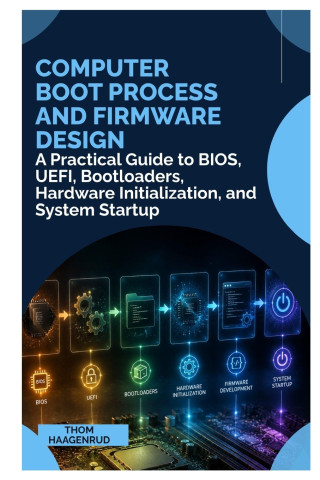
COMPUTER BOOT PROCESS AND FIRMWARE DESIGN
Autor Thom Haagenrud
What really happens between pressing the power button and seeing a working operating system?Behind every successful startup is a carefully coordinated chain of processor reset, platform initialization, memory setup, firmware polic ... celý popis


- Jazyk:
 Angličtina
 - Vazba: Brožovaná
- Počet stran: 184
Nakladatelství: Independently published, 2026
- Více informací o knize


Mohlo by se vám také líbit
-

Murdoku
270 Kč -

Threshing Day (Wing and Claw Collection)
400 Kč -

Berserk Deluxe Volume 1
880 Kč -

Threshing Day (Limited Deluxe Edition)
473 Kč -

White Nights
87 Kč -

Berserk Deluxe Volume 2
918 Kč -

The Odyssey
326 Kč -

What Happened Yesterday
371 Kč -

Kid's Box New Generation Level 2 Activity Book with Digital Pack British English
251 Kč -

Onyx Storm (Deluxe Limited Edition) (The Empyrean, 3)
536 Kč -

Berserk Deluxe Volume 3
805 Kč -

Dancing The Dream
482 Kč -

Kid's Box New Generation Level 1 Activity Book with Digital Pack British English
251 Kč -

Jojo's Bizarre Adventure: Part 7--Steel Ball Run, Vol. 8
415 Kč -

Kid's Box New Generation Level 2 Pupil's Book with eBook British English
522 Kč -

The Count of Monte Cristo
227 Kč -

Iron Flame
552 Kč -

Fourth Wing
527 Kč -

The Score
231 Kč -

Yesteryear
310 Kč -

Kid's Box New Generation Level 3 Activity Book with Digital Pack British English
251 Kč
Dárkový poukaz: Radost zaručena
- Darujte poukaz v libovolné hodnotě a my se postaráme o zbytek.
- Poukaz se vztahuje na celou naši nabídku.
- Elektronický poukaz vytisknete z e-mailu a můžete ihned darovat.
- Platnost poukazu je 12 měsíců od data vystavení.
Více informací o knize COMPUTER BOOT PROCESS AND FIRMWARE DESIGN
Nákupem získáte 42 bodů
 Anotace knihy
What really happens between pressing the power button and seeing a working operating system?
Behind every successful startup is a carefully coordinated chain of processor reset, platform initialization, memory setup, firmware policy, device discovery, image loading, security verification, and operating-system handoff. When something breaks, the visible symptom may be nothing more than a black screen, a missing boot option, a kernel failure, or a machine that suddenly takes minutes to start.
Computer Boot Process and Firmware Design takes you inside that chain and shows you how to reason about it as an engineer.
Starting with the first instruction after reset, this practical guide follows the machine through legacy BIOS and modern UEFI, Platform Initialization, DRAM and hardware discovery, GPT and the EFI System Partition, boot managers and loaders, kernel handoff, and the transition into user space.
You will learn how to:
• Trace startup from processor reset to the first user-space process
• Understand the architectural differences between BIOS and UEFI
• Work with UEFI boot variables, device paths, protocols, and ExitBootServices()
• Understand memory initialization, PCIe, ACPI, SMBIOS, interrupts, and hardware handoff
• Analyze GRUB, systemd-boot, U-Boot, and Windows Boot Manager
• Understand initramfs, kernel parameters, device trees, and loader-to-kernel contracts
• Distinguish Secure Boot, measured startup, TPM 2.0, attestation, revocation, and recovery
• Inspect real startup evidence on Linux and Windows
• Build and test UEFI applications with EDK II and OVMF
• Experiment safely with QEMU instead of risking production hardware
• Compare the design philosophies of EDK II, coreboot, and U-Boot
• Debug no-start and slow-start failures using timelines, milestones, logs, and controlled experiments
• Design safer update, rollback, recovery, testing, and production-readiness strategies
This is more than a collection of commands or firmware terminology. The book teaches a reusable mental model: identify who owns the machine, determine what state exists, find the last known-good milestone, and identify the contract that must hold before the next stage can begin.
Architecture figures, comparison tables, code examples, practical exercises, troubleshooting workflows, field triage cards, and a technical glossary turn complex low-level concepts into an engineering workflow you can apply to unfamiliar platforms.
Whether you are a firmware developer, kernel engineer, embedded developer, security engineer, systems engineer, DevOps professional, or technically curious developer, this book gives you a structured way to understand what happens before the operating system takes control-and what to do when startup goes wrong.
Build the mental model. Trace the ownership transfers. Find the failure boundary. Design firmware that can be understood, tested, recovered, and trusted.
Parametry knihy
423 Kč
- Plný název: COMPUTER BOOT PROCESS AND FIRMWARE DESIGN
- Podnázev: A Practical Guide to BIOS, UEFI, Bootloaders, Hardware Initialization, and System Startup
- Autor: Thom Haagenrud
- Jazyk: Angličtina
- Vazba: Brožovaná
- Počet stran: 184
- EAN: 9798170517299
- ID: 53688005
- Nakladatelství: Independently published
- Hmotnost: 232 g
- Rozměry: 229 × 152 × 12 mm
- Datum vydání: 29. August 2026
Osobní odběr Praha, Brno a 47680 dalších
Copyright ©2008-26 nejlevnejsi-knihy.cz Všechna práva vyhrazenaSoukromíCookies

 Vrácení do měsíce
 571 999 099 (8-15.30h)