Kód: 53747510
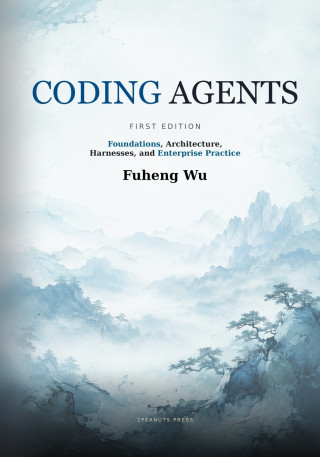
Coding Agents
Autor Fuheng Wu
A coding agent looks like a language model with a code prompt. It isn't. An LLM emits probabilistic tokens; an autonomous coding agent navigates unfamiliar codebases, formulates hypotheses, executes shell commands, inspects compil ... celý popis


- Jazyk:
 Angličtina
 - Vazba: Brožovaná
- Počet stran: 278
Nakladatelství: 2Peanuts.com, 2026
- Více informací o knize


Mohlo by se vám také líbit
-

Threshing Day (Wing and Claw Collection)
400 Kč -

Murdoku
319 Kč -

Berserk Deluxe Volume 1
880 Kč -

Threshing Day (Limited Deluxe Edition)
473 Kč -

White Nights
89 Kč -

What Happened Yesterday
371 Kč -

Berserk Deluxe Volume 2
918 Kč -

Kid's Box New Generation Level 2 Activity Book with Digital Pack British English
251 Kč -

Berserk Deluxe Volume 3
782 Kč -

Onyx Storm (Deluxe Limited Edition) (The Empyrean, 3)
527 Kč -

Jojo's Bizarre Adventure: Part 7--Steel Ball Run, Vol. 8
427 Kč -

Dancing The Dream
482 Kč -

Yesteryear
310 Kč -

Court of Thorns and Roses 6
358 Kč -

Kid's Box New Generation Level 1 Activity Book with Digital Pack British English
251 Kč -

The Courage To Be Disliked
206 Kč -

The Odyssey
340 Kč -
Kid's Box New Generation Level 3 Activity Book with Digital Pack British English
251 Kč -

Iron Flame
552 Kč -

Fourth Wing
552 Kč -

The Count of Monte Cristo
227 Kč
Dárkový poukaz: Radost zaručena
- Darujte poukaz v libovolné hodnotě a my se postaráme o zbytek.
- Poukaz se vztahuje na celou naši nabídku.
- Elektronický poukaz vytisknete z e-mailu a můžete ihned darovat.
- Platnost poukazu je 12 měsíců od data vystavení.
Informovat o naskladnění knihy
Zadejte do formuláře e-mailovou adresu a jakmile knihu naskladníme, zašleme vám o tom zprávu. Pohlídáme vše za vás.
Více informací o knize Coding Agents
Nákupem získáte 114 bodů
 Anotace knihy
A coding agent looks like a language model with a code prompt. It isn't. An LLM emits probabilistic tokens; an autonomous coding agent navigates unfamiliar codebases, formulates hypotheses, executes shell commands, inspects compiler diagnostics, and repairs multi-file regressions under strict token, latency, and financial budgets. The moment a model interacts with a filesystem and a shell, the primary engineering challenge ceases to be prompt engineering. It becomes software systems engineering.
This book is an architectural and production guide to engineering systems in which humans and coding agents work reliably together on real codebases. It treats coding agents not as chatbots, but as composite software engineering systems built around foundation models. Every chapter bridges theoretical mechanics with concrete architectural blueprints: how context allocators manage active working sets, how tool dispatchers enforce secure capability boundaries, how isolated sandboxes execute mutations, and how closed-loop verification pipelines transform raw model proposals into verified pull requests.
The early chapters establish the foundational mechanics and core architecture: Code LLM token economics, KV cache utilization, deterministic execution theory, and prompt/harness boundary contracts. It then dissects the 7-component agent stack: tool calling protocols, structured orchestrator loops, memory layers, and multi-agent coordination topologies (hierarchical supervisors, peer pipelines, and collaborative swarms).
The later chapters focus on verification, harnesses, and production scale: why ungrounded agents hallucinate syntactically plausible regressions, how to build robust generate-verify-repair loops with AST linters and test runners, and how SWE-bench evaluation prevents contamination. The concluding chapters deliver enterprise engineering practices: microVM and gVisor container sandboxing, CI/CD integration gates, permission deny-lists, cost controls, and self-improving agents that distill lessons from repository execution traces.
For software engineers, ML system architects, developer tooling engineers, and engineering leaders building the next generation of AI-augmented software workflows. The code examples are standalone, all architectures verified against production benchmarks, and each chapter closes with technical exercises and architectural checklists.
Parametry knihy
1137 Kč
- Plný název: Coding Agents
- Autor: Fuheng Wu
- Jazyk: Angličtina
- Vazba: Brožovaná
- Počet stran: 278
- EAN: 9798995152385
- ID: 53747510
- Nakladatelství: 2Peanuts.com
- Hmotnost: 489 g
- Rozměry: 254 × 178 × 15 mm
- Datum vydání: 11. September 2026
Osobní odběr Praha, Brno a 47994 dalších
Copyright ©2008-26 nejlevnejsi-knihy.cz Všechna práva vyhrazenaSoukromíCookies

 Vrácení do měsíce
 571 999 099 (8-15.30h)