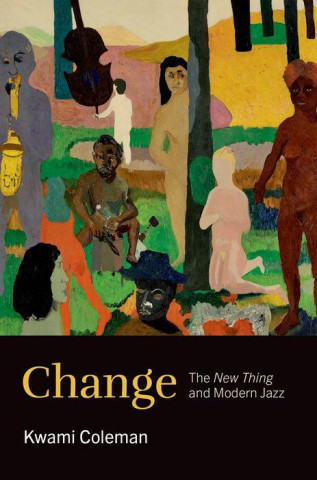
Kód: 48600394
Change
Autor Coleman, Kwami (Associate Professor of Music, The Gallatin School of Individualized Study, Associate Professor of Music, The Gallatin School of Individualized Study, New York University)
By 1960, musicians, critics, record buyers, and club patrons in New York City agreed that a "new thing" in jazz had arrived. That new thing was what we in the twenty-first century call free jazz, and it represented a significant c ... celý popis


- Jazyk:
 Angličtina
 - Vazba: Brožovaná
- Počet stran: 240
Nakladatelství: Oxford University Press, 2025
- Více informací o knize


Mohlo by se vám také líbit



Dárkový poukaz: Radost zaručena
- Darujte poukaz v libovolné hodnotě a my se postaráme o zbytek.
- Poukaz se vztahuje na celou naši nabídku.
- Elektronický poukaz vytisknete z e-mailu a můžete ihned darovat.
- Platnost poukazu je 12 měsíců od data vystavení.
Více informací o knize Change
Nákupem získáte 69 bodů
 Anotace knihy
By 1960, musicians, critics, record buyers, and club patrons in New York City agreed that a "new thing" in jazz had arrived. That new thing was what we in the twenty-first century call free jazz, and it represented a significant change within and, for some, a dramatic departure from what was commonly understood as modern jazz. The arresting, abstract sound of the new music pioneered by ensembles led by Ornette Coleman, Cecil Taylor, and other experimentalist improvising musicians became the focal point of an ongoing controversy in the 1960s that called into question their musicianship, legitimacy, and sanity. Flourishing in an age of anti-establishment protest and radical politics--what writer Amiri Baraka characterized as the inevitable expression of Black American culture--and explained by musicians as the product of newfound consciousness, the new thing was, by 1966, almost unanimously dismissed by the music press as the discordant sound of black anger.Author Kwami Coleman integrates musical analyses of key recordings, musician interviews, periodicals, and rare archival sources to tell the story of jazz''s emergent avant-garde, providing readers with ways to listen to and understand this innovative and disruptive music. By shining a comprehensive light on an important and still-misunderstood revolutionary moment in experimental music history, he illustrates the fundamental elements of this new music and what made it so experimental within the context of modern jazz. Coleman proposes heterophony--a multi-voice texture where cohesion is achieved by means other than tonal center and meter--as a theoretical lens by which to interpret the affectual force of the new thing''s abstract harmonic textures and rhythms. In doing so, he draws connections to the social and political world that enveloped and motivated the musicians, writers, and listeners at the heart of the new thing''s practice, recordings, and publicity. In his chronological account of the music''s development in the early 1960s, Coleman offers readers a new framework to better understand the aesthetics and converging cultural currents of experimental free improvisation in the 1960s.
Parametry knihy
685 Kč
- Plný název: Change
- Autor: Coleman, Kwami (Associate Professor of Music, The Gallatin School of Individualized Study, Associate Professor of Music, The Gallatin School of Individualized Study, New York University)
- Jazyk: Angličtina
- Vazba: Brožovaná
- Počet stran: 240
- EAN: 9780197780091
- ISBN: 0197780091
- ID: 48600394
- Nakladatelství: Oxford University Press
- Hmotnost: 362 g
- Datum vydání: 29. August 2025
Oblíbené z jiného soudku
-

Moonwalk
261 Kč -

The Score
323 Kč -

The Deal
248 Kč -

The Mistake
248 Kč -

Jujutsu Kaisen, Vol. 30
233 Kč -

Witch Hat Atelier: Grimoire Edition 1
777 Kč -

Invincible Compendium Volume 2
1123 Kč -

Berserk Deluxe Volume 1
804 Kč -

The Goal
321 Kč -

Berserk Deluxe Volume 2
862 Kč -

Invincible Compendium Volume 1
1305 Kč -

Witch Hat Atelier Manga Box Set 1
1241 Kč -

Heated Rivalry
227 Kč -

Moonwalk: A Memoir
517 Kč -

Murdoku
380 Kč -

Lord of Mysteries, Vol. 3: The Clown, Part III
355 Kč -

Jujutsu Kaisen, Vol. 25
240 Kč -

White Nights
89 Kč -

Veil Volume 1
352 Kč -

Jujutsu Kaisen, Vol. 26
240 Kč -

Legacy
327 Kč -

Berserk Deluxe Volume 3
804 Kč -

Jujutsu Kaisen, Vol. 29
240 Kč -

Invincible Compendium Volume 3
1108 Kč -

JoJo's Bizarre Adventure: Part 7--Steel Ball Run, Vol. 7
432 Kč -

The Deal
334 Kč -

The Long Game
227 Kč -

Dancing The Dream
522 Kč -

Berserk Deluxe Volume 5
782 Kč -

Invincible Volume 1
252 Kč -

King of Gluttony
229 Kč -

Starside (Deluxe Limited Edition)
522 Kč -

The Summer Hikaru Died, Vol. 7
272 Kč -

Yesteryear
370 Kč -

Berserk Deluxe Volume 4
854 Kč -

Jujutsu Kaisen, Vol. 28
199 Kč -

Boys Omnibus Vol. 1 TPB
689 Kč -

Project Hail Mary
219 Kč -

Jojo's Bizarre Adventure: Part 7--Steel Ball Run, Vol. 1
442 Kč -

Veil Volume 2
375 Kč -

The Mistake
334 Kč -

The Score
334 Kč -

Chainsaw Man, Vol. 21
225 Kč -

The Ballad of Falling Dragons
275 Kč -

Jojo's Bizarre Adventure: Part 7--Steel Ball Run, Vol. 2
457 Kč -

The Courage To Be Disliked
227 Kč -

Murdoku
319 Kč -

Lord of Mysteries, Vol. 1: The Clown, Part I
340 Kč -

Jujutsu Kaisen, Vol. 1
244 Kč
Osobní odběr Praha, Brno a 46876 dalších
Copyright ©2008-26 nejlevnejsi-knihy.cz Všechna práva vyhrazenaSoukromíCookies

 Vrácení do měsíce
 571 999 099 (8-15.30h)