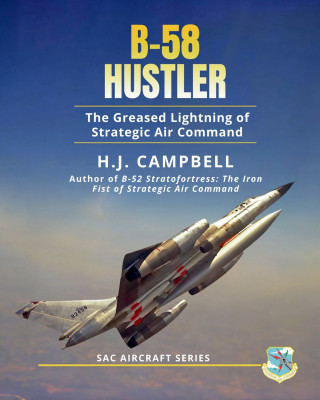
Kód: 53242598
B-58 Hustler
Autor H.J. Campbell
In October 1963 a B-58A, SAC's "Greased Lightning", set five world records including a speed record flying 8,028 miles from Tokyo to London in 8 hours, 35 minutes, and 20.4 seconds at 938 mph average. This bested the previous reco ... celý popis


- Jazyk:
 Angličtina
 - Vazba: Brožovaná
- Počet stran: 226
Nakladatelství: Electrikbooks, 2026
- Více informací o knize


Mohlo by se vám také líbit
-

Moonwalk
270 Kč -

The Score
244 Kč -

Berserk Deluxe Volume 1
779 Kč -

The Deal
242 Kč -

The Mistake
254 Kč -
Jujutsu Kaisen, Vol. 30
226 Kč -

Berserk Deluxe Volume 2
942 Kč -

Dancing The Dream
517 Kč -

Murdoku
334 Kč -

Berserk Deluxe Volume 3
804 Kč -

The Goal
244 Kč -

White Nights
89 Kč -

Chainsaw Man, Vol. 21
240 Kč -
Invincible Compendium Volume 2
1108 Kč -

The Legacy
244 Kč -
Jujutsu Kaisen, Vol. 29
240 Kč -

Invincible Compendium Volume 3
1108 Kč -

Lord of Mysteries, Vol. 3: The Clown, Part III
373 Kč -

Jujutsu Kaisen, Vol. 26
240 Kč -

Witch Hat Atelier: Grimoire Edition 1
786 Kč -

JoJo's Bizarre Adventure: Part 7--Steel Ball Run, Vol. 7
427 Kč
Dárkový poukaz: Radost zaručena
- Darujte poukaz v libovolné hodnotě a my se postaráme o zbytek.
- Poukaz se vztahuje na celou naši nabídku.
- Elektronický poukaz vytisknete z e-mailu a můžete ihned darovat.
- Platnost poukazu je 12 měsíců od data vystavení.
Více informací o knize B-58 Hustler
Nákupem získáte 85 bodů
 Anotace knihy
In October 1963 a B-58A, SAC's "Greased Lightning", set five world records including a speed record flying 8,028 miles from Tokyo to London in 8 hours, 35 minutes, and 20.4 seconds at 938 mph average. This bested the previous record of 17 hours and 42 minutes held by a British jet by more than half. The flight demonstrated SAC's ability to divert a B-58 to hit a target at any spot on the globe and do it supersonically!
But this wasn't the first record for the B-58. It set more records than any other combat aircraft and still holds the Tokyo to London speed record. It set 19 world records including 13 speed records, one endurance, three payload, and two altitude records with the aircraft flown in combat configuration by SAC combat crews. Five of the records were formerly held by the Soviet Union. The B-58 won all major international awards including the Bendix Trophy, Thompson Trophy, Blériot Trophy Cup, Mackay Trophy, and Harmon Trophy.
Designed in the 1950s, the B-58 Hustler provided the U.S. Air Force with a capability not available in any aircraft in its day. It is the only Mach 2+ supersonic bomber ever produced. It could fly at high altitudes or at low-level just below the speed of sound, carrying five nuclear weapons to its targets. It was nearly undetectable by enemy radars due to its low radar cross section and was better than larger aircraft at flying through heavy turbulence due to its solid delta wing design. It could get airborne in only half the time required by other bombers. Because of its ability to take off very quickly there was no need to spread the Hustlers over many bases keeping operating costs low.
The B-58 quickly became a very effective aircraft. By the end of 1963, Air Force crews had made over 10,500 flights in the B-58, amounting to about 53,000 flying hours. Of these hours, 1,150 were supersonic and 375 were at Mach 2.0. By the mid-1960s, with the B-47 nearly phased out, the B-58 and B-52 were the only two bombers programmed into the 1970s. They formed the all-important mix of aircraft and missiles which Air Force leaders unanimously agreed was critical in maintaining a credible deterrent force.
Despite its growing acceptance, on 8 December 1965 Secretary of Defense Robert McNamara directed the phase out of 345 older B-52C through F models and all B-58 bombers by June 1970. On 10 December, McNamara also announced the decision to procure a new FB-111A aircraft to replace the retiring B-52 and B-58 aircraft. These decisions were met with objections and concerns from Air Force leaders and many in Congress. Nonetheless, after several changes and delays in the retirement plans, the last of the B-58 fleet arrived at the boneyard six months early on 16 January 1970.
But the B-58 was loved by many and left behind a legacy of a highly advanced aircraft that employed the latest technologies and design techniques, and the only Mach 2+ bomber ever to serve in U.S. Air Force operational squadrons!
Parametry knihy
849 Kč
- Plný název: B-58 Hustler
- Podnázev: The Greased Lightning of Strategic Air Command: The Iron Fist of Strategic Air Command
- Autor: H.J. Campbell
- Jazyk: Angličtina
- Vazba: Brožovaná
- Počet stran: 226
- EAN: 9781737498285
- ISBN: 1737498286
- ID: 53242598
- Nakladatelství: Electrikbooks
- Hmotnost: 459 g
- Rozměry: 254 × 203 × 12 mm
- Datum vydání: 26. June 2026
Osobní odběr Praha, Brno a 46994 dalších
Copyright ©2008-26 nejlevnejsi-knihy.cz Všechna práva vyhrazenaSoukromíCookies

 Vrácení do měsíce
 571 999 099 (8-15.30h)